Monday, August 26, 2013

HIstorical fiction from Franklin and Fennelly

0

Popular southern novelist Tom Franklin has entered the domain of historical fiction before, first with his bestselling Hell at the Breech (2003) and then again (sort of) with his lurid, black-comic, historical fantasy Smonk (2007). So it's not surprising to find myself using this space to review another historical novel with his signature attached to it, namely The Tilted World, scheduled for release in September.   What's different this time is that Franklin isn't the author but the co-author, the other co-author being none other than his energetic and ambidextrous wife Beth Ann Fennelly, she of well-deserved poetry and nonfiction fame (and current director of the esteemed MFA program at the University of Mississippi).  It's hard to know what made Fennelly want to jump into fictional waters or Franklin to move aside so gracefully to allow her a place in the pool, but readers will be glad for their mutual cooperation.  The historical setting for The Tilted World is the Great Flood of 1927—an event, the authors note in their engaging afterword, that not only displaced thousands of southerners and came with a political fallout similar to that which followed Hurricane Katrina in 2005, but which permanently altered the social and political landscape of America.  An event as titanic as that one certainly deserves a fictional retelling, but what proves more relevant to, and interesting in, the novel is another aspect of 1920s American history: prohibition.   After all, the America Franklin and Fennelly depict is an America very late into the peculiar experiment, an America in which revenuers can easily be bribed or otherwise made to disappear, where the revenuers themselves when off duty enjoy illegal whiskey as much as anyone, where things have gotten so bad Herbert Hoover has to create a special task force of select, honest revenuers, because so many in the service are uselessly corrupt.  In such an America move our two protagonists: Ted Ingersoll, a former army sharpshooter and one of those honest revenue agents, and Dixie Clay, a young wife of a Mississippi bootlegger who, only after she marries and realizes exactly how her husband makes his money, discovers she is quite the natural at making moonshine herself. 

What brings the two protagonists together is a child--orphaned due to a violent raid on a bootlegger--that Ingersoll needs to find a foster home for, and the fact that Dixie has recently suffered through a series of dispiriting miscarriages.   Indeed, Dixie is quite glad that Ingersoll found his way through the woods to her home, so glad she puts aside her natural suspicions.  And not surprisingly, Ingersoll takes a shining to the pretty, freckled, whip smart young woman.  There are a few roadblocks to romance though.  First of all, Dixie is married.  Second, she's a bootlegger.  Third, a historic flood is about to release itself upon the American South.  And fourth, her cad of a husband Clay is, unknown to Dixie, conspiring to commit a severe act of sabotage against their hometown and just at the worst possible moment.  Will love prevail?  Well, maybe so.  


Cagily focusing The Tilted World on two equally significant protagonists—one male, one female—the two different writers develop the novel on separate tracks for most of its length, permanently bringing together the protagonists only about three quarters of the way through.  (And fittingly with a powerhouse, nearly perfect scene that features a medical emergency with the child and some brilliantly calm parental nerves.)  It’s impossible not to imagine Franklin acting as the writer of Ingersoll or to imagine anyone but Fennelly as the originator of Dixie, who discovers her true role in life after Ingersoll gives her the orphan to raise as her own.  Throughout, Fennelly portrays Dixie’s struggles to align who she is with what she is allowed to do.  Not merely a pretty, innocent woman done wrong, Dixie is a proud craftsman, a woman given the unusual job of running the still because of her bootlegger husband’s frequent sales trips.  She proves not just capable at making tasty moonshine but superb at it, so good her husband insists she sacrifice quality for quantity so that he can better keep up with demand and turn an even better profit.  Dixie refuses to submit to this violation and comes up with a better plan: she increases the quality even more, so that her customers will be willing to pay many times what they would for ordinary liquor and in the process earn her husband the enhanced profit he seeks.  This sly strategy to both maintain her self-respect and pacify her husband fails in the end.  But then again everything is destined to fail in the light of the unprecedented natural disaster released upon Mississippi.  

Franklin’s Ingersoll, meanwhile, is a loveable, quietly heroic galoot.  While he’s a well-crafted and credible hero, what fascinates the reader in his chapters is less Ingersoll himself than the world of revenuers, those men trying to carry out a strange job against impossible odds, cultual lethargy, and their own growing distaste for the hypocrisy of it all.  In the Ingersoll chapters, Franklin’s taste for the lurid, the off-color, and the folkloric rise to the fore, engendering the fine entertainment we have come to expect from him. 

Eventually, of course, the two separate tracks of the novel merge, and half the delight of the book from that point on is guessing which scenes and what lines and which character impulses one of the authors suggested to the other.  It is a credit to them both that the latter chapters, when Dixie and Ingersoll are bound together, are as seamless and engaging as any in the book.

The Tilted World is a well-told, commercially viable literary novel set in the time of a notable historical event.  It’s no knock to the novel to say that one can easily imagine a movie coming from it.  It is that tight of a creation.  Of course, as with any book there are flaws.  One could wish for an even stronger emphasis on the flood itself and the resulting geo-political damage, or for a further exploration of the history of enforcement of the Volstead Act—but it’s a novel not an academic treatise.  One could wish that the inevitable pairing of Dixie and Ingersoll seem a bit less inevitable and the sex scene between them a little less ludicrous and a lot less telegraphed; one could wish for a few more characters who seemed less like types we’ve seen in southern fiction before.  On the other hand, when two writers of very different styles and sensibilities work together it is always a risk that they will cancel each other out, that what makes each most idiosyncratic, even masterful, will be sacrificed in the name of compromise, with the result being a muddled mess of competent but finally uninteresting writing.   It’s safe to say that that did not happen to Fennelly and Franklin in The Tilted World.  Rather than blunting each other’s strengths they seemed to have enhanced them.  In fact, it seems as if it’s the poet Fennelly who discovers and probes and solidifies the heart of the book, while it’s the fiction writer Franklin who keeps the story humming along at a steady pace.  That’s a delicate dance few writing couples, to say nothing of writing married couples, can pull off.  It’s a pleasure worth the price of admission to see Fennelly and Franklin make it work.

Monday, August 12, 2013

A new blog future

0

I started Creating Van Gogh with the idea of thinking through and expounding on various issues I was confronting in my attempt to write a compelling, credible historical novel: What were the "rules"?  How   do I handle this research thing?  What exactly is the proper function of the imagination in historical fiction, and is its function any different than for any other kind of fiction?  What do I do with contrasting historical "facts"?  What am I allowed to do when borrowing work that my character, in real life, created?  These are only a few of the many questions I've considered in my four years of doing this blog, and I've gotten some useful answers from my readers.  Of course, there are plenty of questions I probably should have considered but didn't.  And along the way, as various professional and personal events have unfolded in my life, I've written about other issues not strictly related to historical fiction: some crazy administrative developments at my university, for instance, and how the public conception of a writing professor rarely corresponds with the real nature of the job.  I've written about a Novel Writing Workshop I teach; what I've learned; how I might do it better.  I've written about four different AWP conferences and the UK's Great Writing conference; I've written about Toad Suck Review, the journal I help edit; I've written about the connections between running and writing.  I've recommended books; I've reported on some of my publications.  In short, Creating Van Gogh today is less about historical fiction, or about my Van Gogh novel, than it is about the state of imaginative writing generally and the art of teaching imaginative writing.  Yes, that's right, I'm guilty of making another writing and teaching blog.

That being the case, I've decided to create a new blog this fall that in its very conception is broader than the my original conception for Creating Van Gogh and thus fairly allows me to discuss any relevant issue or development or fantastic idea I've heard about in regards to the literary life and the unique nuturing of literary lives that takes place in university settings.  As I said, I've been kind of doing this already, and so it's probably time for the blog itself to match the identity of the content.  I haven't finalized a name yet.  I'm toying with a few possibilities, Letteratti being the one I like the most right now.  When a name is finalized, you'll be the first to know.  Meanwhile, after a few more entries, Creating Van Gogh will go into suspended animation.  It won't quite end; that is, I certainly can see myself putting up the occasional post, especially for any updates regarding my book.  But for the most part it will be in a state of rest.   I began the blog while I was in the throes of finalizing a draft of my novel.  Now that the novel has been published, it seems like a good time to let it nap.

                                                                *    *    *

Other publishing updates: It's been an unusually active summer for me in terms of placing my work, both long and short.  Traditionally, literary journals go into suspension during the summmer months, but as more and more journals go online, it's not unusual anymore to find journals that read and publish all year round; and sometimes this means a dizzyingly fast turnaround between acceptance and publication.  One online journal thankfully caught me by phone the day before I was to leave on an extended trip to Europe.  A trip in which I had NO phone service and limited internet access.  Whew!  They informed me of the acceptance and said they needed a recent photo of me, which I proceeded to pose for and my wife proceeded to take.  I emailed it to them that afternoon and within a week my story, and the picture, was up on their web site.  

In any case, here's a countdown of my publications/acceptances this summer, with links to the works provided where possible.  In May, an excerpt from Days on Fire appeared in Versal, the great English-language journal published in Amsterdam.  In July, I was the featured contributor on the journal's blog.  You can check out my answers to their rather creative questions here.  Also this summer, I published (in a somewhat trimmed down state) my quirky story "Homeroom" (written as a series of high school homeroom announcements) in theNewerYork Press's Encyclopedia of Experimental Literature (EEEL); I published the longish story "Home Visit" in Gemini; and I published the memoir essay "A Minute Inside the Ocean Cafe, July 1980" in Squalorly.   Meanwhile, my half-personal/half-journalistic essay on marathon running, "Thirteen More Miles," is soon to appear in the journal 1966, a magazine conceived with the fantastic idea of focusing on research-driven narrative nonfiction.  (The link takes you to the journal but not to my essay--I promise it will be there soon.)  Finally, as I reported in my post of last week, I placed my historical short (long) story "On Cherry Street" in Pembroke.  The story should appear this fall.

And, the best news of all is that Days on Fire is out and available on Amazon and Barnes & Noble.com, capping a summer that has been quite the whirlwind for me--in more ways than one.

Monday, August 5, 2013

Another long wait pays off

0

Well, it's been a summer of results after long waits.  Of course, it's well known that patience is a virtue, and I like to think that's true, but there's no life like the writing life to test the maxim.  And test it and test it and test it again.  I once had to wait four years between a story being accepted and finally appearing in a journal.  The journal was a long-established one with a great reputation, but it had a backlog of accepted works and was undergoing a series of staff and format changes.  Things there seemed mighty chaotic.  Many months after accepting the story they told me I'd have cut its length by 50% or just withdraw it.  50%?  If I hadn't been so happy to have the story accepted by this journal, I would have pulled it immediately.  I mean, 50%?  I wondered if after a cut of 50% it would even be the same story anymore.   But I buckled down, found the necessary solutions, trimmed my story, and sent it back to them.  All done, I figured.  Any day now I should see it appear, albeit in reduced form.  It was then they told me it might take a while longer for the story to appear, given the structural changes they were enacting at the magazine.  Was I willing to wait?  Sure, I replied, I can wait a bit longer.  I just didn't realize that would mean three years.  But just as I was about to give up on the esteemed journal, the story indeed was published.

Admittedly, the waits don't always work out.  I once had a different story accepted by a small press (no longer in business) that published a series of really intriguing, thematic anthologies.  The story was a peculiar, idiosyncratic magic realist piece I'd written in grad school--a story I really loved but had had a hard time placing, so I was more than gratified by the acceptance.  The publisher sent me a publishing agreement to sign, which I dutifully filled out and fired back to them.  The book, I was told, would take about a year to appear. Well, a year later I'd heard nothing, so I called the press at the phone number listed on the papers they sent me.  They picked up right away.  What's going on with that anthology, I asked.  The woman I spoke with had an immediate answer: "Next year."  Okay, another year's wait.  I didn't like it, but I could handle it.  The following year, again having heard nothing more from the press, I called again.  This time I got the head editor on the phone.  Straight off, he apologized for the delay.  Then he informed me that he'd had trouble lining up the necessary financing to publish the book--apparently other volumes he'd created were in similar straits--but he expected within the year the book would finally appear.   "I love putting these anthologies together," he said.  "The problem is finding the money to actually print them."

 I appreciated his honesty, but I had to wonder why his press continued to advertise for submissions to new anthologies when he couldn't bring out the books he'd already created.  Something there was structurally dysfunctional.  It was about this time that I explained the situation to a new colleague at work.  He asked the name of the press.  When I told him, he smiled.   "You're going to have to wait even longer," he said.  Apparently, a book of poems by a friend of his had won a contest sponsored by this press.  After waiting several years for his book to be published, my colleague's friend just gave up and starting submittng the book to other presses, one of which did eventually publish it.  I wondered aloud about how the first press--the one I was dealing with--felt about that.  "Oh," he said, "they didn't mind.  They actually suggested he do that, if he didn't feel like waiting anymore."  At this point, I'd given pretty much given up hope of "my" anthology ever appearing in print, but I allowed the press another six months to a year before I contacted them one more time.  Again, I got the head editor on the phone.  When I reminded him who I was and mentioned the name of the anthology he'd promised to publish, the man just sighed: a huge, hopeless, defeated, guilty rush of air.  This time there was no talk of next year.  The most hopeful thing he could say was, "I'd still love to publish that book someday."  At that point, I officially gave up on the anthology.   And no, it was never published.

This summer has been a bit brighter as far as waits go.   As I reported in last week's post, my Van Gogh novel, Days on Fire, so many years in the making and shaping, is finally out and available via several means, including Amazon.com, Amazon UK, and Barnes and Noble.com.   And, as a terrific followup to that news, I got a email last week from Jessica Pitchford, the editor at Pembroke, a literary magazine headquartered at the University of North Carolina-Pembroke.  Pembroke is a journal I've been trying to break into for years.  Almost as soon as I began submitting stories to national magazines, I was submitting to Pembroke.  Year after year, I sent them pieces that I was pretty sure would work, and should work; and while I came close, I was always turned down.  Well, for this submission I sent Jessica a story called, "On Cherry Street," a historical fiction that is part of my story-collection-in progress, Island Fog, every story of which is set on Nantucket Island, Massachusetts.  "On Cherry Street" is one of my favorite stories in the whole book.  Perhaps my absolute favorite.  I've read portions of it twice at conferences--most recently at the Great Writing Conference in London in June--and it always generates interest.  Where can I find the story?  I want to read all of it.  I want to know how it ends!  Problem is, it's that particularly tough literary sell: a long short story.   (It's over thirty pages.)  Its length alone limits the number of journals I can send the story to, and then there's the simple fact that it may or may not fit the "tone" of a given journal, even one that takes long stories.  Well, just last week, I found out that Jessica had accepted "On Cherry Street" for Pembroke.  She liked it so much she was moving other pieces around and changing their sizes in order to make room for it.  Wonderful!  So I've killed two birds with one stone: I've placed a story that I really love and have dearly wanted, for its own sake, to see in print; and I've finally made it into Pembroke!  After how many years now . . .


Monday, July 29, 2013

Days on Fire is PUBLISHED!!

3

In my last post, I wrote about meeting with the directors of Elan Sud and discussing a possible French-language edition of my Van Gogh novel.  Well, how fitting that with this post I can finally announce the publication of the original English language version of the book.  That's right, Days on Fire is finally out and available!  The book can be purchased through Amazon. com here; also through Barnes & Noble.com here; and through Lulu.com here.  It can also be special ordered by your favorite neighborhood bookstore through Ingram Distributors.  Finally, for readers in the UK, the book is available through Amazon.co.uk.  Click here for that link.

This sure has been a long time coming.  I started this blog, after all,  back in 2009.  Along the way, various readers have been asking me, "Why can't I buy a copy of your book?"  Well, the simple and most truthful reason is that all good things take time, and I think it took a fair amount of time for the book to finally take the shape it needed to be.  But here it is.  If you decide to get it, I hope it is the pleasure for you to read that it always was for me to write--even despite how long it took!

Tuesday, July 16, 2013

Enjoy the unexpected

0


Last week, I had one of the more unique experiences of my writing life: meeting with the directors of Elan Sud, a boutique French publisher, at their cozy headquarters on a quiet side street in Orange. The interview was arranged by the woman who owns the house we were renting in Rapheles-les-Arles, an avid book reader and the friend of an author who publishes with this press.  It was a wonderful experience talking with Madame Corinne Neidegger and her partner Monsieur Dominique Lin. Madame Neidegger understands spoken English but speaks little herself; Dominque speaks and understands English, yet it is, of course, very far from being a first language for him; I understand spoken French somewhat, but I don’t speak it well at all.  So for over an hour we engaged in a fascinating triangulated conversation.  Madame Neidegger asked me questions in French, and I answered them mostly in English, with interpretations and amplifications provided by Dominique, a working writer himself--I bought one of his novels (Toca Leon!) during my visit--with long experience in the publishing industry, as has Madame Neidegger.  In fact, Madame Neidegger once worked for Actes-Sud, one of the largest publishers in all of France and a company headquartered in Arles.

A passion for well-written, well-edited books is what encouraged them to start Elan Sud.  Like many niche presses, it is a labor of love and one that tries to address important needs left behind by mainstream publishers.  For Elan Sud, this means publishing, among other things, graphic novels, novels by young first time writers (through a labor intensive, multi-stage submissions and drafting process), and publishing fiction set in atypical settings, like Cuba.  We spent a good deal of time discussing my Van Gogh novel, but also many minutes reviewing the state of publishing in France.  What was striking was how similar their complaints were to complaints made about publishing in the United States; e.g., a few massive houses buying up many smaller presses, a lack of courage and originality in what they publish, too many examples of patently bad books—with little evidence of editorial oversight—being not only allowed into the market but turning into bestsellers.  The subject of Fifty Shades of Gray came up.  (Yes, the book has been published in France too.)  I told them what I tell everyone: I hear that it’s pretty badly written.  Dominique was beside himself.  “Of course, of course, it’s badly written. That’s what everyone says.  And I don’t understand.  When somebody  tells me this food smells terrible and tries to give it to me, I will not eat it.  But if someone says , this book is terrible, people want to read it!” 

They are both lovely, dedicated, and shrewd people, with wonderful senses of humor and an abiding interest in publishing provocative work.  Here I thought I was driving to Orange from Arles just to drop off a copy of my novel, and I found myself invited in, given a place to sit, offered coffee, and engaging in a chat that lasted seventy minutes long and covered everything from my own life history to the history of my book to the characteristic of my book to the characteristics of their press to the state of “the book” to the practical challenges of literary translation.  We even talked over their philosophy on book covers.  I’ve never had a more engaging if nerve-wracking hour, an hour I could never have imagined for myself years ago when I first started my book.  One I could have never imagined for myself when I first thought of visiting France.  Sometimes, it’s simply amazing where a project can take you.  In this case, I really mean where.


Monday, July 8, 2013

Toujours Montmajour

0

Van Gogh visited the abandoned abbey of Montmajour several times when he lived in Arles.  For a dedicated hiker like himself, the long steady trudge up the side of a hill a few miles outside of town presented no great obstacle, even with an easel strapped to his back, and from inside the abbey the views of the surrounding countryside were spectacular, well worth to him whatever effort it took to get them.  Right now in Provence we are starting to feel the heat of
midsummer--something of course the area is known for, along with the intensely bright sunshine that beams at you from cloudless blue
skies--and the heat, like the long walks, never seemed to bother Van Gogh either, despite his fair Dutch skin.  Even during the dog days of August he claimed to be as happy working in the heat as a cicada singing in a tree.  (Something else the area is known for.)

So I feel it's appropriate that I visited Montmajour for the fourth time myself the other day, during the middle of a heat wave.  It's the kind of place that seems forever unchanging but at the same time wears a new face each time you visit.  Kind of like provence itself.  A bit of a side note here: I was just thinking to myself the other morning, and jotting down in my journal, that Provence seems
to have a very different idea of progress than other places I know.  It's not that nothing changes here--inevitably that happens--but at a significantly slower, steadier pace and in ways that are intentionally meant to integrate with life and the rhythms of life that have been long established.  New houses get built, but not so many as to wreak wholesale havoc on the landscape.  And the houses themselves are built to fit in with the overall look of the region.  It's what people want.  It's what house buyers want.  The idea is that the new houses look like they have been there for decades.  The roads are well-maintained, but they are almost uniformly narrow, and that's not going to change.  For instance, the road that takes you from  Raphele to Arles--D453--features beautiful rows of plane trees bordering both sides for a stretch that goes on for miles.  It would be impossible to expand that road without getting rid of the bordering plane trees.  So will they ever do that?  Of course not.  In America, especially recently, and especially in central Arkansas, where I happen to live, politicians and city planners seem to think that nothing says progress more than ripped up roads and more ripped up roads.  New housing developments and more new housing developments.  That, from the American view, is progress.  From the Provencal point of view that is regress.  Change that integrates with a centuries old way of life is beneficial and acceptable; change that threatens that way of life is unthinkable.  No wonder this place seems so significantly the same each time I visit--and no wonder its rustic beauty endures.


Back to Montmajour.  Due to the very slow pace of change, it's possible to get views from the abbey that are identical, or nearly so, to what Van Gogh saw when he tramped up there: wheat fields, pasturing lands for horses, a single farm house bordered by tall trees acting as a wind break, a tall rocky hill in the near distance, the ancient cityscape of Arles much farther away.  As I said, it's worth the visit just to see that view.  But the abbey itself always maintains a shadowy solemn stone grandeur, something that didn't particularly interest Van Gogh--who rarely sketched or painted the abbey itself--but never fails to affect me.  When you visit, you start in the crypt area of the abbey and slowly wind your way upward.  First to the tall, empty walls of the church--a sign informs you that despite its current bare appearance the church was extremely ornamented and decorated during its day--and then to open courtyard bordered by several small chambers.  Rooms for the monks long ago.  Finally outside to the upper rim of the abbey, where one finds those great views.  But it hardly stops there.  A defensive tower was installed at the abbey in the fourteenth century at the command of the abbot in reaction to troops from Les Baux who were attacking Arles.  Today one can climb a tall, tightly winding stone staircase to reach the  top of the tower and there be rewarded with even longer, more distant views.  One can see clear all the way to Tarascon.  Coming down from and out of the tower, your self-guided tour naturally leads to the back of the outer area where you see a series of rectangular, box-like holes cuts into the rocky terrain.  (Check the picture above.)  And by rocky I mean literally into a sheet of rock itself.  These holes are the remains of a very old burial ground.  Indeed, it was this burial ground which necessitated the abbey being built in the first place.  As you stand outside looking at these tiny graves carved into rock, the wind blows past your ears, the road outside is silent, and you can still feel the presence of ideas and people--and ideas of people--long past but still whispering.

It's a quiet experience, visiting the abbey.  It's certainly a tourist spot, but not exactly overrun--not during any of the four times I've come.  The abbey keeps itself current today by hosting a series of art exhibits all year long.  Fascinating to see these old stone rooms enlivened with contemporary art.  Some might see that as a violation, but I don't.  The art, while not expressly religious, seems appropriately selected for the space.  Given that the abbey is most famous now for the hold it once kept on a single lonely Dutch painter, who lived in Arles for merely a year, I love to see that Montmajour's administrators honor its connection to art in what I think is the best way possible--by featuring the output of current, working artists.   The stone structure of a dead abbey shines with the creations of living imaginations--and stirs the living imagination of any who walk through it.

Tuesday, July 2, 2013

Great Writing great

0

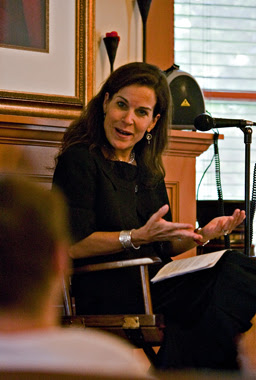
While in the United States most people are still sound asleep, I'm typing this post from what is just about my favorite locale in the world: a little provencal town called Raphele-les-Arles and an elegantly restored farm house its owners call Mas Ballot.  We just came over yesterday from London where the Great Writing conference convened last weekend.  As usual, Great Writing was superb, with an astonishing variety of participants and a palpable spirit of collaboration.  I talked with a Scottish woman who long ago migrated to northern Israel and now teaches in a university there.  I talked with an Australian woman who lives in Turkey.  I talked with a Mexican-American woman from California who teaches writing in Germany.  I talked with an American poet who before coming to the conference had done the grand tour of Europe with his grandchildren and his daughter--Nicole Cooley--who, as it turned out, was one of the stars of the conference.  (She's pictured below.)  I talked with an Irish woman who not quite so long ago migrated to New Zealand, where she is currently finishing a Ph.D., although she may soon need to move to California because it appears that her partner is set to take a job there.  I talked with a South African woman who lived three years in the U.S. and has for sixteen in England.  I talked with an Englishman who teaches in Scotland and an Irishman who teaches in England.

I heard a researcher from South Africa present a paper comparing the approaches of two separate primary school teachers in her country and how the assignments they used--and the results they got--reflected their two very different attitudes toward creative writing itself.  (Not surprisingly, the teacher who trusted in and encouraged her students' originality, who saw creative writing as an important act in and of itself, not merely a means to teach a variety of language arts terms, achieved much more with her students.)  What I couldn't help but think was that this all sounded exactly like the problem with language arts instruction in my son's own school back in Conway, Arkansas.  I heard a poet read who is half-Tanzanian and half-British but who was raised in northern Canada, where she still lives and teaches and farms.  (Yes, by choice and it's no easier to farm there--organically, no less--than you might expect.)  I heard a French woman who lives in Australia read a paper on the work of the Irish poet Seamus Heaney.  I heard an Australian fiction writer who teaches in England and whose last novel was a considerable literary success in America--i.e. David Rain (author of The Heat of the Sun)--give a wonderful presentation on the "Seven Myths of Writing."  (That's him pictured above.)  I heard an academic from New Zealand read a homage to Flannery O'Connor, a paper that focused on O'Connor's days as a student in the Iowa Writers Workshop, where the New Zealander academic had spent a summer two years earlier participating in fiction workshops led by Lan Samantha Chang.

It was inspiring to see so much thought, so much concern, so much passion expressed on the subject of writing and writing instruction--and from so many corners of the world.  We teachers of writing walk around with the notion, I think, that we are all so provincial, suffering in our own little salt mines with nobody much paying attention or understanding.  But Great Writing demonstrated again, as it always does, how hopelessly wrong such ideas are. With a conference so globally aware and globally focused, it should come as no surprise that even the meeting's two main
organizer's--Graeme Harper and Simon Holloway--are from elsewhere.  (Graeme currently lives and teaches in Michigan, and Simon teaches in Manchester, England.)  Not a single person associated with the conference actually works for Imperial College, London, where the gathering took place.  Everything about Great Writing--from its planning to its outreach to its intentions--is "from afar."  That's what makes it such a fascinating gathering, especially for writers like me whose experience with writers conferences mostly derives from the enormous and inward-looking AWP conference.  Great Writing is much less enormous and much more outwardly focused.

Nowhere was this more apparent than in the Great Writing Keynote Lecture, which this year was not so much a lecture but a series of short (five minutes) presentations on various issues surrounding creative writing from ten different speakers from around the world.  Graeme called it "10 X 5," and it might have been the highlight of the gathering, because not only was it fascinating to hear what concerns different people from different parts of the creative writing universe, but it stimulated a terrific amount of discussion immediately afterwards, which was exactly the point.  An English writer and teacher expressed concern that with his students increasing fascination with, and commitment to, electronic media they might lose their connection to the immediate, visceral world around them.  Thus he takes them to an old but still functioning train station in Staffordshire and makes them observe the living stories being written moment by moment in that building by those who pass through it.  A Scottish writer noted that with the growing independence movement in Scotland, a movement that has embraced Scottish writers among other aspects of Scottish culture, being a working creative writer in Scotland today is implicitly a political act.  Nicole Cooley decried that outrageous cost of many American MFA programs and also their lily-white color (too few teachers, students, and visiting writers of color, she rightly companied).  Her applause line: "No one should have to go $60,000 in debt to become a poet."  Another speaker from England, a woman who is a poet and archivist, argued that creative writers ought to take better advantage of the archives of their local institutions.  There is no end to the number of stories embedded in those documents, she said.

It's to be expected that any discussion about issues in creative writing practice and creative writing instruction leads to complaints about creative writing's place in the academy.  This was certainly true Saturday evening in the post-lecture discussion.  There is, after all, much to complain about.  And some of the complaints--not all but some--are amazingly consistent from continent to continent.  But finally Simon Holloway raised a good point.  He said that in all the years he had participated in Great Writing he had constantly heard creative writing instructors strike up defensive poses, as if they had to justify the very existence of their discipline.  (Unfortunately, they probably did--and in many places, my own university included, they still do.)  "But when," Simon asked, "are we going to go on the offensive?  When are we going to say to these administrators, 'Look at all the students we bring in; look at all the tuition funds we raise; look at all the prestige and good press we generate.  What are you going to do for us in return?'"  Simon suggested that maybe it's about time to turn the tables and offer a few "help us or else" ultimatums.  It was great to hear, great to consider, and probably long overdue.  It's a kind of fighting spirit I'll need to remember when long after this exquisite French rest stop is over and I'm back in the academic trenches in Arkansas.