
Showing posts with label AWP. Show all posts

Tuesday, September 4, 2012

Identity revisited

0


A couple posts ago, I touched briefly on the phenomenon of how one person can have various identities within a single piece of writing.  To reprise my point: at the very least, three separate "you"s are always present in any memoir essay (or autobiographical poem or autobiographical story): the you that experienced the event in real life, the you that is the character experiencing the event in the essay, and the you that is the author controlling how the essay is written.  While the middle you is connected deeply and tangibly to the first and third yous, the person who experiences and the person who writes are so far removed from one another that at times--if not at all times--they feel like differentiated human beings.  Well, I've just read an article by Eric LeMay in the latest edition of the AWP Chronicle that gets right at this understood, but rarely talked about, phenomenon.  I recommend the essay to writers and non-writers, teachers and students, alike for its insight and its progressive pedagogical ideas.  LeMay begins his article with a review of the brief essay "Borges and Myself," written by none other than Jorge Luis Borges (or one of himselves).  Other than Wayne Booth's seminal study The Rhetoric of Fiction (1961), which isolates a species of person known as The Ideal Author, "Borges and Myself" is the only bit of prose I can think of that accurately, and acutely, gets to the heart of a writer's divided identity.  As LeMay reminds us, in the essay, Borges's narrator delineates between the Borges who shops for coffee and has a fondness for hourglasses and the Borges who subsumes in all the rude fabric of life for the sake of his stories.  The former is certain he will be defeated and forgotten, taken over by the voracious, restless, ambitious latter.  Indeed, he ends with this classic summatiion of the problem: "Which of us is writing this page I don't know."

I remember how thrilled I was when I first encountered that essay as a freshman in a college composition class. I was a neophyte creative writer, to say the least, but the essay struck me as profoundly and stunningly true. Already true, even then, to my experience as a writer.  Why had no one written about this before?, I remember thinking.  And why don't we who try to write shout it from the mountaintops?
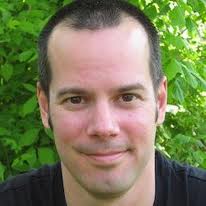


LeMay (that's him above) doesn't try to outdo Borges with an essay of his own about writerly identity.  What he does instead is explain how in his classroom at Ohio University he uses the Borges essay to encourage his students to conceive and define a writing identity for themselves.  Thusly, LeMay hopes to launch them more directly into a conscious writing life.  In short, he wants them to take their writing ambitions more seriously, so seriously that must be owned by a whole other self.  He starts this process by having them write a short essay, modeled on Borges's, about the Other who is the Writer who carries their name.  By LeMay's own admission some of the writing he gets as a result of the assignment is disappointing; and none of it, of course, can come close to Borges' psychological sophistication.  But the idea behind the assignment is both credible and tantalizing--and just damn innovative.  If you have access to the Chronicle take a look.  If you don't have access to the Chronicle, get access!  It really is that interesting a piece.

Tuesday, December 14, 2010

Novel Class Survives!

2


A few months ago, I blogged about one of the classes I'm teaching this semester: Novel Writing Workshop. As I explained at the time, I had taught the class twice before, somewhat successfully, but decided to do it differently this semester. Rather than have my students simply plan and begin novels, workshopping the chapters as they went, I decided that this time they would all start and finish their novels. In one semester. They would be producing a draft of a novel, of course, not one immediately ready for publication, and the word count I asked for--55,000--would put their novels on the short side. But, even so, let's not kid ourselves. 55,000 words is an awful lot to ask of students in one semester. A friend of mine taught a Novella class last year. His minimum word count was 15K and apparently a few of his students struggled to produce that much. So I didn't quite know what to expect when I presented my semester plan to them. But I know what I feared: A goggled eyed response, a few choice epithets relating to my sanity, and an empty classroom the next week when the whole group sensibly dropped my course. That first week of the semester, whispers, recollections floated through my head: a presentation I'd heard years ago about a Novel Workshop taught in England for graduate students--a two semester affair in which, the presenter explained, we of course don't expect the students to actually have finished their novels at course end; a teacher of mine in graduate school gossiping about a class taught by John Gardner, a graduate level class in which he demanded that the students finish novels in one semester and at the end of which most had dropped out and more than one suffered a nervous breakdown or divorce or both; an AWP session I attended two years ago about teaching novel writing workshops and at which the general notion of the panelists seemed to be "Of course, you could never do this kind of course with undergraduates."

Did I really know what I was doing? No, but I did know that I really didn't like hearing that students in my previous novel workshops had barely taken any steps toward completing their novels once the semester was over. Most had done no further writing past chapter 4. So how much--I thought and thought and thought--did they actually learn about writing novels?

I'm happy to report, now that we've reached exam week at UCA, that of the original 15 students, 11 endured to the end of the semester. And of that 11, 10 have already given me their completed 55,000 word novels, with the 11th to be delivered to me at any moment. 11 of the 15 finished their projects. That's a hell of a good percentage. (I wrote one too, meeting the same word counts they did. I actually like my little book a lot, but that's material for some other post.) What's more, several of them went over the 55,000 goal. One enterprising guy--who never came close to having a nervous breakdown--actually produced over 75,000 words. Another student quietly reached the 55,000 goal a week before she had to and then refrained from saying so because she was afraid the class would resent her for it. (She didn't need to worry; it wasn't that kind of class.) Another student not only finished a 55,000 word novel for me but at the same time composed an Honors College research thesis about an entirely different subject altogether. (I have no idea how she survived.) I am just so proud of this group. Not a one of them blinked when I explained the set up of the class; many of them were actually excited. And they are even more excited now at having finished their books and their word count. One student announced last week with a huge smile, "I can take that Novella course and it will seem like nothing!"

Most important is they learned from doing about the process of composing a book length fiction. They struggled with juggling characters, plots, story arcs, rising action and climaxes. What to leave in, what to leave out. All the messy, and even onerous, decisions of book writing. (A couple students realized they were actually composing the first of what must be a series. One of these students asked if I was teaching the course next semester, so she could write Book 2!) Most of all they now know what a commitment it takes to stick with and finish a novel. And they've each discovered what writing habits/schedules work for them. One student, a talented but extremely intuitive writer, struggled much of the semester to keep up with the words counts but in the last few weeks hit on a schedule that worked for him: 1000 words a day. That was not too much to overburden him and it was plenty enough to keep him connected to his book. He found it not so very trying after all and told me that he wished he had been writing that way since the beginning. He hadn't, but the important point is that the class allowed him to discover that way of writing.

Yes, I am now faced with a pile of novels to read. But here's the most satisfying part: They're good novels! Some of them are actually really good. Now I haven't gotten all the way through them yet, and I won't for a while, and maybe I'll be singing a different tune come January, but let me just say that I don't think I've ever been more impressed with and proud of my students as I read these semester-long labors of love. There's no way, as an undergraduate, I would have felt ready to take on a novel--not in one semester. 11 of my undergraduate students just did. And they didn't just survive; they thrived. Kudos to you all. It was a great four months.

Tuesday, September 29, 2009

One reading suggestion

0


No news today on my own book. Just know that I'm still working on it, everday. Thought I would share a word about a historical novel I'm reading at the moment. Peter Carey's True Hisrtory of the Kelly Gang. Mr. Carey will be a visiting writer at my university next month, so I'm catching up on his work. And I'm happy to read any well-written historical novel while I'm busy on a historical novel of my own. If you don't know Carey's work, you should. He's won the Booker Prize--twice (!).

What I'm finding especially interesting about Kelly Gang is Carey's approach to the narrator's voice. How to capture historical speech is a question every writer of historical fiction has to struggle with, and I've sat in on more than one AWP session in which this exact question comes up. There are different schools of thought. Some think you need to imitate as best you can how people actually spoke during the period depicted. Others ask: Yes, but how can you know? We don't have voice recordings from Elizabethan England, for instance. We only have written documents. And as we all know, written documents--especially from an age in which most people did not write--are hardly a reliable indicator of how the general public spoke. Finally, I think, it's just got to feel right to the reader. If your best attempt at earlier speech patterns comes across as a forced or clownishly bad imitation, the reader could dump the whole novel for no other reason. In my book, I'm avoiding modern slang but I'm more or less making the speech patterns sound like our own. Why? Because in conversations I'm trying to transmit the emotional nature of those conversations: relaxed, angry, whimsical, questioning, etc. For a modern reader to hear a conversation as relaxed the diction and sentence structure must sound relaxed in his/her ear. Using outworn constructions won't come across as relaxed.

But here's the thing. In Kelly Gang, Carey is imitating past written speech. (19th c.) More than that, it's the written speech of a only barely literate, if intelligent, person. He gives himself an extra hard chore. Not only does it have to sound like believable 19th c. writing but the 19th c. writing of a near-illiterate. (And it is meant to be read as writing--something expressly put down on paper--not simply the narrator's consciousness. The premise of the novel is that these writings were found bound in packets and are being presented to the reader.) It's a pleasure to watch on the page as paragraph after paragraph Carey confronts this challenge. He employs an interesting and nearly convincing combination of atrocious grammar, almost non-existent punctuation, and the occasionally archaic or ornate sounding word (e.g., "adjectival"). The point of that latter, I'm assuming, is to remind the reader what century the book is set in. But, too, it feels intuitively right. How many people with poor writing skills can at the same time demonstrate ornate, even flowery speaking styles? There's some of that in this narrator, who is of course not speaking but writing. But he writes in a verbal style, his narrative directed at a specific listener inside the world of the story, not at a general reader. Check this one out, especially if you like novels with unique narrative voices.