

 2
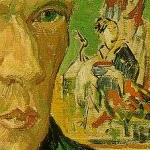
2 A couple years ago this blog put me in contact with Anne Whitehouse, a poet and novelist who had written a poem called "Van Gogh in Arles" detailing Van Gogh's heroic struggles to keep painting outdoors in the face of the infamous mistral of Provence. Anyone who has ever visited that part of the world knows how real and ferocious a force a mistral can be. (I keenly remember going running one morning in the middle of a mistral and finding myself barely able to move forward. Thank heaven it was a sunny late spring day and not the middle of winter.) I admired Anne's poem then and provided a link to it. I'm happy to tell you now that the poem is included in Anne's poetry collection, One Sunday Morning, available from Finishing Line Press.
 Just as in her previous volume, Blessings and Cursings, Whitehouse is able to capture the dualistic nature of so many common experiences; the two-sided identity of what might seem to be singularly positive or negative developments; or, viewed through a different lens, the deeply unified nature of what appears on the surface to be a divided, battle-torn life. With a voice of gorgeous understatement and placid wisdom, she pushes at several tiny but beautiful ironies, ironies that are subtle until she exposes them, and then they seem perfectly obvious. An example of this phenomenon is the poem "Meditations in June," a poem of lessons learned in a life honestly spent, a poem that admits--like almost all of Whitehouse's work--to being "ever more certain / Of my uncertainty." In the poem's final stanza, Whitehouse invokes a visit to a hospital to see a terribly ill friend, and her summary of that experience could stand as the ethos of the entire collection:
The world is a terrible place.
There's no getting out alive,
Said my friend from his hospital bed,
Elation disguising his dread--
Or the other way around.
 Is this life the locus of more elation or more dread, the book seems to ask; and, more to the point, is it possible that there's no difference? Certainly, scattered through its pages are examples of both and either. Several of the poems seem almost to be gathered out of variant pieces that when brought together resonate with a new, surer power. They seem less like conscious riffs on a theme than an after-the-fact discovery of connections and oppositions where previously none were suspected. For example, there is the poem "Consolations," the three parts of which describe, respectively, the poet lusting after fruit she spies at the highest reaches of a tree ("orange-yellow suns glowing / in green shade"), a WWII veterans attempt to escape lingering nightmares from that war through fierce, scientific concentration on nature, and the poet--her voice returned to the poem--describing a dive into the sea. Each segment details a consolation but also suggest the ways in which the consolation is inescapably bound with an original torment. The oppositional language of the last stanza brings this home: "the coolness seeped in my skin / and spread all through me / and I relaxed, and I was warm." There may be no better example of the unity of torment and consolation than the title poem, which describes a wounded stag, "blood stream[ing] from the hole in its rump" after its tail has been ripped off by coyote, who stands nearby, eyeing the poet and worrying the tail "To and fro like a fish in its mouth." As barbaric as the image is, it is underscored by the stag's unavoidable beauty: "Its antlers . . . fuzz-tipped and green, / Its large eyes liquid and brown." Also by the poet's rising sense of awe at the spectacle of nature at work. The nature of nature, if you will. When the stag limps away, "its left foreleg . . . lame / . . . its life helplessly slipping away," the image is of course a sad one, but not necessarily tragic.
While Whitehouse includes no haiku in the volume, every poem demonstrates the directness and elegantly austere language characteristic of that form, not surprising in a poet who, like so many eastern masters, attempts to show through nature what is behind nature and through the individual life what is behind that life, constructing it and maintaining it in a beautiful, tenuous balance of opposites.