Showing posts with label structuring novels. Show all posts

Tuesday, November 17, 2009

More about how

0


In my last post, I wrote about one foundational decision I made in regards to the book's structure. That decision I owed to another writer's novel. But a different aesthetic decision I can trace back to Van Gogh's paintings themselves. This feature of my book came to mind almost immediately after I conceived of writing it at all: To distinguish each of the separate "eras" in Van Gogh's life with a signature color. After all, his metamorphosis as a colorist is one of the most significant--perhaps the most significant--aspects of his development as an artist. (Not to sound too banal, but what blew me away in my visit to the Van Gogh museum was the intense, literally glowing, brightness of the pictures.) At different times during his career, different colors dominated. And it occurred to me that you could even characterize the years before he became a painter with signature colors; not colors that are found in paintings (because he was composing none) but colors which capture the "shade" of his life and ambitions. I would emphasize these shades by using the respective color words, or synonyms, frequently in the respective chapters. I didn't want this to be over the top, too heavy, too obvious, or too distracting, and so far I think I've succeeded. If anything, as I've revised I've cut back actually on these color words. But the scheme should still apparent to anyone reading carefully. Or even anyone reading loosely, since each chapter carries a color word as its title. In fact, the title of the whole book (have I mentioned it yet on this blog?) is one big fat color word of its own: Yellow.

Choosing the signature colors wasn't very hard. Some are obvious. Yellow, for instance, for Arles, where he famously and deliberately strove for the "high yellow note" that so dominated his paintings from that time. For his time in the hospital at Saint-Rémy I chose aquagreen: a decidedly cooler color than yellow and one, in fact, that does appear in the Saint-Rémy paintings. But his actual use of the color is less important that what the choice indicates: a deliberate effort to scale back from extremes, an overt desire to calm down both his pictures and his life. Nuenen became brown because there is simply so much brown in those very earthy paintings; the Borinage became black because a.) What else can you choose to describe his time among coal miners, and b.) in the Borinage he suffered through the worst depression of his life. His years trying to learn how to become a missionary and lay preacher? White, of course, because it suggests both purity and a white-hot fanaticism. His childhood in rural Brabant? Green. Paris? My first inclination was red. I thought it captured the dynamism of the city and suggested too his foray into intenser colors. But finally I went with orange. Because I see more orange than red in the Paris paintings and because there's something more off-center and sickly about the former color. (Van Gogh always recognized that he learned a great deal in Paris, but he also thought the city almost ruined his health.) There are some other periods and other colors, but you get the idea. Color isn't merely what Van Gogh's paintings were made from, it's embedded in the structure of my text.

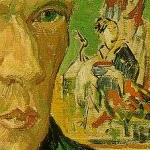
[Above on the right is the very brown "Cottage with Peasant Woman Digging" (1885), painted in Nuenen, and, on the left, "Arles: View from the Wheat Fields" (1888).]

Saturday, November 14, 2009

Beginnings of How

0


In the very first post I wrote for this blog (just click on "About" to see it), I explained how I received the idea to write a novel about Van Gogh in the first place. But that's just one aspect of the origins of this project, the "What." Equally pressing, and this is of course true anytime you write anything, was: "How?" That is, how did I want to approach my subject after I realized that Van Gogh must be my subject? How should I structure the novel? What motifs would I press? I guess you could broadly call these issues of style rather than subject. One very important stylistic decision I made stemmed from having reading Ron Hansen's Mariette in Ecstasy not long before the idea for the novel came to me. If you haven't read Hansen's delicious little book, you must. With exquisite delicacy and much quiet poetry, he details the life of a cloistered nun in upstate New York in the early 20th century. I know, that doesn't sound especially thrilling but, Hansen's book is a wonder and rightly earned considerable acclaim when it appeared in 1991. When I got around to reading it, what I marveled at most was how beautifully contained are each of the chapters. Every chapter, even if it details only single minute in his protagonist's life, is a universe unto itself. Hansen's narrative develops in moment-by moment-by-moment thrusts; there are virtually no bridging sections. This seemed a fascinating and atypical way to structure a novel, but it also felt just "right" for the subject. Since at the time I was exploring the world of monasteries in order to write a novel of my own, I knew how the lives of cloistered nuns and monks are purposefully kept the same--at the surface level--from day to day. They attend services on a fixed schedule, keep to regular work details, and engage in regularly scheduled meals, private prayers, and bible reading. On the surface, it's none too exciting and doesn't seem to ever vary. But that's the point and the purpose. Where the action is--where it's supposed to be--is on the level of the soul: those moments of profound confrontation with yourself or with God, wrapped by external quiet. The structure of Hansen's novel cannily emphasized this philosophy of living.

When I conceived of my Van Gogh novel, I immediately thought of Mariette and wanted to adopt Hansen's structure as my own. For some reason I felt it would be "right" for my subject too. My book would be a small book, composed of a series of wildly divergent but significant moments in the painter's life. Even more so than in a conventional novel, my book would proceed scene by scene, rather than chapter by chapter or year by year. Like Hansen, I would create very few bridges. Well, I've actually stuck to that plan during the four years I've worked on the book. Except the novel, in its present incarnation, is not in the least short. Scenes, after all, require pages to effectively be dramatized, and if you write enough scenes you end up with a heck of a lot of pages. And since, unlike Hansen, I am more or less covering the entire life of my protagonist, brevity is virtually impossible. That said, it's important to recognize that this commitment to scene over summary can sometimes be the most efficient way to cover a broad span of years. I think of some of Jo Ann Beard's essays in her brilliant The Boys of My Youth. She'll present a scene from one year in her life, then jump to another year, and then another, allowing that one scene to represent all the fundamental tensions of the speaker during that period. In this way, she can suggest her whole life in 30 or 40 pages, whereas as a more overtly inclusive narrative would have taken many more pages and perhaps not achieved any greater payoff. As I said: efficient. I guess with my novel so far I've not been courgeous enough to let a single scene represent Vincent in each of his various life "periods." (He had several such periods.) Some of these periods--notably Paris and Arles--I've rendered in several scenes. At this point, I've written so many scenes I have a hefty--too hefty?--novel, even after doing quite a lot of cutting. But the thing is, I can honestly say that each of the scenes contributes something important and unique to my picture of Van Gogh. I'm glad I developed the novel in this manner and can't really imagine doing it any other way. I only hope my book can do justice to the influence of Hansen's beautiful and exotic Mariette.