
My wife and I drove to
Kansas City late last week. Our university was on Fall Break so we took the opportunity to explore what may soon become one of our favorite cities. More on that some other time. (And, by the way, a thanks to my brother and his wife for the boysitting help.) On the drive up and back, my wife finally was provided access to the manuscript of my novel-in-progress. She read to herself while I drove and I read aloud to her while she drove. While she cetainly did not finish the whole thing, there were some important first impressions. First--thankfully--she liked it. Quite a lot. (I allow myself to take her praise seriously because she teaches creative writing--and is a novelist herself.) Second, she had some concerns about the scenes that feature a point-of-view character other than Vincent himself. As I explained in an earlier post, various scenes throughout the book, although in third person, emphasize the perspective of other individuals. While the book, as I've presently assembled it, is mostly in chronological order, I did not write it that way. I wrote The Hague scenes for a while, then some St. Remy scenes, then childhood scenes, and so on. On putting them altogether I'm discovering that there are long stretches from Vincent's perspective only and also stretches in which many different perspectives are highlighted. We went through the latter on our way back from K.C. Stephanie's concern is that too many of these other people have condescending views of Vincent, sometimes quite negative views. And she worries this might give the reader the wrong idea of my main character. "It distracts from the story you're trying to tell," she says.
Basically, I think she's right. And I'm grateful for the criticism because it makes it easier for me to cut scenes. Cutting is the name of the game from here on out. (I've got to reduce this behemoth by at least a third.) On the other hand, some of these other viewpoints are critical to the point my book makes about Vincent. While we revere his art, the image many of us have of Van Gogh is "the crazy guy who cut his ear off." And ''the crazy guy" is certainly the view that too many people had of him while he was alive--without revering his art. My point in juxtaposing these different points of view with Vincent's is to show how thoroughly misperceived he was, sometimes by those who were supposed to know him best.
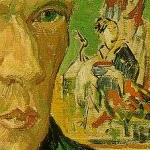
Like, for instance, his father. (Pictured above.) The Reverend Theodorus Van Gogh certainly demonstrated concern and love for his son, but he never "got" him. (An old old story, I realize.) Yet while Vincent's relationship with his brother
Theo has been well-documented, even theatrically dramatized, I think Vincent's relationship with his father, both the good and the bad, was actually more important, was at the center of his life--and it's at the center of my book. I feature a number of scenes from Theodorus's point of view, and I suspect/hope these will be saved from the cutting room floor. For instance, just a little while ago, I was revising two successive scenes: one from Vincent's POV in which he engages in political agitation on the behalf of Belgian miners, and a second, from Theodorus's POV, in which the reverend reproves Vincent for doing this and for losing his position as a lay missionary to the miners. The contrast in ethos between the two scenes couldn't be greater. In the first, the desperate need of the miners for better protections is highlighted, with the point being that Vincent's agitation can be read as Christian activism. Whereas what we get from Theodorus's viewpoint is that Vincent violated the "rules" of his position and is to blame for the fallout. This dual vision gets to the heart of Vincent's conflict with his father and, more broadly, to much of the trouble he suffered through in his life. I think I can trust my reader to get the point. At least that's what I'm saying now. (Check in later for updates.) But many many thanks to my wife for showing me several scenes in a very different light.




 0
0


