
Showing posts with label Great Writing conference. Show all posts

Tuesday, July 2, 2013

Great Writing great

0

While in the United States most people are still sound asleep, I'm typing this post from what is just about my favorite locale in the world: a little provencal town called Raphele-les-Arles and an elegantly restored farm house its owners call Mas Ballot.  We just came over yesterday from London where the Great Writing conference convened last weekend.  As usual, Great Writing was superb, with an astonishing variety of participants and a palpable spirit of collaboration.  I talked with a Scottish woman who long ago migrated to northern Israel and now teaches in a university there.  I talked with an Australian woman who lives in Turkey.  I talked with a Mexican-American woman from California who teaches writing in Germany.  I talked with an American poet who before coming to the conference had done the grand tour of Europe with his grandchildren and his daughter--Nicole Cooley--who, as it turned out, was one of the stars of the conference.  (She's pictured below.)  I talked with an Irish woman who not quite so long ago migrated to New Zealand, where she is currently finishing a Ph.D., although she may soon need to move to California because it appears that her partner is set to take a job there.  I talked with a South African woman who lived three years in the U.S. and has for sixteen in England.  I talked with an Englishman who teaches in Scotland and an Irishman who teaches in England.

I heard a researcher from South Africa present a paper comparing the approaches of two separate primary school teachers in her country and how the assignments they used--and the results they got--reflected their two very different attitudes toward creative writing itself.  (Not surprisingly, the teacher who trusted in and encouraged her students' originality, who saw creative writing as an important act in and of itself, not merely a means to teach a variety of language arts terms, achieved much more with her students.)  What I couldn't help but think was that this all sounded exactly like the problem with language arts instruction in my son's own school back in Conway, Arkansas.  I heard a poet read who is half-Tanzanian and half-British but who was raised in northern Canada, where she still lives and teaches and farms.  (Yes, by choice and it's no easier to farm there--organically, no less--than you might expect.)  I heard a French woman who lives in Australia read a paper on the work of the Irish poet Seamus Heaney.  I heard an Australian fiction writer who teaches in England and whose last novel was a considerable literary success in America--i.e. David Rain (author of The Heat of the Sun)--give a wonderful presentation on the "Seven Myths of Writing."  (That's him pictured above.)  I heard an academic from New Zealand read a homage to Flannery O'Connor, a paper that focused on O'Connor's days as a student in the Iowa Writers Workshop, where the New Zealander academic had spent a summer two years earlier participating in fiction workshops led by Lan Samantha Chang.

It was inspiring to see so much thought, so much concern, so much passion expressed on the subject of writing and writing instruction--and from so many corners of the world.  We teachers of writing walk around with the notion, I think, that we are all so provincial, suffering in our own little salt mines with nobody much paying attention or understanding.  But Great Writing demonstrated again, as it always does, how hopelessly wrong such ideas are. With a conference so globally aware and globally focused, it should come as no surprise that even the meeting's two main
organizer's--Graeme Harper and Simon Holloway--are from elsewhere.  (Graeme currently lives and teaches in Michigan, and Simon teaches in Manchester, England.)  Not a single person associated with the conference actually works for Imperial College, London, where the gathering took place.  Everything about Great Writing--from its planning to its outreach to its intentions--is "from afar."  That's what makes it such a fascinating gathering, especially for writers like me whose experience with writers conferences mostly derives from the enormous and inward-looking AWP conference.  Great Writing is much less enormous and much more outwardly focused.
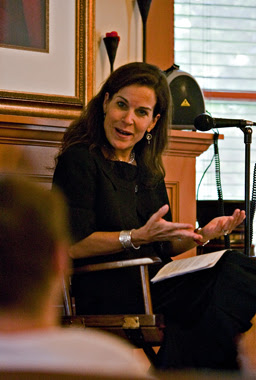
Nowhere was this more apparent than in the Great Writing Keynote Lecture, which this year was not so much a lecture but a series of short (five minutes) presentations on various issues surrounding creative writing from ten different speakers from around the world.  Graeme called it "10 X 5," and it might have been the highlight of the gathering, because not only was it fascinating to hear what concerns different people from different parts of the creative writing universe, but it stimulated a terrific amount of discussion immediately afterwards, which was exactly the point.  An English writer and teacher expressed concern that with his students increasing fascination with, and commitment to, electronic media they might lose their connection to the immediate, visceral world around them.  Thus he takes them to an old but still functioning train station in Staffordshire and makes them observe the living stories being written moment by moment in that building by those who pass through it.  A Scottish writer noted that with the growing independence movement in Scotland, a movement that has embraced Scottish writers among other aspects of Scottish culture, being a working creative writer in Scotland today is implicitly a political act.  Nicole Cooley decried that outrageous cost of many American MFA programs and also their lily-white color (too few teachers, students, and visiting writers of color, she rightly companied).  Her applause line: "No one should have to go $60,000 in debt to become a poet."  Another speaker from England, a woman who is a poet and archivist, argued that creative writers ought to take better advantage of the archives of their local institutions.  There is no end to the number of stories embedded in those documents, she said.

It's to be expected that any discussion about issues in creative writing practice and creative writing instruction leads to complaints about creative writing's place in the academy.  This was certainly true Saturday evening in the post-lecture discussion.  There is, after all, much to complain about.  And some of the complaints--not all but some--are amazingly consistent from continent to continent.  But finally Simon Holloway raised a good point.  He said that in all the years he had participated in Great Writing he had constantly heard creative writing instructors strike up defensive poses, as if they had to justify the very existence of their discipline.  (Unfortunately, they probably did--and in many places, my own university included, they still do.)  "But when," Simon asked, "are we going to go on the offensive?  When are we going to say to these administrators, 'Look at all the students we bring in; look at all the tuition funds we raise; look at all the prestige and good press we generate.  What are you going to do for us in return?'"  Simon suggested that maybe it's about time to turn the tables and offer a few "help us or else" ultimatums.  It was great to hear, great to consider, and probably long overdue.  It's a kind of fighting spirit I'll need to remember when long after this exquisite French rest stop is over and I'm back in the academic trenches in Arkansas.


Monday, June 24, 2013

Over the pond and keep going

0

While I continue with my summer fiction writing course at UCA, and while I'm getting close to the bottom of the stack of novels from my spring Novel Writing Workshop class, I am also furiously working out last minute preparations for our trip across the ocean to UK's Great Writing Conference, which will be held this coming Saturday and Sunday at Imperial College, London.  My wife's cousin, Brendan Pettei, is kindly hosting us for the weekend at his flat in Chelsea.  (Brendan is on semi-temporary assignment in London for a New York-based financial services company.)  It will be great to be met by family so far from home.  Meanwhile, the conference is shaping up to be a stunner.  America's AWP Conference prides itself on being the largest creative writing conference in the world--and it sure is that--but AWP cannot match Great Writing for its international flavor.  As many as fifteen different countries will be represented at next weekend's gathering, including Japan, Finland, Spain, the United Arab Emirates, Portugal, South Africa, South Korea, and Jordan.  As one might expect, there will be numerous speakers from England, Scotland, Canada, and the United States, along with several from Australia and New Zealand.  It won't be an AWP-sized event (thank goodness), but it appears to be the biggest Great Writing ever, and perhaps one of the best.

Like many of the presenters, I will wear dual hats: moderating a session on Saturday morning and then presenting in a session Sunday afternoon (the final slot of the conference).  The theme of the Saturday session will be "Gothic Surrealism."  The readers in that one are all creative writers (and academics) from England: Tim Rhys, Paul Houghton, and Lisa Mansell.  They are, respectively, two novelists and an avant-garde poet.  I'm very much looking forward to the session.  Not only does their individual work sound fascinating, but it's a special pleasure of the Great Writing Conference to meet and hear writers one would otherwise never have the opportunity to encounter--or even know about.  

My session on Sunday is an intriguing mixed-bag with each speaker embracing places, people, or writers from the past.  I will read from a historical fiction set on Nantucket Island, Massachusetts, part of a collection I have developed called Island Fog.   The second presenter, Sarah Penny, a native of South Africa and a lecturer in creative writing at London's Brunel University, is the author of a series for children called The Bundu Bashers.   (That's her in the photo below.)  In her presentation Penny will recount her experience interviewing Ouma Una.  Ouma Una was part of a community of Khomani San (bushmen) who once lived in a section of the Kalahari Desert before the South African government forced them off the land in 1931 and turned it into a national park.  The South African government then required the Khomani San to work for white farmers in the region and forbade them from speaking their native language, N/uu.  Penny interviewed Ouma Una as background for one of her books and based one of her characters on the woman.   At the time of the interview, Ouma Una was the last person alive to have lived in the park before the explusion and one of only two remaining speakers of N/uu.  Sounds fascinating.  The final presenter, Tatheer Faiq (pictured above), is an academic from Griffith University in Brisbane.  She will discuss the work of the nineteenth century Arab writer Mohammad al-Muwaylihi.  According to Faiq, al-Muwaylihi, "promoted a culture of resistance to a prescribed ideological standpoint."  (Always a good thing.)  Faiq will go on to explain that al-Muwaylihi's notion of nationhood was one in which "an idealized Occident met the Orient in a global context."  Sounds like Great Writing in a nutshell!  And thus a perfect last paper for the conference.

When we're done at Great Writing it's off for a little R and R in France, where we will be joined by my brother Jerry and his family.   Well, semi-R and R, I should say, because I will at the same time be reviewing the final projects of my summer fiction writing students--who will email them to me--and then figuring and posting their semester grades.  Sometimes you just have to be very thankful for the internet.

Monday, June 3, 2013

Summer business

0

A draft schedule of the upcoming Great Writing conference appeared in my email inbox this past week, making the conference--which is not very far in the future--finally more real to me.   While none of the scheduled sessions have been assigned titles or rooms yet, I do know when my session will run (not the best slot, actually: last session of the conference, 2:30-4:00 on Sunday afternoon); and I'm assuming all the presenters in my session will read from their own creative writing, because that's what I'll be doing.  But with Great Writing it's hard to say.  Like the International Conference on the Short Story in English, Great Writing is unique in that it blends both academic papers and creative presentations on the same program.  Personally, I love that.  I think it not only makes the conference attractive to a wider spectrum of authors; but it lends balance, credibility, and a renewed vitality to both creative and academic pursuits.  Great Writing goes one step further by sometimes blending creative and academic presentations in the same session!  So hold on for further details about the conference as soon as I receive them.  As I've mentioned before, it will be held June 29 and 30 at Imperial College, London.

                                                            *  *  *

Speaking of the International Conference on the Short Story in English, one aspect of my current early summer busyness is trying to imagine and codify a Study Abroad course for next summer.  The idea is to get UCA students over the pond to Europe so that they can participate at the end of their stay in the Short Story Conference, which in 2014 will be held in Vienna.  Due to various institutional delays at UCA, the whole process for submitting and reviewing Study Abroad proposals is seriously behind schedule, but I expect to be informed any day now that I need to get my proposal in ASAP.  So I am furiously researching things to do and places to stay in Vienna, Salzburg, and Prague.  It's exciting work actually, inventing a course--and student experiences--out of whole cloth.  What I will likely propose is a Topics in Creative Writing course called "Writing Europe in Fiction."  The students will read some European short story writers before we leave--mainly writers from west-central Europe (because that's where we will be headed)--and then spend three weeks actually abroad.  When we return the students will workshop fiction they wrote as a result of their trip abroad.  Our base in Europe will be Vienna, but I'm hoping for side trips to Melk, Salzburg, and Prague.  According to UCA Study Abroad guidelines, the person who proposes the course is supposed to come prepared with clear and specific information on airfares, train tickets, accomodations, museum fees, plans for the student's meals, etc., as well as lay out an academic schedule for the course.   So lately I've been tossing around different ideas for places to visit, juggling potential student nourishment and potential student interest with the realities of cost and the possibility of student exhaustion.  (Should we go see an opera in Vienna's reknowned and beautiful State Opera House?  Great idea!  Wait, it costs 164 euros for a single ticket?  How about the Vienna Mozart concert instead--only 89 euros.)  It's certainly a work-in-progress, with a lot of hard decisions left to be made.  In Salzburg there will be an opporutnity to take a Sound of Music tour or a trip to Hitler's Eagle's Nest in Bavaria.  We won't have time to do both, and the cost is similar.   While the Eagle's Nest has actual historical significance, I have a feeling the students would be more interested in a Sound of Music tour; plus it would let us explore more sites in Salzburg proper.  Of course, since the schedule is a work-in-progress, we might not end up doing either!

                                                         *  *  *

Little followup to a news item from some weeks ago.  Versal magazine, based in Amsterdam, has just released its issue 11, and it's ready to order.  The issue features a chaper from my Van Gogh novel.  For the sake of the magazine, I called the chapter "The Dealer's Brother."  It depicts a Paris party that Van Gogh and various other eminences and wannabes attend.  It's told from the point of view of Suzanne Valadon, a postimpressionist painter who did a lot of modeling for other painters during her early days in Paris and who did in fact write about once seeing Van Gogh at a party.  I had great fun writing it, and I'm so happy Versal accepted it.   On Friday, they emailed me a list of interview questions.  The magazine runs a blog that features short interviews with some of its contributing writers.  My interview should be posted to the blog at some point in the next several weeks.  I must say, they sent a rather eclectic batch of questions.  Some were more typical ("What's your writing process?" "What are you working on now?") while others tried to put you on the spot ("What vegetable best represents you?" "What dirty little secret are you hiding?" "What's on your playlist?")  I answered as best I could, but I can only hope that I came across as interesting enough to make it worth their time.  You can read the interview when it's posted and let me know!

Monday, April 22, 2013

London here we come

2

I mentioned in a post several months ago that I will be reading at the Great Writing Conference, held at Imperial College, London at the end of June.   Well--after bureacratic delays that made the U.S. government look like a comparative bastion of efficiency--my university finally figured out how to extend a contribution toward the total cost of the trip, and so our travel plans were finalized just last Friday.  While we're paying more for our tickets than if we'd made the reservations back in October, when I submitted my funding request to the university, I'm excited that the trip is finally real.  We're actually going.  As I wrote in my previous post about the conference, I haven't attended or spoken at Great Writing since 2007, when it was held at Bangor.  While I'll always remember that trip as a lovely one--and certainly one I'd love to make again--there's no matching London as a summer destination.  (Well, so okay, there is Paris.)  Best of all is the conference itself, which in the past has always featured smart discussions, diverse topics, and plenty of time set aside for collegial conversation over coffee (or whatever else one prefers).  I always return home with new writers in mind and at least one really great pedagogical idea I'm dying to try out.  And last I heard, the conference is still willing to consider proposals in hopes of filling out its last few slots.  So while the American dollar is still fairly weak against the British pound, making the trip not exactly cheap, if you're an American creative writer in the academy looking for a place to present a provocative paper you've just written or looking for a new place to read from your own work, I urge you to--quickly!--consider the Great Writing conference.  Hey, it's London, people!


                                                                          *  *  *


Meanwhile, in Boston . . .  On to more somber thoughts.  It's ironic that when I first wrote about my intention on presenting at Great Writing, I also wrote about Boston, the site of this year's AWP conference.  Now I find myself, for much sadder reasons, writing about Boston again in a post about Great Writing.   At this point, the identities of both the victims and perpetrators of the Boston Marathon bombing have been well-publicized world wide.  We've watched as last Thursday night and Friday a literal explosion of activity happened in the search for those perpetrators and as an unprecedented manhunt occurred that ending up killing one perpetrator and wounding another.  We know who, we know when, and we know what.  The only real mystery remaining, and it's always the biggest, is the why.   All last week this question bugged me, since I couldn't see one outcome from the bombing that held any benefit for anybody.  The Boston marathon?  Why?  Even if the motivation was simply to kill as many innocent persons as possible, there were far more lethal methods the perpetrators could have employed.  The entire business made no sense.

Just since the manhunt on Friday, pieces of information have come out about the two perpetrators, especially the older brother: Tamerlan Tsarnaev.  It appears that in the last three years he had become, in the words of some who knew him, "very religious." And in the last year he had begun watching jihadist videos and even adding some of them to his YouTube channel.  And of course he took that six month trip to Chechnya and Dagistan, which has led to speculation that he received training there in terror tactics.  I read Saturday that Tamerlan Tsarnaev had been increasingly upset over what he regarded as a "lack of values" in the West.  Did this, in his mind, justify murder?  If so, I have to wonder why for him being a murderer didn't also indicate a "lack of values."  Most value systems, whether they be religious or secular, forbid murder.  It appears that Tamerlan Tsarnaev is the victim--for lack of a better word--of a particular kind of religious mind set.  (I say particular because I know for a fact that many religious people and religious systems do not endorse it.)  This particular religious mind set--utterly dualistic, harshly judgmental, prejudiced in the extreme--makes one so unable to recognize the common humanity in other people, or whole populations of people, that behavior as unthinkable as murder becomes justifiable.  This kind of thinking, it seems to me, is so twisted and so fundamentally contradictory as to border on mental illness.  It's also, as my wife pointed out, completely megalomaniacal: I am God; I get to decide who lives and who dies; and on my terms.  Most of all, of course, it is just sad.  Like everyone else, I hope investigators get some answers out of the younger brother, Dzhokhar Tsarnaev.  But I have my doubts.  I fear that he'll not be able to provide any explanation for what the brothers did.  At least not any explanation that makes sense.  But, then again, sense and murder are two words that don't belong together in the same sentence.

One positive note: As I write this, it is Sunday, April 21, 2013.  The London Marathon is underway, and nothing untoward has happened.  London and Boston again . . . But it looks like we can anticipate a happier ending this time.

Monday, January 21, 2013

Novel writing class returns

0


After a break of two-and-a-half years, Novel Writing Workshop returns to my university this semester.  In the interim period, dozens of students have asked me about the class and scores of oral histories have been told; a few students lobbied my department's Chair hard for its return; and, not insignificantly, our first collection of graduate students matriculated.  In some ways, it's a very different pedagogical landscape now than when I taught the course a couple years ago.  Then, novel writing workshops were still relatively rare and excitingly new, certainly on the undergraduate level, and the idea that the students would not just start but finish a novel in one semester struck me as potentially hazardous: to GPAs; to other course work; to jobs; to relationships; most of all, to sleep schedules. Yet that's what I asked the students to do.  And nearly all of them succeeded.  Now, novel writing workshops are a considerably less unusual phenomenon.  Indeed, sometimes I think they are everywhere.   Still more typical on the graduate as opposed to the undergraduate level--although one of our graduate students, who was an undergrad a year ago, informs that he took a novel writing course in college--they are, in any case, far more characteristic of creative writing degree programs than in the past.  It can't be coincidental that at the AWP conference in Boston this year, a panel will be held on not just on promoting the idea of the novel writing workshop but on the fact of it; that is, the nuts and bolts of how different experienced instructors of the course have taught it.  I think it's even fair to say that novel writing workshops are becoming the cornerstone of progressive fiction writing programs.  And in part this is because in the last three years those who teach the course have been talking to each other about it--Cathy Day's blog The Big Thing has been especially instructive--pushing each other, motivating each other, spreading the gospel.

So I'm glad it's back at my school, and I know the students are too.  But I admit to being a bit nervous.  In the intervening years since last I taught the course, a mythology has developed around it, a retrospective awe.  Students have told me that for years, ever since they selected our major, they have been eagerly anticipating the chance to experience this one course.  Can this semester possibly meet their high expectations?  Yes, it can.  But, here's the scary part: It's all up to them.  More than any other course I teach, in my novel writing class, the students teach themselves and teach each other.  I offer them a platform through which they can learn about novel writing, but they have to take advantage of it, and they have to encourage each other to take advantage of it.  While I do separate the class into small peer review groups, there will be no full class workshopping.  As I emphasized at our first meeting the other night, the course is about production more than anything else.   The last time I taught the course, again to all undergraduates, the room was fully with unusually mature and unusually talented people.  What the course offered was exactly what most of them were looking for: space, opportunity, deadlines.  Almost entirely seniors, they'd workshopped plenty in their college career.  What they wanted from Novel Writing was something else,  and they were eager to take control of it.  There were certainly bumps along the way that semester, but for the most part--with a notable exception or two--a genuine esprit de corps ruled.

I can only hope my current group has the same experience.  It's a fresh batch, with different backgrounds.  For the first time, graduate students are participating along with undergraduates.  That's a new dynamic for me, and for both of those student populations.  And there's another professor sitting in!  Not even from my own department!  Like last time, we will read Chris Baty's No Plot No Problem (for practical motivation) and a couple of short novels (as models for storytelling over a reasonably short space), and we will periodically break off into peer groups.  But mostly we will be writing.  I'll be writing along with them, which actually is going to be more of a challenge for me this time than last.  Mainly because right now I am in the latter stages of a novel I started early last semester.  I had intended on exploring this novel idea through the Novel Workshop, but when the class was delayed from fall until spring I didn't feel like waiting.  Now I will need to hurry to finish my draft, then immediately start another novel--the subject of which I haven't even clarified for myself yet.   Hard to know what the next few months will bring, but I'm sure it will be an adventure.  There will be exhileration and despair.  There will be careful planning and last second inspiration and a great deal of fatigue.  Some will give up; most, I hope and expect, will soldier on.  Some will get pissed at me and at their peer reviewers.  Some will get pissed at the novels we read.  But if they each individually can hold it together, when the finish line comes they will have learned more than from perhaps any other writing course.  And they will have learned it the best possible way: by doing it themselves.

Publication announcement: I'm happy to report that another chapter from my Van Gogh novel will soon appear in print.  The journal Versal, an international literary magazine based in Amsterdam, is publishing a chapter from the section of the book that details Van Gogh's Paris years.  The point of view character is Suzanne Valadon, a post-Impressionist painter who circulated widely among the Impressionists and Post-Impressionists and even modeled for a few of them.  During my research for the novel, I read an account she'd written of seeing Van Gogh at a Paris party.  I used some details from that account to construct the chapter.  The issue of Versal will appear in May, accompanied by a launch party in Amsterdam.  Really sorry to have to miss that one.  While I will be in London in June for the Great Writing Conference, there's simply no way for me to make it to Amsterdam in May.  Ah, well.

Monday, November 26, 2012

Boston and London

2


2013 promises to be an exciting year of conferencing for me.  It starts in March, as I head to Boston for the annual mammoth necessary insanity of the AWP Conference.   Boston, of course, is one of the great heritage cities of the United States and has the added benefit of being the hometown of my oldest sister.  I'll be wearing two hats at AWP this year.  I'll be there to represent Toad Suck Review, of which I am currently the associate editor, as we share our brand new issue #3 with the world.  (See my previous post for more commentary about this.)  But I will also be speaking on a panel that addresses the subject of novel writing workshops.  Such workshops are a relatively new, but exciting, development in the world of creative writing instruction.  For decades the short story form has dominated fiction workshop activities, and basically for one reason: a class can easily read in advance and discuss in one class period an entire short story (or two or three).  It's a manageable sized bite of work to prepare and process.  Now I adore the short story form--I really do--but it's a fact that most fiction-writers-in-training have their eyes on writing novels eventually (or immediately), and it's also true that novels are typically preferred over story collections in the eyes of publishers.  Most of all it's true that learning to write a successful short story does not really train one to write a successful novel.   They are very different animals.  So what, as creative writing teachers, do we do about this? Do we open up our regular workshop class to both novels and stories?  Or do we create separate classes just for novel writers?  And if the answer to that is yes, can we ask students to write a whole novel in a single semster's time?  Do we expect the whole class to read it?  How do we workshop it?  Does a teacher possibly have time to read 15 or 20 student novels over the course of a semester or at the end of the semester?  These are good, pressing questions, and different teachers--myself included--have come up with their own answers to them.  What we should not and cannot do is fail to encourage our students in their pursuit of longer forms.  That would be a disservice.  By happy fortune, I will again be teaching my Novel Writing course next semester--to a mixed group of graduate and undergraduate students--and therefore I will be able to bring my latest news, and my latest experiences, to the panel discussion.  I'm really looking foward to it.

The wanderings continue this summer when I head off to another of the world's leading cities for the Great Writing Conference, held June 29-30 at the University of London, Imperial College.   The brainchild of Australian Graeme Harper--who studied, wrote, taught, and administered in the UK for decades and does so now in the United
States--Great Writing is in its fifteenth year and going strong.  Without question it is the most important creative writing conference in the United Kingdom and arguably the second most important in the world.  Writers and teachers from virtually every part of the Anglophone world participate.  I submitted both a proposal for a critical presentation--on historical fiction (of course)--and a proposal for a creative presentation.  Graeme later informed me that the selection committee liked both proposals and accepted both, but I had to choose to present one or the other.  As a creative writer, it's my first instinct and my first pleasure to read from my own fiction, so that's what I've decided to do.  I will read from a collection of short stories--half historical and half contemporary in nature--that are all set on the island of Nantucket, Massachusetts.  Nantucket is a hisorically fascinating and physically beautiful place, a piece of the United States but at the same time--in rather fundamental matters of personality--not really.  I can't know how many in the audience will have ever been there, but it doesn't really matter.  My job is to bring the island to them.

What an honor to have the chance to speak at both Great Writing and its American predecessor in the same year.  In many ways, Great Writing is a superior experience to the manic, crazy-busy, bacchanalian, writers-on-steroids entity that is AWP.  At Great Writing, the papers seem a tad more thoughtful, the audiences a bit more attentive, and the discussions between sessions more relaxed and more probing.  (Because more time is afforded for them.)  It's a very nourishing conference, and I've missed it.   I last attended Great Writing in 2007, when it was held in Bangor, Wales; the year before that I attended my first Great Writing in Portsmouth.  Both Bangor and Portsmouth are quietly charming locations, cities I was quite glad to get to know.  But it is certainly hard to beat London as a site for a major international conference.  We won't quite stop traffic like the Olympics did, but I like to think that, for a few days at least, Great Writing will something real to the cultural life of the capital.