
Showing posts with label Graeme Harper. Show all posts

Tuesday, July 2, 2013

Great Writing great

0

While in the United States most people are still sound asleep, I'm typing this post from what is just about my favorite locale in the world: a little provencal town called Raphele-les-Arles and an elegantly restored farm house its owners call Mas Ballot.  We just came over yesterday from London where the Great Writing conference convened last weekend.  As usual, Great Writing was superb, with an astonishing variety of participants and a palpable spirit of collaboration.  I talked with a Scottish woman who long ago migrated to northern Israel and now teaches in a university there.  I talked with an Australian woman who lives in Turkey.  I talked with a Mexican-American woman from California who teaches writing in Germany.  I talked with an American poet who before coming to the conference had done the grand tour of Europe with his grandchildren and his daughter--Nicole Cooley--who, as it turned out, was one of the stars of the conference.  (She's pictured below.)  I talked with an Irish woman who not quite so long ago migrated to New Zealand, where she is currently finishing a Ph.D., although she may soon need to move to California because it appears that her partner is set to take a job there.  I talked with a South African woman who lived three years in the U.S. and has for sixteen in England.  I talked with an Englishman who teaches in Scotland and an Irishman who teaches in England.

I heard a researcher from South Africa present a paper comparing the approaches of two separate primary school teachers in her country and how the assignments they used--and the results they got--reflected their two very different attitudes toward creative writing itself.  (Not surprisingly, the teacher who trusted in and encouraged her students' originality, who saw creative writing as an important act in and of itself, not merely a means to teach a variety of language arts terms, achieved much more with her students.)  What I couldn't help but think was that this all sounded exactly like the problem with language arts instruction in my son's own school back in Conway, Arkansas.  I heard a poet read who is half-Tanzanian and half-British but who was raised in northern Canada, where she still lives and teaches and farms.  (Yes, by choice and it's no easier to farm there--organically, no less--than you might expect.)  I heard a French woman who lives in Australia read a paper on the work of the Irish poet Seamus Heaney.  I heard an Australian fiction writer who teaches in England and whose last novel was a considerable literary success in America--i.e. David Rain (author of The Heat of the Sun)--give a wonderful presentation on the "Seven Myths of Writing."  (That's him pictured above.)  I heard an academic from New Zealand read a homage to Flannery O'Connor, a paper that focused on O'Connor's days as a student in the Iowa Writers Workshop, where the New Zealander academic had spent a summer two years earlier participating in fiction workshops led by Lan Samantha Chang.

It was inspiring to see so much thought, so much concern, so much passion expressed on the subject of writing and writing instruction--and from so many corners of the world.  We teachers of writing walk around with the notion, I think, that we are all so provincial, suffering in our own little salt mines with nobody much paying attention or understanding.  But Great Writing demonstrated again, as it always does, how hopelessly wrong such ideas are. With a conference so globally aware and globally focused, it should come as no surprise that even the meeting's two main
organizer's--Graeme Harper and Simon Holloway--are from elsewhere.  (Graeme currently lives and teaches in Michigan, and Simon teaches in Manchester, England.)  Not a single person associated with the conference actually works for Imperial College, London, where the gathering took place.  Everything about Great Writing--from its planning to its outreach to its intentions--is "from afar."  That's what makes it such a fascinating gathering, especially for writers like me whose experience with writers conferences mostly derives from the enormous and inward-looking AWP conference.  Great Writing is much less enormous and much more outwardly focused.
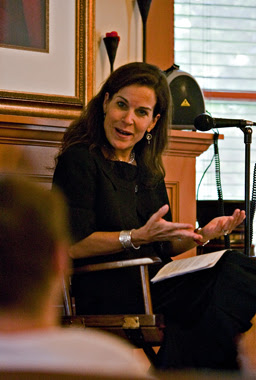
Nowhere was this more apparent than in the Great Writing Keynote Lecture, which this year was not so much a lecture but a series of short (five minutes) presentations on various issues surrounding creative writing from ten different speakers from around the world.  Graeme called it "10 X 5," and it might have been the highlight of the gathering, because not only was it fascinating to hear what concerns different people from different parts of the creative writing universe, but it stimulated a terrific amount of discussion immediately afterwards, which was exactly the point.  An English writer and teacher expressed concern that with his students increasing fascination with, and commitment to, electronic media they might lose their connection to the immediate, visceral world around them.  Thus he takes them to an old but still functioning train station in Staffordshire and makes them observe the living stories being written moment by moment in that building by those who pass through it.  A Scottish writer noted that with the growing independence movement in Scotland, a movement that has embraced Scottish writers among other aspects of Scottish culture, being a working creative writer in Scotland today is implicitly a political act.  Nicole Cooley decried that outrageous cost of many American MFA programs and also their lily-white color (too few teachers, students, and visiting writers of color, she rightly companied).  Her applause line: "No one should have to go $60,000 in debt to become a poet."  Another speaker from England, a woman who is a poet and archivist, argued that creative writers ought to take better advantage of the archives of their local institutions.  There is no end to the number of stories embedded in those documents, she said.

It's to be expected that any discussion about issues in creative writing practice and creative writing instruction leads to complaints about creative writing's place in the academy.  This was certainly true Saturday evening in the post-lecture discussion.  There is, after all, much to complain about.  And some of the complaints--not all but some--are amazingly consistent from continent to continent.  But finally Simon Holloway raised a good point.  He said that in all the years he had participated in Great Writing he had constantly heard creative writing instructors strike up defensive poses, as if they had to justify the very existence of their discipline.  (Unfortunately, they probably did--and in many places, my own university included, they still do.)  "But when," Simon asked, "are we going to go on the offensive?  When are we going to say to these administrators, 'Look at all the students we bring in; look at all the tuition funds we raise; look at all the prestige and good press we generate.  What are you going to do for us in return?'"  Simon suggested that maybe it's about time to turn the tables and offer a few "help us or else" ultimatums.  It was great to hear, great to consider, and probably long overdue.  It's a kind of fighting spirit I'll need to remember when long after this exquisite French rest stop is over and I'm back in the academic trenches in Arkansas.


Friday, March 8, 2013

AWP 2013, Day One

0

Well, as I feared, the winter weather is upon us.  It arrived late Wednesday and continues as I type this early Friday morning.  While the conference seems perfectly crowded, I have to suspect that many conference goers suffered delays or cancellations of their travel plans.  After all, it's not just Boston that got hit but the whole northeast portion of the United States.  UCA's own inaugural class of MFA students is here, and they are staying two hours away.  Yet so far they have been able to fight through the snow to reach the city and enjoy themselves.  "Enjoy" has included visiting Charles Bukowski's favorite old hang out--not that far from the Convention Center, it turns out--and getting brand new Boston-based tattoos.  They've also been extremely helpful with manning the Toad Suck Review book table in the Book Fair hall.  Thanks, guys.  I must say part of my suspicion about cancelled or delayed travel plans is that the Book Fair itself seems less jammed than usual.  Now, TSR is in the second floor Book Fair hall, whereas about 65% of the other tables are on the ground floor hall, and this might have something to do with the light traffic we were getting on Day One.  But even the ground floor Book Fair hall seemed hardly so no-elbow-room-busy as in years past.  We'll see today.  This state of affairs could change overnight.

Some highlights from Day One: I went to two sessions yesterday, both reasonably interesting.  The first session was one of those classic AWP overly-crowded-into-a-tiny-room affairs, with scores of listeners spilling out into the hallway.  Hey, AWP, somebody wasn't thinking right when they scheduled the room for that session.  The subject?  Fairy tales in adult fiction.  Maybe that seems esoteric, but plenty of writers were eager to hear about it. The panel included, among others, Jane Yolin, Kelly Link, and Kate Bernheimer, a rather star-studded group, to be sure.  I was especially happy to see Kelly Link, a writer whose work I've long admired but who I've never met in person.  In my opinion she was the rock star of the panel, although her manner is anything but.  In fact, she tended to defer to the other panelists, more than I think she should have.  It was a well run session, with lots of time left for audience questions, and there were some smart ones.  One interesting issue, for which no real answer was given, was what to do when you are employing a non-western fairy tale but writing for a western audience.  How can the audience pick up on the multiple levels of meaning and of story that you are embedding by consciously employing such a tale?  The short answer is that they can't, but I don't think that's the kind of fully thought out response that the asker was looking for.  An interesting bit of information that popped out: up until just last year, the National Book Foundation, which awards the prestigious National Book Award every year in various categories had forbidden books based on myths, legends, or fairy tales from being considered for its fiction prize.  What?  I know, a head scratcher.  Apparently, many National Book Award judges were unaware of this prohibition as they had indeed considered and honored various fairy tale/myth based books in the past.  But even so the rule is clearly in violation of the spirit of creative freedom (to say nothing of aesthetic wisdom); yet it was only removed last year and only because of a conscious petitioning effort spearheaded by Kate Bernheimer.

The second panel, cutely named "All the Young Dudes," featured three youngish male writers who had recently published short story collections with small presses.  It was sort of a combination reading/how to session, as in "How did you guys get your short story collections published?"  I must say that the questions that followed their reading were fairly amateurish and even stupid ("What do you do if your girlfriend gets mad at you for writing so much instead of spending time with her?").  And this from MFA grads, no less.  (The obvious answer to the above question, delivered by one of the panelists: "Get a new girlfriend.")  I shouldn't be surprised at my disappointment with the questions.  It's been my experience at AWP that any session that professes to deliver the "secrets" of how to publish tends to be attended by desperate sounding and desperate seeming people.  They tend to be among the more unseemly aspects of any otherwise interesting convention.  The readings were okay--just okay--with one reader and one story clearly shining: a dramatic monologue written by Jared Yates Sexton of Georgia Southern University and included in his new volume An End To All Things (Atticus Press).  It was a smart story and well-performed.   We chatted afterwards.  His department, an independent writing department, is trying to found a MFA program.   Since we just did so, I figured I might be able to offer some information and perspective.

Some more Day 1 highlights: 1) The journal Unstuck, which promotes "surreal, futuristic, and fantastic literature," was running an interesting writing conference-specific writing contest.  On the back of the instruction sheet for the contest one was supposed to write a short story--and only on the back; it could be no longer--and then return the sheet no later than the close of the day today (Friday).  In other words,  you couldn't send them anything you've already written.  You have to do it here.  What's more, the sheet included a list of characters, a list of settings, and a list of items.  One element from each list had to appear in the finished story.  I picked alien invasion, funeral urn, and saloon.  (Believe it or not, it's a serious story.)  I composed it while I sat at our not-terribly-busy TSR book fair table, with some guidance from the folks at the next table on what drinks to choose for my particular protagonist.  It was fun and fairly quick and I hope they like it.  To "win" the contest is simply to have your story selected for inclusion in a special issue of Unstuck.  2)  I visited with the kind folks at the journal Versal.  This is an American-staffed magazine that is housed in Amsterdam.  Created ten years ago by expatriates for the local expatriate community in Amsterdam, it's now an international journal that comes every year to AWP and even sometimes sponsors readings and panels at the conference.  They will be publishing a chapter from my Van Gogh novel in the next issue, and the invited all contributors  to stop by their table for a taste of good Dutch gin.   I'm not a big gin drinker, but I have to admit it was strong and smooth.  3) I ran into Louise Harper, the wife of Graeme Harper, an Australian writer who directs the Great Writing Conference in the UK.  It was good to catch up with her.  She and Graeme kindly hosted us for dinner back in 2006 when Great Writing was in Portsmouth, then Graeme's home university.  I remember fondly taking the hovercraft over to the Isle of Wight and enjoying a beautiful supper and great conversation in their home.  Our kids were with us on the trip, and Louise kindly kept them the next couple days while we attended the conference.  Fantastic to see her again.  As I always tell people, AWP is all about seeing your life as a creative writer flash before your eyes over the course of three days.  It's started happening already.

Monday, November 26, 2012

Boston and London

2


2013 promises to be an exciting year of conferencing for me.  It starts in March, as I head to Boston for the annual mammoth necessary insanity of the AWP Conference.   Boston, of course, is one of the great heritage cities of the United States and has the added benefit of being the hometown of my oldest sister.  I'll be wearing two hats at AWP this year.  I'll be there to represent Toad Suck Review, of which I am currently the associate editor, as we share our brand new issue #3 with the world.  (See my previous post for more commentary about this.)  But I will also be speaking on a panel that addresses the subject of novel writing workshops.  Such workshops are a relatively new, but exciting, development in the world of creative writing instruction.  For decades the short story form has dominated fiction workshop activities, and basically for one reason: a class can easily read in advance and discuss in one class period an entire short story (or two or three).  It's a manageable sized bite of work to prepare and process.  Now I adore the short story form--I really do--but it's a fact that most fiction-writers-in-training have their eyes on writing novels eventually (or immediately), and it's also true that novels are typically preferred over story collections in the eyes of publishers.  Most of all it's true that learning to write a successful short story does not really train one to write a successful novel.   They are very different animals.  So what, as creative writing teachers, do we do about this? Do we open up our regular workshop class to both novels and stories?  Or do we create separate classes just for novel writers?  And if the answer to that is yes, can we ask students to write a whole novel in a single semster's time?  Do we expect the whole class to read it?  How do we workshop it?  Does a teacher possibly have time to read 15 or 20 student novels over the course of a semester or at the end of the semester?  These are good, pressing questions, and different teachers--myself included--have come up with their own answers to them.  What we should not and cannot do is fail to encourage our students in their pursuit of longer forms.  That would be a disservice.  By happy fortune, I will again be teaching my Novel Writing course next semester--to a mixed group of graduate and undergraduate students--and therefore I will be able to bring my latest news, and my latest experiences, to the panel discussion.  I'm really looking foward to it.

The wanderings continue this summer when I head off to another of the world's leading cities for the Great Writing Conference, held June 29-30 at the University of London, Imperial College.   The brainchild of Australian Graeme Harper--who studied, wrote, taught, and administered in the UK for decades and does so now in the United
States--Great Writing is in its fifteenth year and going strong.  Without question it is the most important creative writing conference in the United Kingdom and arguably the second most important in the world.  Writers and teachers from virtually every part of the Anglophone world participate.  I submitted both a proposal for a critical presentation--on historical fiction (of course)--and a proposal for a creative presentation.  Graeme later informed me that the selection committee liked both proposals and accepted both, but I had to choose to present one or the other.  As a creative writer, it's my first instinct and my first pleasure to read from my own fiction, so that's what I've decided to do.  I will read from a collection of short stories--half historical and half contemporary in nature--that are all set on the island of Nantucket, Massachusetts.  Nantucket is a hisorically fascinating and physically beautiful place, a piece of the United States but at the same time--in rather fundamental matters of personality--not really.  I can't know how many in the audience will have ever been there, but it doesn't really matter.  My job is to bring the island to them.

What an honor to have the chance to speak at both Great Writing and its American predecessor in the same year.  In many ways, Great Writing is a superior experience to the manic, crazy-busy, bacchanalian, writers-on-steroids entity that is AWP.  At Great Writing, the papers seem a tad more thoughtful, the audiences a bit more attentive, and the discussions between sessions more relaxed and more probing.  (Because more time is afforded for them.)  It's a very nourishing conference, and I've missed it.   I last attended Great Writing in 2007, when it was held in Bangor, Wales; the year before that I attended my first Great Writing in Portsmouth.  Both Bangor and Portsmouth are quietly charming locations, cities I was quite glad to get to know.  But it is certainly hard to beat London as a site for a major international conference.  We won't quite stop traffic like the Olympics did, but I like to think that, for a few days at least, Great Writing will something real to the cultural life of the capital.