Showing posts with label Vincent Van Gogh. Show all posts

Monday, October 20, 2014

New Van Gogh collection!

0

When I was working on my Van Gogh novel, Days on Fire, the one source I found myself coming back to constantly was the mammoth, three volume, hardbound Complete Letters of Vincent Van Gogh, published originally by Bulfinch back in the 1950s.  It's an incredible resource: a better, fairer, clearer view into the mind and world of Van Gogh than any biography or novel (shhhh) or recollection "by those who knew him" (which are often marred by how little they really knew him).  Exacting descriptions of place he has visited; despair about his artwork and exultation about the same; resentment toward his brother and exhortations to him; disputes with his father; chatty discussions about (now long forgotten) artists or art dealers or paint supply store owners; opinions about the (countless) books he read; revelations about the women he loves and about love itself; depictions of the depressingly, growingly hopeless life at St. Paul's asylum in Saint Rémy--it's all there, along with so much more.  A whole adult life documented with a fantaticism of detail that is just about one of a kind, really.  As I say so often, I think surely it must be these letters--and Van Gogh's roadside eloquence--that accounts for our continued fascination with the man, just as much as his beautiful paintings and a life that was marked with so much tragedy, idealism, and stubbornness.   The one drawback to such a thorough recored, of course, is its necessary length.  The Complete Letters runs to something like 1800 pages.   Not a weekend read!  And while it's useful to watch the arc of the man's life play out over these hundreds of missives, long and short, profound and mundane, energized and bored and despairing, it's also true that not every letter is crucial to understanding Van Gogh, his time, and his milieau.  Or not crucial in the same way.  

So it's welcome news that in December a new selected edition of Van Gogh's letters will be published by Yale University Press, one with the beguiling title Ever Yours: The Essential Letters of Vincent Van Gogh.  You might have read Dan Piepenbring's early glimpse into the volume, published recently in Paris Review.  It certainly does sound like a promising new book: almost 800 pages in length, with 265 out of the extant 820 letters included, along with family photographs and 87 pages worth of reproductions from the actual handwritten letters.  At $50 it doesn't come cheap, but for a Van Gogh lover--or anyone simply curious about learning more about this fascinating person--it looks to me like money well spent. Of course, which letters you finally deem "essential" will depend on who you are and what you are trying to learn about the painter, but without yet having had the chance to review the collection I can take a pretty fair guess at some of the letters regarded as "musts": the letters written to Theo in the period of abject despair and loss of identity after being removed from his position as lay minister to miners in the Borinage region of Belgium; the letters to Theo explaining why the "no" delivered to Vincent by his cousin K was not really a "no," and why even in the turbulent state of his emotions it was better by far to feel such a powerful love than none at all; the letters to Theo glorifying the peaceful home life he enjoyed with his new life partner Sien and why, despite her being a former prostitute, Vincent regarded her as his wife and insisted the family do as well; letters describing his almost manic level of energy and the resulting "high yellow note" that marked his painting in that fitful, historic, crucial summer in Arles in 1888; the heartbreaking letter from St. Paul's in which he describes the painting he has just made in honor of the birth of his nephew (named after him) and his desire to bring it to the boy in person.  Interesting man, yes?  And let's face it, 800 pages--while hardly an inconsequential entry into Van Gogh's life and writing--is a much quicker read than 1800 pages.  This sounds like the perfect introduction to the other Van Gogh: the riveting literary artist.

                                                          *  *  *

Not to blow my own horn, but I am amazed and humbled by the fine reception my story collection Island Fog is receiving from book bloggers and other reviewers.  Here are two I found out about just yesterday: one comes from the book blog Books Are Love; the other from the Australian book blog The Bookshelft Garogyle.  (Great title, huh?)  Then there's the really positive one I got from Kirkus.You just write the stories and try to make them the best you can; then they go out there and you can't ever really (really) know if they are as good as you hope, not until such kind words come back to you.  I can't say how grateful I am.   And a little amazed.


Monday, January 21, 2013

Novel writing class returns

0


After a break of two-and-a-half years, Novel Writing Workshop returns to my university this semester.  In the interim period, dozens of students have asked me about the class and scores of oral histories have been told; a few students lobbied my department's Chair hard for its return; and, not insignificantly, our first collection of graduate students matriculated.  In some ways, it's a very different pedagogical landscape now than when I taught the course a couple years ago.  Then, novel writing workshops were still relatively rare and excitingly new, certainly on the undergraduate level, and the idea that the students would not just start but finish a novel in one semester struck me as potentially hazardous: to GPAs; to other course work; to jobs; to relationships; most of all, to sleep schedules. Yet that's what I asked the students to do.  And nearly all of them succeeded.  Now, novel writing workshops are a considerably less unusual phenomenon.  Indeed, sometimes I think they are everywhere.   Still more typical on the graduate as opposed to the undergraduate level--although one of our graduate students, who was an undergrad a year ago, informs that he took a novel writing course in college--they are, in any case, far more characteristic of creative writing degree programs than in the past.  It can't be coincidental that at the AWP conference in Boston this year, a panel will be held on not just on promoting the idea of the novel writing workshop but on the fact of it; that is, the nuts and bolts of how different experienced instructors of the course have taught it.  I think it's even fair to say that novel writing workshops are becoming the cornerstone of progressive fiction writing programs.  And in part this is because in the last three years those who teach the course have been talking to each other about it--Cathy Day's blog The Big Thing has been especially instructive--pushing each other, motivating each other, spreading the gospel.

So I'm glad it's back at my school, and I know the students are too.  But I admit to being a bit nervous.  In the intervening years since last I taught the course, a mythology has developed around it, a retrospective awe.  Students have told me that for years, ever since they selected our major, they have been eagerly anticipating the chance to experience this one course.  Can this semester possibly meet their high expectations?  Yes, it can.  But, here's the scary part: It's all up to them.  More than any other course I teach, in my novel writing class, the students teach themselves and teach each other.  I offer them a platform through which they can learn about novel writing, but they have to take advantage of it, and they have to encourage each other to take advantage of it.  While I do separate the class into small peer review groups, there will be no full class workshopping.  As I emphasized at our first meeting the other night, the course is about production more than anything else.   The last time I taught the course, again to all undergraduates, the room was fully with unusually mature and unusually talented people.  What the course offered was exactly what most of them were looking for: space, opportunity, deadlines.  Almost entirely seniors, they'd workshopped plenty in their college career.  What they wanted from Novel Writing was something else,  and they were eager to take control of it.  There were certainly bumps along the way that semester, but for the most part--with a notable exception or two--a genuine esprit de corps ruled.

I can only hope my current group has the same experience.  It's a fresh batch, with different backgrounds.  For the first time, graduate students are participating along with undergraduates.  That's a new dynamic for me, and for both of those student populations.  And there's another professor sitting in!  Not even from my own department!  Like last time, we will read Chris Baty's No Plot No Problem (for practical motivation) and a couple of short novels (as models for storytelling over a reasonably short space), and we will periodically break off into peer groups.  But mostly we will be writing.  I'll be writing along with them, which actually is going to be more of a challenge for me this time than last.  Mainly because right now I am in the latter stages of a novel I started early last semester.  I had intended on exploring this novel idea through the Novel Workshop, but when the class was delayed from fall until spring I didn't feel like waiting.  Now I will need to hurry to finish my draft, then immediately start another novel--the subject of which I haven't even clarified for myself yet.   Hard to know what the next few months will bring, but I'm sure it will be an adventure.  There will be exhileration and despair.  There will be careful planning and last second inspiration and a great deal of fatigue.  Some will give up; most, I hope and expect, will soldier on.  Some will get pissed at me and at their peer reviewers.  Some will get pissed at the novels we read.  But if they each individually can hold it together, when the finish line comes they will have learned more than from perhaps any other writing course.  And they will have learned it the best possible way: by doing it themselves.

Publication announcement: I'm happy to report that another chapter from my Van Gogh novel will soon appear in print.  The journal Versal, an international literary magazine based in Amsterdam, is publishing a chapter from the section of the book that details Van Gogh's Paris years.  The point of view character is Suzanne Valadon, a post-Impressionist painter who circulated widely among the Impressionists and Post-Impressionists and even modeled for a few of them.  During my research for the novel, I read an account she'd written of seeing Van Gogh at a Paris party.  I used some details from that account to construct the chapter.  The issue of Versal will appear in May, accompanied by a launch party in Amsterdam.  Really sorry to have to miss that one.  While I will be in London in June for the Great Writing Conference, there's simply no way for me to make it to Amsterdam in May.  Ah, well.

Monday, January 23, 2012

Up to 150

2


Well, at least the first hundred were fast. This post counts as no. 150 for Creating Van Gogh, a project started back in 2009 and still continuing despite some rather obvious fallow periods. I can't say that when I started Creating Van Gogh, with the specific intention to write about issues I was encountering as I worked through my Van Gogh novel Days on Fire, that I expected it would last into 2012. But I didn't expect it wouldn't either. I was simply ready to get going and see what happened. As I mention above, that first 100--fueled by a fall sabbatical and by constantly encountering new concerns about, and new challenges in, my manuscript--were written in only nine months or so. It's taken me a year and a half to add another fifty posts and reach the "sesquicentennial" mark. Clearly I slowed in my postings after the summer of 2010, but I've also broadened the scope of the blog. Hopefully to good effect. After all, if the purpose of this blog is only to write about the composition of one novel, then after the novel is done there's no point in still going on with it. But that's not the only purpose, and I think there's a good deal to be gained by going on. If nothing else, I've made new friends and colleagues through this blog, one being writer Cathy Day, who is not only writing historical fiction but attempting to remake how creative writing is taught in the academy, a subject of great concern to me too, as you can probably tell by my constant references to the university where I teach. Another such colleague is Erika Dreifus, internet wunderkind, who has not only produced a terrific collection of short historical fiction, Quiet Americans, but who maintains several great web resources for writers, including her blog, Practicing Writing. Creating Van Gogh has also allowed me to raise and explore questions related to historical fiction generally, not just my Van Gogh novel; to discuss various issues going on in the academy and the culture; to recommend books I've enjoyed; to report on conferences like AWP; to tell you about my latest fictional projects; to let off steam (for instance about the debacle of defunding the National Writing Project and other important literacy programs); and even to think through conumdrums like literary agents, as I did in my last post. I've tried not to stray too far the subject of historical fiction, and I've strenuously kept this blog from being about "what I ate for lunch," but I do recognize that to give Creating Van Gogh new life and to keep it going, I can and should comment on several different writing and fictional concerns. Because historical fiction is fiction, first and foremost, and it has a lot more in common with creative writing generally than with history writing. At least that's what I think, and that's what I'm going to keep saying, as long as Creating Van Gogh is around.

Here's hoping for a 150 more posts in the coming years. And let's hope too that they are a fruitful 150. Thanks to everyone who reads.

Saturday, July 23, 2011

I'm back! And with titular news

1


I know. It's been so so long since I added a new entry to this blog. Readers probably suspected that Creating Van Gogh had gone belly up. Not to worry. CVG is alive and well. But certainly much has happened out there since last I posted five months ago. Where to begin: NWP is still up in the air; Republicans are still angling to blow up the federal government figuring that Obama will be blamed for it; the last space shuttle flight is over and done (are you really sure you want to do that NASA?); March Madness happened and the College World Series, the French Open and Wimbledon; and the annual Tour de France--I hope to see it live someday--is almost finished. But what about me you ask? Well, not surprisingly, I've been busy as well. I finished a novel I started last fall; I traveled with my colleague Garry Craig Powell and five UCA students to Lawrence, KS to participate in a faculty and student readings exchange with the University of Kansas; I successfully completed a French 1320 class that I sat in on during the spring semester (much thanks to instructor Veronique Odekirk); I started and finished a great summer 1 Forms of Fiction class at UCA; I wrote a proposal for a Forms of Fiction textbook; I drove my oldest son to Durham, NC so he can participate once again in the wonderful Duke-TIP program; I've taken up some duties as the new Associate Editor of the journal Toad Suck Review (formerly The Exquisite Corpse); I've listened to Await Your Reply (Dan Chaon) and Miss New India (Bharati Mukherjee) and Selected Shorts (NPR) and Coffee Break French Season 3 (members version) on my iPod during my daily sweatfests, and I've spent the last week trying to endure the mind-numbing Arkansas summer heat with my youngest son--i.e., fighting with him to get off my computer and take the dog out to pee--while my wife is away at the Writers Colony at Dairy Hollow finishing up the novel she has worked on for so long. (Congrats, sweetie.)

Of more interest to readers of this blog, however, will be some quiet but important developments in the life of my Van Gogh novel Yellow. No earth-shattering announcements yet. But there has been progress. I've been working closely with a kind and wise literary agent who has pushed me to sharpen and improve the book in important ways. What in its first typed form was 1250 ungainly manuscript pages is now a tight, focused 550 and includes some relevant and hopefully useful appendices, namely a chronology of the life of the real Van Gogh (my Van Gogh sure feels real to me, of course) and a detailed explanation of what sources I used and how I used them. The most obvious change is that my book now has a new title. I have to admit that this decision was a hard one for me. Since I first conceived of the book some ten years ago, I've only ever had one title in mind: Yellow. Not only is that the color most typically associated with Van Gogh's paintings, especially the paintings he created during what I consider his finest, most luminous period--when he worked in Arles, France--and not only did color and colors become a crucial stylistic element and organizing principle to the novel, but "yellow" seemed to speak to an important psychological tendency in Van Gogh: his eager pursuit of extremes. And I must say that I also like the title's directness. Easy to say; easy to remember. Long story short, it was actually quite hard to think of any other title being attached to my novel. Literally for months I remained stymied--and stumped. What else could I call this thing? Finally, at the end of May, after much sturm und drang, I came up with something: Days on Fire. The agent I'm working with likes it, and I must say that I do too. I like it a lot, actually. It keeps some of the same associations as Yellow, but with more linguistic and imagistic energy. What do you think, dear readers? How does the new title work for you? Does anyone out there have title-changing stories of their own?

From this date forward I will now refer to my novel as Days on Fire. Yellow is now officially kaput. And I promise not to be so long in updating the blog next time. I am going away on vacation at the end of next week, but I have a few entries in mind to put up before then or even while I travel!

Monday, January 24, 2011

A bit of Yellow in NDR

5

Those who read this blog regularly know that a piece of my Van Gogh novel Yellow was accepted a couple months ago by the The New Delta Review, a print magazine that is launching itself anew as an online enterprise. Well, the day has arrived. NDR, in its new online identity, is up and running. Issue One! And in that issue you can find "The Evangelist," the title I've given to my novel excerpt. I hope you all like it. Hard to say whether it's representative of the book as a whole since the point-of-view character appears only in this one chapter. But the chapter certainly is representative of how some people saw Van Gogh, especially in his earlier years, before he decided to become a painter. Follow this link to the excerpt. And enjoy!

Thursday, December 23, 2010

Publishing success for Yellow

2


It's only a step, but a very gratifying one: A chapter from Yellow was just accepted for publication by The New Delta Review, a fine journal published out of LSU. The excerpt will appear in the spring, just as the magazine is switching to an online format. That's good news for anyone in the blogosphere who would like to get a little taste of my Van Gogh novel. I will certainly post about it when the issue is up and running. The chapter will run under the title "The Evangelist."

I'm quite happy at the news of this acceptance. Publishing novel chapters is always a tricky business. Some journals simply won't take them; others, understandably, only want to see novel chapters that work as stand alone stories. Culling one's novel for chapters that function that way is intriguing and delicate work, often requiring significant cutting and recombining. Fortunately, in Yellow, a somewhat episodic novel, I found several such chapters. ("The Evangelist" is the first to be accepted for publication.) Interestingly, more than a couple of these were chapters that featured a different point-of-view character than Vincent. I'm guessing the reason that these stood out is that they are literally stand alone in the novel itself, the only chapters which feature those particular point-of-view characters.

The chapter accepted by The New Delta Review, like all the novel's chapters, is told from the 3rd person limited point of view with the point of view character being one P. C. Gorlitz, a man who rooms with Van Gogh in Dordrecht. Gorlitz is an actual historical figure, one of those minor names who come up when you start to research Van Gogh's biography and read his letters. Very little is known about him now, except that he was a young schoolmaster when he shared a room in a boardinghouse with Vincent. In 1914 an article about Van Gogh, written by one M.J. Brusse, appeared in a Rotterdam newspaper. The article quotes from a letter Brusse received from Gorlitz in which Gorlitz recalls his months rooming with Van Gogh. I used a few of the details from Gorlitz's recollection to build my chapter, but the personality of the man himself and the core facts of his life, such as his attitude toward the teaching life, were utterly imagined. This, of course, is one of the great joys of historical fiction: taking an actual person and giving him a new life through the exercise of one's creative faculties. After writing the chapter I felt, of course, that the real Gorlitz must have been exactly like my Gorlitz. Well, maybe he was and maybe he wasn't; but in any case, my Gorlitz feels as real to me as anyone--living, dead, or imaginary. Is there a difference?

Saturday, November 13, 2010

The Specter of Stone

3


It wasn't as if I'd never heard of the man . . .

As difficult as it is for some people to believe, I conceived of, researched, and began writing my Van Gogh novel Yellow before I knew of Irving Stone's earlier Van Gogh novel Lust for Life. Sure, I knew Stone's name. I'd heard of The Agony and The Ecstasy, his fictional take on Michelangelo, if only because of the celebrated 1965 film starring Charlton Heston, a staple of local "4:00 Movie" programs during the pre-cable 70s of my childhood. But I think it was my wife who casually asked one day, "You do know he wrote a novel about Van Gogh too, don't you?" Uhh . . . Truly, my blood ran a little cold. But with some quick internet leg work I found the dates on Lust for Life the novel (1934) and the movie (1956). I breathed a little easier. After all, the book was published more than seventy years in the past. Should a book from that long ago permanently mark as "Off Limits" a famous man's life? It's one thing if the book was 10 or 20 years old, but 70? If anything, I figured it was time for an updated examination of the painter. Isn't that what writers and scholars are supposed to do? After all, in my research for the novel it became clear that the number of Van Gogh biographies ran into the dozens. Dozens of biographies, but only one novel allowed? Surely not. And, besides, how many other people--and here I mean readers, not just the public in general--were probably as ignorant of Stone's book as I was?

So I happily solidered on, spending years drafting, revising, editing, and shaping Yellow. The result is an admittedly long novel--though I cut out a great deal--but long for a good reason: I'm showing Van Gogh over virtually his whole life span, from his childhood in rural Brabant to his release from St. Paul's mental hospital in Saint-Remy, France, three months before he died. I realized, of course, that some agents and editors might balk at a novel close to 800 pages long. What I didn't expect, but what I've heard recently, is concern over the legacy of Stone. Lust for Life, I hear from some quarters, is simply too embedded in our culture--it's still in print and still selling well--squeezing out the possibility that any other novel can try to tell the story of Vincent's whole life. If one writes about Van Gogh these days, it must be from a drastically restricted vantage point. It's disheartening to hear such opinions, not only because it means the speaker won't be representing my novel, but also because I suspect the speaker is misguided. After all, another way to think about the same set of facts is this: The continued success of Lust for Life, more than seventy years after its first publication, shows just how deeply ingrained is western society's fascination with Van Gogh, how we revel in his many evident quirks and gape awestruck at his determination, how we see him as the truest archetype for the iconoclastic, starving artist--a "real" artist if you will. And how willing we are to lay down money for him. If we're that interested in Van Gogh, doesn't this suggest other Van Gogh books could succeed as well as Lust for Life? Or simply succeed? After all, our media--books, television, movies--is, if anything, famous for its willingness to recycle ideas and characters. How many Da Vinci Code knockoffs appeared in the wake of Dan Brown's book?How many new vampire series have appeared in the last five years? Yet there's only room for one Van Gogh novel?

Ironically, Yellow isn't a knockoff of anything. I still haven't read Stone's book, though I'm certainly more aware of it these days. While I was writing, I avoided it on purpose. I had a pretty clear idea of what I wanted to achieve in Yellow, and I didn't want to feel like I had to pull back or change course because of something Stone did; whether that meant trying to avoid being like Stone or trying to actually mimic something about Lust for Life that I admired. I wanted and needed to stay true to my own vision of Van Gogh and of my novel. That seemed easiest to do without Irving Stone's 70+ year old Van Gogh vision running through my head. And it seemed the only way to make a Van Gogh biographical that could stand on its own and draw new generations of readers. Even now, as I'm more or less done with the book, I still don't seek out Lust for Life. In part it's lethargy, in part it's because I have so much else, for a variety of reasons, that I simply have to read. But of course, having not read Lust for Life, I am arguably not the best person to say whether Yellow charts new territory or not. So what do you all think? Does it sound like I have case, or does it seem true to you that Lust for Life has permanently coopted Vincent Van Gogh from fiction?

I began this project after being so purely blown away by the Van Gogh paintings I saw in Amsterdam's Van Gogh Museum. My feelings were so stirred they simply demanded a fictional response. I didn't know what else to do with them. I simply couldn't turn this subject down. I still believe I made the right decision in pursuing it. But Irving Stone is trying his best to shake that belief.

Tuesday, September 7, 2010

Van Gogh the lefty--verified!

13


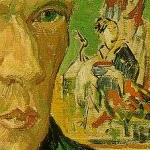
I posted several weeks ago about my reasons for portraying Van Gogh as a lefthander in my novel. My choice was based solely on Van Gogh's personality profile, backed up by my amateur's knowledge of the theories of handedness. (And, admittedly, some personal projection, as I myself am lefthanded.) What a pleasant surprise then to receive an email from Svend Hendriksen, a Danish gentleman currently living in Greenland, who has looked into the question of Van Gogh's handedness with considerable attention. Svend tells me I'm right: Van Gogh was undoubtedly a lefthander! And the evidence can be found in the paintings themselves. Svend calls my attention most particularly to an 1888 self-portrait by Van Gogh. (That's it over there). Notice that Van Gogh holds his palette in his right hand, indicating that he paints with his left. Now many would (and do) look at the portrait and say that since Van Gogh must have employed a mirror while painting the picture, what we see is a mirror (that is, reversed) image of the man. Thus, they conclude, he painted with his right hand. And Svend reports that the Van Gogh Museum in Amsterdam does describe Van Gogh as being righthanded. However, Svend points out that the button on Van Gogh's coat is on the same side as the palette he holds, and on men's coats of the period this button would have always been situated on the right side. In other words, this evidence suggests that Van Gogh in real life, not just in the portrait, held the palette with his right hand. It's perfectly possible that for the sake of his painting he corrected the reversed image to show the world how he really worked: with his left. From what I know of Van Gogh generally, it is not hard to imagine him being stubborn on this point.


Svend has passed along a number of other interesting tidbits about Van Gogh, for instance that photographs of the man's paint box reveal that he kept it quite full. As Svend says, it's "a huge volume for a poor man's palette." Well, certainly paint was dear, an expense that Van Gogh avoided for years by concentrating solely on his drawing. But when he began painting he sacrificed almost everything else--food included--to keep himself supplied. And looking at his effusive, glorious pictures, especially from the Paris and Arles periods, it certainly looks as if he operated with a full box. Svend's comments make intuitive sense.


Svend, by the way, was not trained as an art historian but as an explosives engineer. He served for years in the Danish army. Yet he now brings his mechnical know-how to the study of paintings. His story reminds me of a phenomenon that I find profound: There is something about Van Gogh--his story, his paintings, his personality--that draws people to him like a magnet. Not only professional art historians but informed amateur sleuths and everyday idlers alike. For instance, the man who owns the house at which I stay when I visit Arles, a science teacher and devoted amateur astronomer, has done considerable work studying Van Gogh's use of constellations in his night paintings. He has even advised academics from America on the matter. Amazing how this Dutch painter, who struggled so and was so little known in his lifetime, has attacted and keeps attracting such a broad, enthusiastic audience. Perhaps this simply proves that Van Gogh knew exactly what he was doing all along: painting not for his time but the future. Indeed.

Thursday, September 2, 2010

Van Gogh in the Middle

1


As we all know, schools are starting these days--at least here in the U.S.--and that means too the beginning of football season. In fact, tonight I will be taking my youngest son and his friend to Estes stadium at UCA to see the Bears' season opener. With football so much in the air and on the news and in people's hearts--at least here in the U.S.--I think, strangely enough, of Van Gogh. And I think of the position of middle linebacker, the man at the exact center of the defense: midway between the sidelines, midway between the defensive line and the defensive backfield; the man with the most leeway of anyone on defense to circuit freely and make whatever plays need to be made. That could mean rushing up to help the line stop a running play, or dropping back to help cover a receiver, or blitzing to try to sack (tackle) the other team's quarterback. A successful middle linebacker sees and understands the field as a whole, and the developing play as a whole, and he uses his roaming freedom to enhance the whole defense.


It may be a stretch of a metaphor, but I feel safe in calling Van Gogh the middle linebacker of the Neoimpressionists working in Paris in the 1880s. That is, he moved freely between factions, between cliques, between individuals, and between styles, with only one end in mind--and it was a good one: learning and absorbing as much as he could. Having just spent several years working alone in the Dutch provinces, and then a few disappointing months in Antwerp, he was not just willing but eager to listen, to watch, to discuss, to experiment, and to change. And he refused to let interpersonal squabbles--replete with their petty resentments, paranoid suspicions, and blatant attempts at empire building--distract him from his purpose. He set up walls against no one, was willing and able to see value in the working practices and painterly results of many different kinds of artists. Whereas almost every other leading neoimpressionist eventually chose a particular camp to belong to, and thus allies to swear by, Van Gogh stubbornly resisted making such choices. He felt that he could and did learn from all of them. Certainly in his paintings from his Paris years we see him trying on and trying out many different artistic gestures. He did not carry all of these gestures with him to Arles--by his own admission, he "abandoned" much of what he learned in Paris (something of an overstatement, actually)--yet it was by carrying on these experiments at all that he grew as a painter; it's why his Paris period counts as the one in which he learned and grew the most. It was in Paris that Van Gogh became a modern painter. And he grew the most because he circulated the most. Whereas Van Gogh's associate Emile Bernard became a disciple of Gauguin and thus turned his back on the Divisionist group of Seurat and Signac and Pissarro, and whereas Seurat despised and scorned Gauguin and thus avoided company with all members of the so-called "Symbolistes," Van Gogh had friends in both camps. He literally worshipped Gauguin and for a long time was terribly close to Bernard, yet he ate and drank with Signac, and he admired Seurat's breakthroughs deeply. He did not fully buy into the optic theories behind Divisionism, but he did see the divisionist method as an excellent way to vary the texture of a painting. A quick scan of his Paris paintings reveals the number of works in which he played with and tried to learn from this method.


Finally, sadly, Van Gogh's attempt to stay above the fray wore him out and depressed him. His resentment over the exaggerated factionalism and trivial backbiting among painters in Paris drove him out of the city. At the very least, it played a significant part in his decision to leave. Probably playing into that decision too was the realization that he had learned as much from these people as he could, and the fear--which he wrote about in his letters--that if he stayed in Paris much longer his health would be ruined and himself turned into an alcoholic. (Much drinking among the painters in Paris of the day, not shockingly.) Shortly after moving to Arles he wrote Theo about how much better felt in his body and how much more at home. (Van Gogh was always fundamentally a rural person.) Ironically, however, only eight months later he suffered his first epileptic attack--if that's what it was--an infamous breakdown greater and more devastating than he ever could have imagined in Paris. At that point, the linebacker had taken more than enough shots, and it was all he could do to get up and off the field with dignity.

Wednesday, August 18, 2010

Dog days

0


I grew up in Southern Maryland, not even a half hour from Washington DC. The entire area is famously muggy and not at all cool in the summertime. DC was built on swamp land and for generations, at least until the dawn of air conditioniung, residents were forced to flee the city during summer, when it turned insufferable. In 1993, I moved to south Louisiana, possibly the only place in the country more muggy--and considerably hotter to boot--than the DC metro area. With temperatures never dipping below 90 and with nearly unimaginable humidity, stepping outside your front door in the summer literally felt like entering a sauna. Yet, I was never really all that bothered by weather; I even went running everyday: 5+ miles. I read the newspaper on the front stoop each morning, armed with a big hot mug of joe. All that is to say that I'm a warm climate person, better able to ignore it, withstand it, work in it, move in it, thrive in it, than most. And yet this summer in Arkansas, I must say, has been wicked. It's been at, near, or above 100 for what feels like two months now. According to the weather people, we're well on our way to setting an all-time record for average daily temperature. (Still don't believe in global warming, people?) And by all-time, I mean all-time. Higher than has ever been recorded since they started keeping records in the 19th century. We've been absolutely baking here. Maybe it's a matter of being 13 years older or maybe it's the difference between 95 degrees and 105 (when the high merely reached 97 the other day, it felt like a relief), but I don't remember the summers in Louisiana being as blindly searing as this one in Arkansas has been. Down there, we stewed in June, July, and August; up here we've been frying.

All this makes me think again of Provence, our three summertime visits, and of course Vincent Van Gogh. The region is renowned for its soaring summer season temperatures; its bright and searing sun. I remember reading in one of Peter Mayle's books (I can't remember which) a good-humored account of Englishmen and other visiting Europeans wilting, red-faced and sweating, in the provencal summer. Van Gogh was not exactly immune to the heat. He certainly felt it, but he also felt that he thrived in it. In letters he recounted heading out each morning, planting his easel in a field, and working all day in the blazing climate, "contented as a cicada in a tree." (The cicada, by the way, is the unofficial symbol of the region.) It's no coincidence that the famous "high yellow" of his Arles paintings most accurately characterizes the paintings he painted during the summer of 1888, his only in Arles, and in my opinion when he worked at the height of his powers, reaching an artistic peak that he never found again.

Well, for all of Provence's celebrated heat, and whatever the part, however minor, that it played in bringing on Van Gogh's physio-psychological meltdown in late 1888, I can tell you from experience that Provence has nothing on Arkansas. Yes, the provencal sky is a gorgeous, bold, clear, blue. Yes, the sun is bright. And yes, it's warm. But the climate of Arles in July/August, I assure you, would be a vacation from the July/August of 2010 Arkansas, or for that matter just about every summer we've experienced since moving up here in 1997. (One of the many reasons I'd love to be there right now.) Our dog this morning even uprooted a cicada nesting deep within the grass of our front lawn. He wouldn't leave the poor thing alone, so up it flew, pulling its thick, round body with its buzzing wings, finally reaching a safe place in a nearby tree. There it settled very happily inside the hot hot heat.

Wednesday, July 21, 2010

Van Gogh the Lefty?

0


For several decades now, the fact that the different hemispheres of the brain control different functions and influence different abilities has been popularized in western media. Especially commented upon is the fact that human "handedness" is influenced by which brain hemisphere is dominant in an individual, and with an inverse relationship, i.e., left-handed people are right brain dominant and right-handed people are left-brain dominant. The left brain, we are told, controls functions such as language--both spoken and written--computational ability, and reasoning. The 4 Rs, if you will. (Schools, it is often noted, are designed to teach and promote left brain activities.) The right side of the brain controls one's intuitions and emotions, one's musical ability, one's visual and spatial abilities, and one's creative and inventive potential. Ever since these ideas were popularized, there has been book after book celebrating the unique qualities of the presumably right brain dominant left-handers among us. And since I'm one of them, I've been given several such books over the years: from my parents, from my friends, and from my wife. The latest, called A Left-Handed History of the World, might be the most ambitious in its argument. After a short introductory chapter in which it lays out general tendencies of left-handed people, Left-Handed History goes on to profile 25 different and very prominent individuals, all left-handed, implicitly and explicitly arguing that it's left handers who have repeatedly made and remade the world. (Some of those profiled: Ramses the Great, Alexander, Julius Caesar, Leonardo da Vinci, Michelangelo, Beethoven, Napolean, Isaac Newton, Queen Victoria, Ghandi, Marie Curie, and Paul McCartney.) Given that only 7-10 percent of the population is left-handed, the profound influence of left-handers on history, the book asserts, is all the more startling. (Btw, if one counts Ronald Reagan, who naturally wrote with his left-hand but was made to switch to his right at any early age--typical of that time--4 of the last 5 presidents have been lefties.)

Brain scientists will tell you that it's not merely a matter of Lefty=This and Righty=That. We all use both brain hemispheres. It's a matter of when and how much. We can get into those sticky issues on another post or another blog. On this blog, and for this post, I want to talk about Van Gogh. Early in my composing of Yellow, I decided to show him as a left-hander. Partly the choice was intuitive, partly projection, and partly because I had in some remote corner of my brain a faux-memory of seeing him listed among history's famous left-handers. Don't get me wrong. It's not like this is a major theme in the novel or anything that I'm pushing in every scene. But I do point out in a few scenes that Van Gogh is drawing or painting or writing with his left-hand. In one scene I even reference the "left-handed scratch" that is his handwriting. The latter reference is admittedly a matter of me identifying with my protagonist--or vice-versa--because unless I am terribly careful my handwriting instantly descends into "left-handed scratch." (This is especially true, and especially problematic, during the white-hot rush of a first draft, which I still insist on doing by pen in a notebook.)

But my choice of making Van Gogh a left-hander wasn't and isn't simply a matter of trying to insert myself into my novel. It also made real sense to me, based on what I knew about him, and about the theories of handedness. It also wasn't a choice that I deliberated about ahead of time. The idea just occurred to me one day as I was composing a scene and so I went with it. It seemed to work. And if it allowed me to better identify and empathize with my protagonist, to see him from the inside, that's all to the good. Besides, whether Van Gogh was or wasn't left-handed, he certainly showed--and shows in my novel--a number of the characteristic traits. Visual acuity, first of all, demonstrated not only in his numerous paintings and drawings but his copious letters, filled with exacting descriptions of pictures and landscapes. His stubborness and his well-chronicled tendency to emotional spasms, whether that meant anger or romantic infatuation, also fits. Also related is the fact that Van Gogh never put his best foot forward verbally as he did through other means. By most accounts, he was a clumsy and naturally awkward speaker. He had a great deal of fire as a human being and as an artist--he made and kept (and lost) some close friends, along with his brilliant paintings--but smooth and orderly did not by any means characterize his speaking style. Left-Handed History goes out of its way to point out that left-handers are fundamentally distrustful of the world's organization and its institutions--perhaps because it was not designed by them or for them--and they can react in two different ways: They become agitators, openly working to overthrow the status quo, or they retreat deep inside themselves, intellectually and philosophically removing themselves from what they regard as a deeply flawed structure. It's safe to say that Van Gogh did both. Perhaps more than any other neo-impressionist, he was determined to evolve modern art, not just sell paintings. He worked doggedly to that end. But he also was a strikingly interior person, tending to withdraw for long stretches from the society around him, in order to go his own way, to follow his own drummer. I'll repeat: He made friends, even close friends, everywhere he lived. Like everyone, he needed human contact, human conversation. But funadmentally the man was a loner.

Last but not least is what Left-Handed History calls Lateral Thinking, the "ability to make unorthodox connections." Apparently, this explains why some left-handers become ingenious and original military strategists (e.g. Alexander), and why others became brilliant, quirky political maneuverers (e.g., Bill Clinton). A talent for strategy-making certainly defined Van Gogh's life. This, more than anything, struck me as I read about him and wrote about him. He almost always had a plan, sometimes quickly evolving and radically changing plans, for how to accomplish his desired ends. This was true when he wanted to become a lay preacher, and it was certainly true when he decided to become an artist. He knew where he wanted to go and was always confident that he knew exactly how to get there. Demonstrating the daring to act on a strategy was never a problem for him. Convincing others that he was right, however, always was.

Friday, June 25, 2010

Missing the mistral

1


Before I'd traveled to Provence I'd heard of course of the mistral, the wickedly strong wind that comes up suddenly and then blows and blows and blows for days on end. I was a little skeptical. How was this possible? And this happens routinely, like getting a heavy rain shower in Arkansas in May? In fact, yes. It's such an ordinary part of life in Provence that no one thinks to say much about it. Van Gogh's only reference to the mistral is when he noted in one of his letters that he was so determined to finish a painting that once he drove the legs of his easel into the ground, strapped the canvas in place, and kept on painting in spite of the wind. I recreate this scene in my novel. I couldn't not do so, after having traveled to the same territory and experienced the same wind. But after living through a mistral or three, it's awfully hard to imagine Van Gogh could have completed that painting, at least to his satisfaction. (He doesn't in my novel.) The mistral blows so hard that once, riding on a bike, I had to get off and push the thing, because simple pedalling became too hard and too slow. I was almost literally going nowhere. On my trip last May I set off on a morning run in the face of a (unusually brief, as it turned out) mistral and could barely move forward against the force of the wind. (It lessened a bit when I turned onto a side road.) My wife has recounted stories of visiting the Arles craft market during a mistral and see all sorts of boxes and items cartwheeling away from vendors' tables.

Having done our French tours always in late spring or summer, we haven't faced the numbing bitterness of a winter mistral. I can only imagine how dispiriting it must be for residents to wait those out. Summer mistrals are a mixed blessing. One hand it knocks the top off the southern heat. (Although compared to summers in Arkansas or Louisiana, I've always found the supposedly scorching temperatures of the south of France way overstated.) It's also fascinating to watch the landscape of this rural, agricultural region sway in the wind for days. And for my wife there is no more special pleasure to be had in France than to lie in the comfort and security of our bed and listen to the mistral howl outside.

On our first trip to Provence, in 2005, we stayed for two weeks and faced one mistral in the middle of the trip. It lasted three or four days at full strength and then quickly leaked away. We woke up one morning, and it was over. On our second trip--a quick stopover not quite one week long near the end of my wife's research trip to England in 2006--the mistral met us the second we stepped off the plane in Nimes. In London, we had been watching the weather reports from Provence and realized a mistral had begun. Given that it was drizzly and terribly cool in London, this at the end of May, a mistral seemed a small price to pay for some Provencal sunshine. Once we'd arrived, however, I began to become impatient for the mistral to pass. We would only be there for a week, after all. It lingered, however, for at least four days, holding back the summery heat that I was actually looking forward to. But when it cleared we had a blessedly warm couple days before returning to England. On my last trip, a year ago, there was only the single, brief mistral (i.e., it lasted a couple days) though I spent five full weeks, and my family two, in the country. That's either a lucky or unlucky development, depending on how you look at it. Most would count it as lucky, I think. But I know that by the time we left, my wife was missing the mistral.

Thursday, March 25, 2010

Another country heard from

0

Just two days ago, my dear hard working wife chimed in with a series of thoughtful comments about my novel. It took her a while, partly due to the length of the manuscript and partly due to the fact that she was reading it on a flash drive, which saves printing costs but also makes ingesting a long novel far more laborious. But, regardless, she gave me some very interesting suggestions. Whereas my first reader seemed to think the novel's first half dramatically held together better than the second half, my wife felt strongly the opposite. (Maybe that's good! Maybe they both hold together!)


I've mentioned it on this blog that Yellow is still a rather hefty manuscript, even though I sliced out a third of its original length some months back. My wife's main suggestion is to look for further cuts in the novel's first half, especially those chapters that feature other points of view from Vincent or his family. Her reason is pretty straight forward: some of the "owners" of these other points of view are not particularly charitable toward Vincent, and she's afraid the chapters might bias the reader against him. Besides, she says, it's his story not theirs. She definitely has a point. So far I've left some of these chapters in as a way to show the attitudes that Vincent had to overcome. The chapters, in my mind, actually reflect more negatively on these other characters than on Vincent himself. Perhaps that is not adequately coming across. And, of course, there is too the fact that Vincent's decision to become a painter, the metamorphosis of his self-awareness, if you will, was certainly a gradual process. Part of what he had to overcome was his own misdirected energies, his passionate desire to follow in his father's ministerial footsteps even though the profession could never have suited him. When you're not in the right "place," the place where you're naturally supposed to be, people pick up on it.


That said, my wife gave me--along with much eloquent and enthusiastic praise (thanks, sweetie)--a lot to think about and process as I go forward into the next stage of revision. And that's exactly what I hoped for and needed when I sought readers for the novel. Now it's up to me to make some hard decisions that I hope will help the book find the form it's finally supposed to take. Letters and emails to agents will just have to wait until this darn book is truly done. But I've known that all along, haven't I?

Wednesday, March 17, 2010

When we look at our research

0


I posted Monday about a thought that came to me during a recent visit by novelist Elise Blackwell to UCA. (That's her on the right.) Blackwell said something else worth noting, so I'll raise the point today. Blackwell suggested that a writer should first do all her research for a novel but then put the research away when she starts to write. I understood her point immediately and have even made it myself in this blog: Writing a historical novel is all about telling a story, not showing off how much you know. Or having to feel burdened by how much you know. Understanding this point is crucial to understanding how good fiction works. But, even so, I felt moved to ask: You didn't research anything after you started writing Hunger? Weren't there new questions that came to mind as you wrote? Blackwell admitted that, yes, of course, certain questions of fact did come up and when that happened she would briefly revisit her original research or simply Google for an answer. But she stuck to her first point that a writer needs to put the research away. I then threw out something I'd heard years ago from writer Tracy Chevalier when she "visited" UCA (via a live feed from a studio in London). Chevalier suggested that a writer should write her story first--to make sure she really remains centered on the story--and then do whatever research seems necessary for the sake of that story.


Blackwell found that a tough one to swallow, and I admit that I do too. After all, aren't our stories often discovered or significantly shaped by the research? There's no way of getting around that they are. I simply can't imagine having started my Van Gogh novel without doing substantial reading into Van Gogh's biography, which directly affected what scenes I decided needing showing. And as for putting away the research you've already completed, I found myself only in half-sympathy. Yes, there is quite a lot of reading and notetaking that I carried out before I started composing Yellow that I never actually looked at while I wrote. Perhaps even the majority of my reading and notetaking. On the other hand, as I wrote I found myself having to research certain areas more substantially than mere fact checking (although I did plenty of that too). Most of all, I found myself delving deeper and deeper into Van Gogh's Collected Letters. These became my bible, my most important resource: for opinions on all sorts of matters but most importantly contemporary painters, for descriptive details about places and people, and for a sense of his emotional and intellectual life at different periods. Before I started composing Yellow, I read three different collections of selected letters, but while I was writing I had the nagging feeling that I might be missing something. So I ordered, at some expense, the hardbound three volume Collected Letters and plowed into it as I kept writing. I tried to read ahead. That is, I tried to be done with the letters from a certain period in his life before I wrote--or rewrote--the relevant scenes in Yellow. Carrying out this reading drastically improved and broadened my novel. Did it fundamentally alter the plot? No, actually, it probably didn't. But it made every scene more convincing, more vivid, more real. At least to me. If I'd just sat content with the already considerable research I'd carried out by the time I started writing, my book would be much lesser for it. Maybe this means I just didn't do enough in the first place. And maybe Elise Blackwell--an admirably thorough person and writer--did.


Thursday, March 4, 2010

More losses than one

0


Olive Hilliard, a dear friend and UCA colleague died last week from the complications of a stroke. This was an utter shock to anyone who taught in Thompson Hall, where the Department of Speech and the Department of Writing are housed. Without exaggeration, Olive was the most beloved person who does or has ever worked in that building. Everything about her shined: her intelligence, her warmth, her sense of style, her concern for students, her love for her children. Her family, of course, is most affected, most devastated by this loss. But there are other losses as well. My wife tells me that Olive was working on a novel when she died. This hurt my heart to hear, because if the novel had turned out like everything else Olive did, it would have been a superb and stylish piece of work. Radiantly beautiful. Now we'll never know. Thinking about this makes me realize again how a writing career is not merely a matter of educating yourself, training yourself, and working godawful hard to meet artistic challenges. It also means keeping on. It also means endurance. I shudder to think of how many great books we have lost over the years to premature death, whether those come from car accidents, substance abuse, unrealized or untreated heart conditions, or--in those most regretful cases--suicide. (It was not that long ago, remember, that we lost David Foster Wallace.) And why stop at books? Think of great music lost. Think of great paintings. The man who is subject of my novel died at 37, and before he had to. So I hope everyone out there dreams hard. But take care of yourself too. Please take of yourself. We'll miss you, Olive. And that novel in you.

Wednesday, March 3, 2010

Another bit out there

0

I tried out part of the novel yesterday on a captive and public audience. My department hosts an annual writers festival featuring writers from around campus and around the state. With purposeful cuteness, we call the festival ArkaText. Anyway, at the faculty reading today I read in public from Yellow for the second time. (The first time, you may recall from a previous blog, was last October at the annual meeting of the Arkansas Philological Association.) It was the first time many at UCA had ever heard the book. We were under a strict time limit (10 minutes) and trying to find just the right part that will go over well in public is always tricky. I practiced reading (parts of) four different scenes: One in which, as boys, Vincent and Theo explore a graveyard and see a bird's first flight; the second, a scene in which Vincent's roommate in Dordrecht comes back from a night out to find Vincent fanatically scribbling bible verses; the third, a scene where, after moving to Den Haag, Vincent is visited in the hospital (he's caught the clap) by his father; and fourth, a completely invented scenario in which Vincent, so desperately poor in Den Haag, decides to look for a job and finds himself dealing art again. (One of my few blatant and conscious violations of historical fact in the novel.)

I decided to read this last scene, because of the four it contained the most dialogue--always a crowd pleaser. Even so, I kept questioning whether or not I made the right choice. Reading a crowd while you read aloud is dicey if also perfectly possible. But thankfully I sensed them warming to the scene, especially toward the end, when I "heard" a more concentrated listening, more weight to their attention. Afterwards, I received some very heartening comments. My friend and colleague Terry Wright--a remarkable poet and digital artist--opined that I had a winner with this novel. Let's hope so. Let's hope so. At the end of the scene, Vincent returns home disgusted with himself for dealing art again (even though he succeeds), argues with Sien, and then heads upstairs to the attic of their rented room, where he sees Sien's two children asleep, children that Vincent had emotionally adopted as his own. I realized after I read that I hadn't explained to my audience who these children were. They appeared out of nowhere. Let's hope the audience got it. They certainly did seem to be listening.

Monday, March 1, 2010

Making a great "film"

0

About a year ago, while driving to work, I heard an NPR interview with Arch Campbell, longtime movie critic for a television station in Washington, DC. Having grown up in that area, and lived there as late as 1993, I remembered Campbell and his entertaining, just-another-guy-in-the-seats approach. So I listened with interest. At one point, the interviewer asked, "What do you think makes a movie great?" Campbell's answer to this almost uselessly gigantic question was surprisingly specific. He said that thinking over what he regarded as the best movies of the last century, one quality they seemed to share was that they were set in the same era in which they were made. They confronted, questioned, revealed, and detailed the moviemakers' own time. The answer gave me pause. I'd never heard anyone say this before. So you can't make a great historical movie? And because I was deep into my Van Gogh novel project, I immediately extended Campbell's statement to books as well. Now, making a movie certainly is not the same thing as writing a book--and Campbell was answering a question specifically about movies--but there has been enough give and take between the two media over the decades that my extrapolation seemed a natural reaction. So you can't make a great historical novel? Or, stated more precisely, a historical novel can't rank among the greatest?

Boxing back, I started mentally listing all the classic historical novels I could think of. What about The Scarlet Letter, that fixture in high school and college literature surveys and arguably the first great novel our country produced? I thought of modern authors and the historical novels they've written. Bernard Malamud's The Fixer. E.L. Doctorow's Ragtime. Madison Smartt Bell's Haitian triology. Susan Vreeland's Girl in Hyacinth Blue. These books are ranked among the best their authors ever produced. And if I heard Campbell today I could throw in Wolf Hall by Hilary Mantel, which only won the Man-Booker Prize last year. I don't know if Campbell expanded on or explained his thesis further. Probably not, because I don't remember anything else from the interview. But, after my initial defensiveness, he certainly got me thinking. Was there something about taking on a historical subject that was inherently self-defeating? I know--and I've blogged about--all the nit-picking tribulations involved in trying to bring an earlier era alive. But it's not just a matter of finding out how people tied their ties or what bread they ate; it's also a matter of having an intuitive feel for the human climate and social psychology of a given period. When one writes about one's own time, one brings such knowledge and such intuition immediately to the writing desk. It doesn't need to be won through research. Does that make the writing process more clear, somehow, and more affecting? Does the chasm of history create a kind of invisible wall too high even for the best of us to overcome?

Finally, I think the answer has to be no. And not just because if the answer is yes, taking on a project such as I have with Yellow means essentially I'm shooting myself in the foot. The answer is no because I don't think there's any artistic challenge that's not worth taking up, and there's none that can't eventually be met. Whether my book succeeds or not, I've had a blast writing it. It's a challenge I can never regret, because I've learned so much from it and have had to push myself so hard in the doing. It's a far more ambitious book than I've ever previously composed--but finally ambition, for an artist, is a good thing. And if doesn't succeed, I'd rather not think it's simply a matter of that darn, inherently problematic, historical fiction. If it doesn't succeed, I'd rather it be on me. I'm eager for all comments/reactions on this question. Is writing a great historical novel that much more difficult than writing any kind of great novel? Are we establishing extra barriers, or are we pushing ourselves to do even better? Should we extrapolate on the opinions of a DC movie critic, or do we switch the channel and just keep on driving to work?

Friday, February 26, 2010

MoMA disappointment

0


I've visited New York a million times. During the 80s my sister lived in Chelsea, and I used to regularly take the train up from Washington to visit. My wife's family, moreover, originates from Queens, and many have resettled no further than Long Island, necessitating several more New York visits over the past seventeen years of our marriage. Yet it was not until just a couple years ago, when AWP held its conference in New York, that I finally made it to the Museum of Modern Art--what everyone calls MoMA. This is curious, because one of the first things I usually do when visiting a city is to check out the art museums. Curious too because over time I've lost patience with much--but certainly not all--of the pre-20th century art that I once admired and studied. Leanness and intellectual complexity are the qualities that I seek in art now, rather than flabby, over obvious, forms. MoMA should have been a natural pilgrimage for me. But what forced me to finally take the visit was not a devotion to 20th century art but my Van Gogh novel. You see, Van Gogh's iconic painting Starry Night (1889) hangs in the MoMA. I don't feature the painting in my novel. I don't dramatize, nor even mention, its composition. (Ironically, there's scant mention of it either in Van Gogh's letters.) If the point of my book is simply a tour of Vincent Van Gogh's Greatest Hits, then it's not a novel and I have no interest in writing it. I have to highlight paintings that fit the scenes I'm composing. This means that many many well known Van Gogh paintings get ignored in my book. Tough. (I actually had a lot more fun with the lesser known works.) That said, I couldn't not see Starry Night, could I? Not when I had a chance? Arguably the most famous Van Gogh painting of all, and the crown jewel of the whole museum? No, I couldn't. So in February 2008 I made the quick hike to the MoMA from the hotel where I was staying for the conference. I'd do it. I'd finally see Starry Night.

I almost wish I hadn't. Starry Night is without question a great, even radical, painting. That's apparent as you stand there jostling elbows with the fifty other people hoping to catch a glance at it. But it simply didn't blow me away. And let me assure you that my experience of seeing Van Gogh paintings in the flesh--not those dopey, insufferable reproductions that get stuck on everything from t-shirts to baby bowls--is that I Get Blown Away. The light and heat radiating from the Sunflowers series, for example, is so palpable you can measure it in degrees and lumens. Same for many of his Arles portraits, such as L'Arlésienne (1888), and landscapes such as The Sower with the Setting Sun (1888) a picture that so astonished me when I saw it in Amsterdam in 2001 that I was still thinking about it eight years later when I wrote the last scene of my novel (in which it features prominently). But it's not only the bright pictures I've been impressed with. The Van Gogh Museum in Amsterdam also displays many works from his Dutch Period. The smoky, oaky, oppressive weight of these pictures--most notably The Potato Eaters (1885)--is just as impressive and just as moving, if in a completely different way, from his simmering Arles summer works. The point is, they all impress.

Starry Night didn't impress me. It looked dingy and faded, as if its sparkle had sunk underwater and been cauterized by seaweed. It didn't have much to show or to tell me. It seemed a painting that we were staring at because we all thought we were supposed to stare at it, not because it was entrancing. Others may disagree--I'm sure others will disagree--but that's what I saw. Van Gogh was known to rely on inexpensive, inferior quality paints because of his poverty, paints that degraded more quickly than most. As brilliant as his paintings
shine--I've heard experts pronounce--they probably shined even brighter in his own time, a thought that is both uplifting and almost impossible to entertain. Perhaps Starry Night is a victim of such degradation. I don't know. I am neither painter nor art historian. That day in the MoMA I was merely an appreciator. I stood in front of the painting for long minutes, letting it touch me as it would. But finally I had to walk away in search of other works, not much touched at all.

Wednesday, February 24, 2010

Gary in first

0

I blogged a couple of weeks ago about the need for me to sit tight and wait for response to my manuscript from the readers I've given it to. Well, I'm happy to report that last week one of my readers chimed in with both gratifying encouragement and thoughtful reservations. I've been living with my Van Gogh project for so long now it's hard to keep my perspective on what works, what doesn't, what's vital, what's not. I can tell you, blog readers, that when I finally finished entering my handwritten drafts into the computer, the novel was upwards of 1250 pages. The version I sent my three readers was 830 pages: long, but 30% shorter than what I had before!The first reader to chime in was Gary McCullough, a professional speech therapist and UCA professor who also happens to be a very active creative writer. Gary has written several novels, is starting to publish his short stories, has impeccable taste in his reading, and feels as much passion for his craft as any writer I've ever met.

Gary told me something that was crucial for me to hear: He could, without difficulty, see Yellow not only being published but "big." (That's the kind of determination you can never make about your own book, so I appreciate Gary's confidence.) On the other hand, he had questions about the conflicts that occupy the last third of the book, when my Van Gogh character--as Van Gogh did in real life--has essentially broken from his family, except for his brother Theo, and commits himself to living the life of a painter in a foreign country. Previous to this point, and especially while his father is alive, Van Gogh struggles mightily against his own family (who regard him as a failure), and against his own uncertainty as to his vocation. Once he moves from Holland, conflicts with his family retreat to the background. (His father, at this point, has passed away.) What I try to show in my novel is that Van Gogh's main conflict from that point on was with his ability to realize the paintings he saw in his mind's eye.

This is not to say that the Van Gogh had no interpersonal conflicts in the last 5 years of his life. Hardly. In fact, his extremely complicated relationship with Paul Gauguin--a third resentful of him, a third suspicious, and at least a half worshipful--became the most dominant and problematic relationship in his life; previously that designation had belonged to his relationship with his father. In my novel, you can't miss Gauguin's presence in the latter chapters. Even so, it is Van Gogh's conflict with paint that dominates the last third of my book, and it's my challenge and my duty, Gary seems to be saying, to make that as vital and engaging a conflict as the earlier one with his family. I agree. Thanks for the input, Gary.

Friday, February 19, 2010

The Name Game

0


I posted a few entries back about the swirling craziness of one's writing process when one is bringing so many different research sources to bear on the act of fictionalization. I have to move regularly and fluidly between computer screen, fold out map, dictionary, book of biography, big fat coffee table art book, volumes of Van Gogh's letters, Van Gogh CD-ROM, etc. Well, of course, the handiest, and most frequently used research source of all is the internet. Some days I feel like I am doing nothing but trolling the web as I write. But such expeditions can be fun, which I discovered as I came to name the several dozen characters in my book. Because I'm writing about Van Gogh, my novel is set in four countries: Holland, England, Belgium, and France. Characters from every one of those nations appear in the book, most of which are characters invented by me, not figures out of history.

I've relied heavily on "Most Popular Names" web sites (e.g., "Popular Boys Name in Holland," "Flemish Last Names," etc.) And I've had a ball with them. Maybe it has something to do with that godliness of the power to name things, the favor the Almighty bestowed on Adam after all, or maybe it's because I'm a writer who cannot stick with a character for more than a few sentences without needing to naming him or her. A big blank space in your notebook, or a ________, or a ***, accompanied by a scrawled "Remember to stick name here," just doesn't cut it. That is an unworkable situation. I need to know what to call somebody. And it goes without saying that names matter, even if you don't name in the overly prescribed, too obvious style of Dickens. As I look (and look and look and look) at these sites I have to be careful to choose names that feel right for the age. After all, most of the sites do not distinguish between past and present--they simply give names. So I have to work from intuition and from my background reading to make sure the choices fit. At one point last fall I had to simply stop writing and start a log on my computer as to what names I'd already selected. Over the course of four years--or even four months--you can easily forget you already named somebody Gaston or Jaap or Hendrick. I certainly did! So I had to make sure to keep these things straight. Because while in the real world plenty of people in a given community might share the same first or last name, it becomes confusing for a reader if in the community of your novel there are two Pieters or two Emiles or two Bills. There's enough going on in my book already, I don't need to confuse matters with my naming. On a last note, I should point out that Belgium is an especially fascinating case, with the southern part of the country being occupied mostly by Walloons--French speakers--and the northern being predominantly Flemish--Dutch speakers--and the capital Brussels being at the center of a bilingual territory. (There is also a population of German speakers.) I have to know exactly which of these groups are likely to be around for a given scene and go from there. Did I say "fascinating"? I mean it's a kick.