Showing posts with label Van Gogh as lefthander. Show all posts

Tuesday, September 14, 2010

The debate continues . . .

0


I hardly knew that when I mentioned my decision to portray Van Gogh as a lefthander in my novel Yellow that the subject might cause such commotion in the blogosphere. My new internet friend Svend Hendriksen--I mentioned him in my last post--continues to send me various proofs of Vincent's lefthandedness. A couple of them certainly bear repeating in this space. First, Svend recommends that I look at Van Gogh's famous Vincent's Bedroom in Arles, a picture the painter cared so much for that he made multiple copies. Svend, with his engineer's eye for detail, points out a few telling features of this painting: 1) the water pitcher on the rear table sits with its handle pointed to the left, a position only favorable to a lefthander; and 2) Vincent chose to put his pillows at the far end at the bed, a position more advantageous to a lefthander. According to Svend, a righthander would naturally put the pillows at the lower end, as getting in and out of that end would be easier for a righthanded person. Svend has sent his analysis to the Van Gogh Museum in Amsterdam and presently awaits a response. Svend also references Van Gogh's pictures of potato and peet diggers. About 90% of these drawings portray the diggers as digging in a lefthanded fashion, an unusual abundance given that most of humanity is righthanded.
Meanwhile, a lengthy and informative comment from "Stuart," coming in response to my last post, points out that Gauguin's famous picture of Vincent working in front of an easel shows Vincent holding the brush in his right hand. Now, one must be careful to take at face value anything that Gauguin said, wrote, or painted. Notice his apparently invented account, published in his memoir Avant et Apres, of Vincent publicly charging him with a razor blade. Notice too his taking credit for advising and influencing Vincent during the creation of the Sunflower series, when that series was completed before Gauguin even arrived in Arles! That said, we can't simply discount the fact that in Gaugin's painting he portrays Vincent as a righty. From this and other evidence, Stuart wonders if Van Gogh was ambidextrous, sometimes using his right hand and other times his left. (See Stuart's comment to get his full explanation.) A new and fascinating possibility! If anyone has an addtional insight to add to this unexpectedly hot topic, please let me know. You can comment on this post or email me at johnv@uca.edu.

Tuesday, September 7, 2010

Van Gogh the lefty--verified!

13


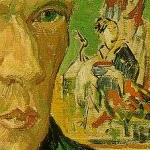
I posted several weeks ago about my reasons for portraying Van Gogh as a lefthander in my novel. My choice was based solely on Van Gogh's personality profile, backed up by my amateur's knowledge of the theories of handedness. (And, admittedly, some personal projection, as I myself am lefthanded.) What a pleasant surprise then to receive an email from Svend Hendriksen, a Danish gentleman currently living in Greenland, who has looked into the question of Van Gogh's handedness with considerable attention. Svend tells me I'm right: Van Gogh was undoubtedly a lefthander! And the evidence can be found in the paintings themselves. Svend calls my attention most particularly to an 1888 self-portrait by Van Gogh. (That's it over there). Notice that Van Gogh holds his palette in his right hand, indicating that he paints with his left. Now many would (and do) look at the portrait and say that since Van Gogh must have employed a mirror while painting the picture, what we see is a mirror (that is, reversed) image of the man. Thus, they conclude, he painted with his right hand. And Svend reports that the Van Gogh Museum in Amsterdam does describe Van Gogh as being righthanded. However, Svend points out that the button on Van Gogh's coat is on the same side as the palette he holds, and on men's coats of the period this button would have always been situated on the right side. In other words, this evidence suggests that Van Gogh in real life, not just in the portrait, held the palette with his right hand. It's perfectly possible that for the sake of his painting he corrected the reversed image to show the world how he really worked: with his left. From what I know of Van Gogh generally, it is not hard to imagine him being stubborn on this point.


Svend has passed along a number of other interesting tidbits about Van Gogh, for instance that photographs of the man's paint box reveal that he kept it quite full. As Svend says, it's "a huge volume for a poor man's palette." Well, certainly paint was dear, an expense that Van Gogh avoided for years by concentrating solely on his drawing. But when he began painting he sacrificed almost everything else--food included--to keep himself supplied. And looking at his effusive, glorious pictures, especially from the Paris and Arles periods, it certainly looks as if he operated with a full box. Svend's comments make intuitive sense.


Svend, by the way, was not trained as an art historian but as an explosives engineer. He served for years in the Danish army. Yet he now brings his mechnical know-how to the study of paintings. His story reminds me of a phenomenon that I find profound: There is something about Van Gogh--his story, his paintings, his personality--that draws people to him like a magnet. Not only professional art historians but informed amateur sleuths and everyday idlers alike. For instance, the man who owns the house at which I stay when I visit Arles, a science teacher and devoted amateur astronomer, has done considerable work studying Van Gogh's use of constellations in his night paintings. He has even advised academics from America on the matter. Amazing how this Dutch painter, who struggled so and was so little known in his lifetime, has attacted and keeps attracting such a broad, enthusiastic audience. Perhaps this simply proves that Van Gogh knew exactly what he was doing all along: painting not for his time but the future. Indeed.