




 0
 I was recently included in an email chain letter to writers who also have blogs. The idea for the chain, launched by Cathy Day and her blog The Next Big Thing, is to answer ten questions about a project you are currently working on, or one you have already completed, while at the same time linking to other writers' blogs where they answer these same questions. In this post you'll find my answers to the questions. Unfortunately, most of the writers I sent the letter on to were either already involved or declined to participate. But I encourage you to follow the link below to my wife's blog Wordamour (this is her personal one, not the one she maintains for the Huffington Post) where you can find her answers to the questions. She has recently finished a World War Two novel called The Lost Son. It features brothers who are separated early in life and wind up fighitng on different sides during the war. It was inspired by a real life story in her own family--although her novel leaves behind family history to go its own way in some important aspects. Read all about the novel and the story that inspired it by clicking here.
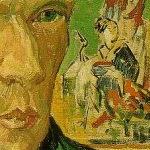
As I mentioned a few posts ago, I am once again teaching Novel Writing Workshop at UCA. This means I'm making my students compose a short novel over the course of one semester. And for the sake of esprit de corps--this class follows the idea of the "writeshop," a term Cathy Day coined--I am taking up my own challenge; that is, I'm composing a short novel right along with them. I'll give a full update next week on how the class is going. I mention it now only to say that the novel I'm writing for the class is so much in the process of formation that I can't possibly apply the ten questions to that book. Not yet. So instead I'll apply the questions to my Van Gogh novel, which I anticipate will soon finally see the light of day. (Pieces of it have already been published or are forthcoming.)
Okay, on to the questions.
Ten Interview Questions for the Next Big Thing:
What is your working title of your book (or story)? After an agent strongly pressed me to come up with a more compelling title for the project, I changed the name from Yellow to Days on Fire. The color yellow is still suggested by the latter title but in a more active fashion. The agent seemed to like the new title, and I've decided to keep it.
Where did the idea come from for the book? I was teaching in Holland one summer and during a short trip to Amsterdam I visited the Van Gogh Museum (along with other prominent museums). Prior to that visit, I might have seen one or two Van Gogh paintings in the flesh at the National Gallery in Art in Washington, near where I grew up, but I wasn't prepared for the sheer stunning light that came off the paintings I saw in the Van Gogh museum. Now I knew what all the hubbub was about. My fascination with the paintings made me more curious about the man, and that set me thinking.
What genre does your book fall under? That one is easy: historical fiction. Although, as I've mentioned on this blog, I don't play absolute, strict adherence to what some would view as the "rules" of historical fiction.
Which actors would you choose to play your characters in a movie rendition? As sexy and fun as it is, this is one question I'm going to have to decline to answer. (Sorry.) After all, if the book were ever to be made into a movie I would be the last person allowed to choose actors for it--there are people called casting directors--and, besides, I just don't know if I follow the movies and television as intensely as I need to to effectively give an answer here. I suppose what I really would like is a surprise choice, someone no one would expect to do the role, and then have that person do a smash up job. Actors surprise you all the time, after all. Think of the truly powerful performance by Bradley Cooper in Silvers Linings Playbook, for instance. (For what it's worth, while Jennifer Lawerence has been garnering awards for her performance in that film, I think Cooper's was far more impressive, demonstrated a wider and more supple emotional range, the whole of which he carried off convincingly.)
What is the one-sentence synopsis of your book? Van Gogh fails and fails and fails, costing his health, his happiness, his family, and a portion of his sanity, but in the end he succeeds where it matters to him the most.
Will your book be self-published or represented by an agency? At this writing, while I'm still waiting to hear from a publisher in France that was recommended to me from someone over there, I anticipate self-publishing the novel.
How long did it take you to write the first draft of your manuscript? The whole process of writing, revising, cutting, shaping, adding, reshaping, and editing the book took so long, was spread out across so many years, that I'm not sure I can accurately answer this question. But certainly it took me at least a year to finish a handwritten first draft. (Believe it or not, that's how I like to compose first drafts, although this semester, for the novel I'm composing in class, I'm drafting straight to the computer.) Probably it was more like a year and a half.
What other books would you compare this story to within your genre? Painters have not infrequently been the subjects of novels; both novels generally and historical novels in particular. There's just something about the exquisite physical torture of trying to turn messy colored fluid into a seemingly concrete reality. A well known painter novel is The Agony and The Ecstasy by Irving Stone, his "biographical novel" about Michelangelo. (I think I like that term, because it certainly applies to my book.) More recently, there was John Updike's Seek My Face and Harriet Scott Chessman's Lydia Cassatt Reading the Morning Paper. The latter novel depicts the sad tension in the Cassatt household due to Lydia's illness. It can be compared to mine in the sense that it is set in a similar time period and country (France) and tries to make real the world of those post-Impressionist painters who are only glittery names to most of us now. But maybe most like mine in its humanizing of a famous but not quite understood figure (i.e. Vermeer) is Tracy Chevalier's Girl with a Pearl Earring. My novel is broader in scope than either Chessman's or Chevalier's but I think, like Girl, brings a new and sympathetic sensibilty to a subject who has been codified by history and popular opinion.
Who or what inspired you to write this book? As I stated in my answer to question 2, it all started with that visit to the Van Gogh Museum in Amsterdam.
What else about your book might pique the reader's interest? Well, Van Gogh wasn't nearly the nut case he is commonly understood to have been, but he did have the courage or stubborness or lack of temperance, if you will, to pursue his passions with almost blind servitude. This is to say there were extreme elements to his personality. I show those elements in the novel, along with his softer side; I think the combination makes for a compelling read. It should also interest readers to see Van Gogh interact with well known artists like Signac, Bernard, and Gauguin. The latter plays quite a large and important role in the last third of the novel.


