





 2
2
Last weekend, my wife and I were discussing the 2010 novel The Postmistress, a book she consulted in order to see how other writers handle fictional material set in World War Two. She feels there are many positive aspects to The Postmistress, but one important facet of the novel seems troubling. The book's hero, in an integral twist of the plot, travels to Europe with a portable recording device. (This is early in the war, before direct U.S. involvement.) There she records accounts of ordinary people taking part in a widespread exodus from Nazi-controlled territories. The problem? The recording technology the character uses was not invented until several years after the end of the war. Okay, you might say, that's an anachronism--apparently a pretty big one--but they happen sometimes, don't they, in historical fiction? If a writer is too sure of her own conception of reality, one shaped by the era she lives in, and if she isn't sufficiently thorough in her research, mistakes happen. Yes, they do. And inevitably readers catch those mistakes and advertise them, and sometimes they disable a book's essential credibility--or the author's. But from whom did my wife find out that the portable recording technology was not invented until well after the end of the war? The author herself! In the author's own afterword! Yes, Sarah Blake, author of The Postmistress, wrote an afterword in which, while describing the extensive research she undertook for the sake of the book, she also admits that the recording technology depicted in her World War Two novel did not exist during World War Two. One can only conclude that Ms. Blake is more upset by the possibility that readers would think she's ignorant than by the possibility that they think she's being deceitful.
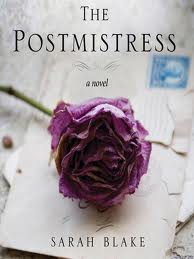
Wait a minute. Sorry about that. One should never talk about aesthetic decisions in moralistic terms. This is an author's choice, not a crime. But we should admit that there's a kind of historical fiction code that Ms. Blake broke along the way to completing The Postmistress. Let me step back for a second and admit--as I have in several occasions before--that my historical fictions are not always 100% accurate to biographical fact. The most glaring example of this is inventing a whole (and extremely short-lived) second attempt at an art dealing career that the historical Vincent Van Gogh never tried. In that case I was guilty of knowingly departing from the historical record, something that certain authors of historical fiction claim one can never do under any circumstances. But it seems to me there's a crucial difference between depicting something that didn't happen but could have and depicting something that could never have happened. One of my professors in graduate school, a fine writer named Wendell Mayo, spent regular time in, and frequently wrote about, Lithuania. His stories were sometimes criticized as being unlikely, unbelievable, too extraordinary. Wendell didn't immediately dismiss the claims. If someone who knew Lithuania well (like, say, a Lithuanian) objected to a plot element on grounds of credibility, he tried out to find out more from the person. "You mean this could never happen?" he might ask. Sometimes the answer was yes. And that, for Wendell, was a legitimate concern. Most of the time, however the answer was something closer to: "No; it's not impossible; it's just not likely. I can't see it." Or: "Well, I've never heard of it happening!" That was good enough for Wendell. As long as a situation was theoretically possible, it was fair game for fiction; which is, after all, fiction.

Applying Wendell's rule of thumb, you can see the problem with The Postmistress. Ms. Blake hasn't developed an improbable plot but an impossible one. Unless, that is, she's writing not for and about our commonly shared and understood reality but the reality of the multiverse, in which, due to its infinite number of universes and infinite number of chronologies, every possibiity, even the impossible ones, are somewhere realized. But that certainly isn't how writers of historical fiction typically define what they do--or ever define what they do. And it's certainly no claim made anywhere else in The Postmistress, which, last I heard, was not being talked about as science fiction.


