Showing posts with label historical accuracy in fiction. Show all posts

Monday, January 9, 2012

Fast and loose?

2


My latest creative project, which for last several weeks has seen me involved in drastic, medically necessary line editing, is a series of stories half in historical in nature and half not. I've mentioned this in a couple blogs since last summer. What binds the stories is the
setting--Nantucket Island, Massachusetts--but I've found some similar themes evolving across the stories, whether they are contemporary or historical. I guess this isn't surprising since all the stories arise out of the same imagination.

The earliest story, chronologically, takes place in 1795. (Interestingly, this was the last story to be drafted.) The catalyst for the story was reading about an actual, and rather significant, event from that year: the robbing of the new Nantucket Bank by a group of off-islanders during the Nantucket's June sheep-shearing festival. No robbery is good for those victimized, but this crime proved particularly divisive, as accusations began flying wildly (cunningly?), especially from the mouth of the bank's president, one Joseph Chase. Islanders very quickly took sides in laying blame. On one side were the Quakers, who tended to be Jeffersonian Democrats; on the other side were the Congregationalists, who tended to be Federalists. Each side thought they had an explanation for the crime and were sticking to their guns, despite evidence to the contrary. This is especially true in the case of the Quakers. (Chase was part of their ranks.) At one point, William Coffin, a Congregationalist and Federalist--and someone suspected of being involved with the robbery--had to carry out his own investigation on the mainland, because the mostly Quaker, Democratic bank directors refused to look into, or didn't want to believe, clues and rumors that pointed to culprits from there. After months of searching off-island, Chase actually brought back to Nantucket two men from New York who admitted to the crime. But the bank directors, too busy trying to pin the crime on Coffin and his Federalist allies, never took the suspects seriously, and the two men were later permitted to escape. It proved a disastrously acrimonious episde for the island, and in the years following Nantucketers tended to look back on the pre-1795 years as a period of prelapsarian grace.

The Nantucket Bank robbery is a fascinating story--with even more complications that I've suggested above--so I couldn't resist approaching the event fictionally. It's probably worthy of a novel, but for now I've merely written a long short story. While I've stayed true to several facts about the case, I've also changed many facts, left others out, and am ignorant of still more. My characters, while based on real participants, are given new names and identities, and revised personal backgrounds. Also, in trying to shape the robbery into a coherent story, I've conflated the timeline and eliminated certain events and people that were significant to the historical account. Whether it works as a story is my main concern, not whether it works as history. Right now I can't tell because I'm still very close to it. My main worry for now, actually, is that because it's based on a real case I encountered in a history book (Nathaniel Philbrick's wonderful Away Off-Shore), I'm trying for too much historical perspective. But I have a feeling that historians, and perhaps Philbrick himself, would say that I'm playing way too fast and far too loose with the facts.

However, I wonder aloud--and am wondering in this post--if by giving my characters invented names and (mostly) invented identities, I have opened up exactly that "fast and loose" space for myself. I guess that's why I did it. (I say "I guess" because it was an intuitive choice. I didn't labor over it; I just did it.) Unlike my Van Gogh novel, I am not using real names. (Altough I am using a real event and a real island.) In my novel, I can fairly be charged, if in just a few spots, of creating an "alternative history." In completely abandoning real names and identities does the fiction become more or less alternative? Can a writer be criticized for not sticking to the "known facts" about a character if that character is fictional? What if the fictional character is in some vital ways drawn from a real person? Does this create a meaningful distinction or a distinction without a difference? Oh, the entangled mental waters one wades into when one starts blending history and fiction. But, then again, that's the fun of it, right?

Wednesday, May 19, 2010

Playing with Paris

0


For many, Arles and Saint-Rémy France are the towns associated with Van Gogh. It is there where you find "Van Gogh walks," with signs posted showing you exactly where he painted which picture, and abundant Van Gogh paraphernalia (maps, t-shirts, cards, posters, ties, etc.). But really, there would have been no triumphs in Arles and Saint-Rémy without the two years he spent in Paris, meeting and learning from so many Impressionist and Neoimpressionist painters. The odd thing about the Paris years for a biographer or novelist is that our best source for information about Van Gogh--his own letters--shrank to a mere fraction of their customary number during the Paris years. (Because he lived with his brother Theo and did not need to write to him.) As a result, many questions arise that have no firm answer. One questionable area is his relationship with Agostina Segatori, an Italian woman who owned the Café du Tambourin, where Van Gogh and his friends frequently went to drink and take meals. It is assumed in many circles--and sometimes repeated as fact--that Van Gogh had an ongoing relationship with Segatori. But because there are so few evident letters from the Paris period, his comments about her aren't conclusive. Some letters suggest a relationship closer than friends; others letters do not. He reports to Theo in one letter (when Theo was away in Holland) that Segatori has either had an abortion or a miscarriage--either way she looks ill; in another letter he reports, rather angrily, that even though her business has dissolved she refuses to give him back some paintings of his that he allowed her to use as decoration for the cafe. There is nothing in the letter to indicate a relationship. So I wasn't sure, as I wrote my Paris chapters, what to do with the woman.

In the end, I played with her a bit. First, since I didn't want to or feel I could just completely ignore the common idea that she and Vincent were lovers, I suggested in a few scenes that they were friendly, people who knew and enjoyed each other's presence, and that one night, after Segatori had drunk a few, they had a fling in her apartment above the cafe. What's also useful to know about Segatori is that she let Vincent use the cafe as the venue for an exhibition of Japonaiserie that he admired so and had collected for several years. She also allowed him to show work made by he and his friends, the painters of the "Petite Boulevard," as he liked to call them, in contrast to the original Impressionists, who were associated with Paris's "Grand Boulevards" a bit further south. I've played with dates and facts a bit to have the "Petite Boulevard" exhibition occur shortly before Segatori decides to sell the place. This creates an interesting tension of guilt and blame in which Vincent thinks Segatori is blaming the failure of the Petite Boulevard exhibit for the failure of her business, although logically that cannot be true. In rendering this scene I also make it clear that the night Segatori and Vincent shared happened just two months earlier. The reader can tell from my descriptions that Segatori is quietly pregnant, but Vincent does not--not yet--realize it. The timing of these various events opens the possibility that the pregnancy suggested by Vincent in his real life letter was the result of his own loins! Let me make it clear that no biographer of Van Gogh, even the ones who regard Segatori as his Paris lover, make this claim or apparently feel they can. In my book it's only a tantalizing suggestion. And the way I paint her, Segatori would not want Van Gogh to know the baby is his, even if it was. She's not cold-hearted, just very very independent. And besides, Vincent, this man she rather babies when he visits her café, is not in her mind someone cut out for fatherhood.

I don't know what a Van Gogh biographer would have to say about how I handle the Segatori relationship, but the fact is that it is a sufficiently mysterious one to allow a novelist freeplay. I think I'm actually being conservative! As it turned out, Van Gogh had no children in real life--at least none he knew of--and though he does not say so explicitly in the letters, this, I think, was one of his most cutting disappointments.

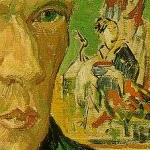
(Picture note: The above painting from 1887 is titled "The Italian Woman." Most commentators feel sure that the model is Segatori.)

Sunday, April 18, 2010

Parting ways with Hansen

2


It's been a week since I returned from the AWP conference in Denver, but my head is still buzzing with questions stemming from the very last session I attended, one on historical fiction (the only one on historical fiction), featuring Ron Hansen, Cynthia Mahamdi, and Philip Gerard. It was a good session, one of the best I attended this year, just unfortunately placed in the very last time slot of a three day conference. Ron Hansen is a terrific novelist, someone who never writes a bad book. He's also someone who has a considerable track record in writing crisp, illuminating, perfectly delivered, historical novels. His book Hitler's Niece is one of the finest novels I've ever read in any genre. (I think I might have said that on this blog before.) In the session, Hansen elucidated twelve "rules" for writers of literary historical fiction, and I was gratified to realize that in composing my Van Gogh novel Yellow, I've followed almost every one of them. In fact, most of his rules seemed like good, plain common sense for any conscionable writer aspiring to write something that has value. I like to count myself in that camp. However, I instinctively parted ways with Hansen at one of his rules. Hansen said that the fiction writer should not knowingly part from fact. This is a disservice to the reader, he suggested, who is trusting the writer to render a realistic, even if imagined, picture of the subject. The reader is trusting the writer to get the details right even as the writer is developing his or her story. It is a disservice to both the reader and the subject, Hansen suggested, to put a character in Rio in 1932, for instance, when according to the historical record the character never went near Rio until 1940.

I understand Hansen's point, and I also understand that almost all of the fictive work of historical fiction is not in developing the basic story but in imagining what real historical events looked like, sounded like, smelled like, and felt like for the real participants. To bring alive in scene what is a mere sentence in the historical record. This will mean making arbitrary decisions sometimes as to what someone is wearing, or what diction they use, or how tightly wound they seem, decisions that are virtually identical to the myriad decisions we make when writing a purely imagined, non-historical work of fiction. It's also true that some subjects are so barely sketched in the historical record that a writer has immense leeway in imagining what really did or didn't happen; the writer can wander off in all sorts of interesting directions without "knowingly departing from the facts." (William Styron noted, in his preface to The Confessions of Nat Turner, that it was exactly because so little was known about Nat Turner that he enjoyed taking him up as a subject.) All of this is to say that I understand how a writer can follow Hansen's maxim to the letter and still be free to write a richly felt, deeply imagined work.

But we can never depart from known fact? Never? And for the reason that we might give false ideas to the poor reader, who will mistake our books for biography? Wait a minute. I'm a writer of fiction. That Yellow is novel--not a biography--I have made, and will continue to make, perfectly clear. In fact, it's impossible not to read it without realizing that it sounds nothing like a biography of Van Gogh, just like Hitler's Niece sounds nothing like a biography of Geli Raubal. And if my book is ever published, it will have one of those big, fat, legalistic warnings labels inside proclaiming it to be a work of fiction. So I'm at fault if a reader mistakes it for straight history? No. Sorry. No way. If a reader is reading a novel, the reader should know what the definition of a novel is. If he or she doesn't, that's not the author's fault. Second, and more importantly, sometimes the writer of a historical fiction must depart from fact in order to make his novel work dramatically. There are a couple times I did this in Yellow, and I think of them as some of the most necessary scenes. Without them, I don't know how I could have held my book together as a novel. A novel certainly can't just be a dramatized version of every notable fact in a subject's biography. If you just starting writing ever inch of a person's life you end up with hundreds, if not thousands, of unusable pages. What you have to do is find a way to coordinate a person's life story into a compelling and credible fiction. And fiction--as we all know--counts on having a plot.

I don't want to sound glib here. I understand a commitment to the facts. It was because I was so interested in the specific facts of Van Gogh's life, because those facts so sparked my imagination to action, that I quickly abandoned my original plan, which was to write a novel about a Van Gogh-like painter. I found that so many of the scenes I wanted in the book were so drawn directly from, and depended upon, the man's real life that to use anything else than the his real name would have been ludicrous. And dishonest. And transparent. But by deciding to write a novel about Van Gogh, and not just pen yet another biography of him, I've made a decision that allows me, by definition, to "knowingly part from fact." I will fight to my last breath for my right, as a fiction writer, to do that; and not just my right, but my responsibility too.

Thursday, December 3, 2009

Turning houses (and hotels) around

0


Several years ago, I wrote a short story in which a wife follows her husband to the site of what she thinks will be an adulterous liaison. At the last moment the wife changes her mind and decides not to confront her husband. She turns around, leaves the hotel parking lot, and heads back the other way toward home. For convenience more than anything else I set the story in a part of southern Maryland that I knew fairly well. In fact, the hotel where I decided the liaison would take place actually exists on Maryland Highway 301, near LaPlata. However, the scene as I imagined it only worked logistically if the hotel stood on the right side of the highway as one drove south, as the wife character did. For the sake of my story, the wife had to take a right hand turn into the hotel from 301, but go back in the opposite direction--northward--when heading home. Problem: the hotel in question doesn't sit on the right side of Highway 301 as you head south. It sits on the left side. In fact, there is no hotel on right side of that stretch of highway. So, I asked myself, what should I do? I actually did worry about this, especially if some squirrelly grandma southern Maryland reader got his or her paws on my story, but finally I decided that verisimilitude was a lot less important to the story than that my scene be allowed to play out as I imagined it. So what did I do? Simple: I moved the hotel to the other side of the highway. Problem solved! Whether or not this would satisfy the famously scrupulous fact checkers at The Atlantic I have no idea, but since the story did not appear in The Atlantic but a different literary journal, who cares.

I ran into a similar situation last May when I took a third visit to the "Pont Van Gogh" outside Arles. (See previous posts.) Staring again at the house sitting just behind the little drawbridge --a drawbridge identical to the one portrayed in Van Gogh's The Langlois Bridge at Arles with Women Washing and other paintings--I realized for the first time that I was looking at the back of the house. Wait a minute?! (Checking the above picture, it's probably perfectly apparent to you that what you are looking at the back of a house. What I can say? I can be awfully slow at times.) There are two small canals in the area and they run parallel to each other. The drawbridge in question spans one, the front of the house in question faces the other. This would not be a problem except that in my novel Van Gogh walks out from Arles to the drawbridge and while enjoying the view of the homey little edifice, he spots the bridgemaster coming out of his house via the front door. This, as it turned out, would be physically impossible as Van Gogh would not even be able to see the man's front door. So, again, I had to ask myself: What do I do? I could have the man come out the back, but this seemed unlikely and would also be increasingly awkward, as the scene also features the bridgemaster's wife and one of his daughters coming out of, and going into, the house. Also, since on my third visit to Pont Van Gogh I finally circumnavigated the house and rendered some very particular drawings of its front, I decided that the front of the house was a piece of scenery I really wanted in my novel. So in the end I had three choices: 1) Ditch the scene; 2) move the drawbridge to the other canal; or 3) turn the house around, so its front faced the bridge. Of these three options, #3 seemed the least drastic, the easiest, and the one that best allowed my scene to do the work it needed to do. In fiction writing classes we talk about staying true to what the story needs rather than what a reader or the author wants, we talk about a hierarchy that puts the story at top, the reader second, and the author last. Sometimes "giving the story what it needs" can be as broad as completely changing the plot, adding a character or characters, or moving the action to a whole other part of the world. On the other hand, sometimes it simply means turning a house around. I'm not sure if such a move would be sanctioned by the Guardians of Purity in creative nonfiction writing, but to me a little move like this is exactly what the freedom--and the responsibility--of fiction writing means. Giving your story what it needs. And it's also why I declare, and will keeping declaring until I am out of breath, that my Van Gogh book is a novel not a biography. That single word designates something crucial, not just about what happens inside the book but about my entire method of composition.

That said, it's certainly true that we writers of historical fiction research our subjects thoroughly in order to render accurate pictures of past peoples, costumes, and geographies. Other posts on this blog have detailed just such efforts. And later ones likely will too. So when, in the making of historical fiction, is it okay to depart knowingly from strict factuality? How much leeway do we give ourselves, and why? Anyone care to comment? Advise?