Showing posts with label Café du Tambourin. Show all posts

Wednesday, May 19, 2010

Playing with Paris

0


For many, Arles and Saint-Rémy France are the towns associated with Van Gogh. It is there where you find "Van Gogh walks," with signs posted showing you exactly where he painted which picture, and abundant Van Gogh paraphernalia (maps, t-shirts, cards, posters, ties, etc.). But really, there would have been no triumphs in Arles and Saint-Rémy without the two years he spent in Paris, meeting and learning from so many Impressionist and Neoimpressionist painters. The odd thing about the Paris years for a biographer or novelist is that our best source for information about Van Gogh--his own letters--shrank to a mere fraction of their customary number during the Paris years. (Because he lived with his brother Theo and did not need to write to him.) As a result, many questions arise that have no firm answer. One questionable area is his relationship with Agostina Segatori, an Italian woman who owned the Café du Tambourin, where Van Gogh and his friends frequently went to drink and take meals. It is assumed in many circles--and sometimes repeated as fact--that Van Gogh had an ongoing relationship with Segatori. But because there are so few evident letters from the Paris period, his comments about her aren't conclusive. Some letters suggest a relationship closer than friends; others letters do not. He reports to Theo in one letter (when Theo was away in Holland) that Segatori has either had an abortion or a miscarriage--either way she looks ill; in another letter he reports, rather angrily, that even though her business has dissolved she refuses to give him back some paintings of his that he allowed her to use as decoration for the cafe. There is nothing in the letter to indicate a relationship. So I wasn't sure, as I wrote my Paris chapters, what to do with the woman.

In the end, I played with her a bit. First, since I didn't want to or feel I could just completely ignore the common idea that she and Vincent were lovers, I suggested in a few scenes that they were friendly, people who knew and enjoyed each other's presence, and that one night, after Segatori had drunk a few, they had a fling in her apartment above the cafe. What's also useful to know about Segatori is that she let Vincent use the cafe as the venue for an exhibition of Japonaiserie that he admired so and had collected for several years. She also allowed him to show work made by he and his friends, the painters of the "Petite Boulevard," as he liked to call them, in contrast to the original Impressionists, who were associated with Paris's "Grand Boulevards" a bit further south. I've played with dates and facts a bit to have the "Petite Boulevard" exhibition occur shortly before Segatori decides to sell the place. This creates an interesting tension of guilt and blame in which Vincent thinks Segatori is blaming the failure of the Petite Boulevard exhibit for the failure of her business, although logically that cannot be true. In rendering this scene I also make it clear that the night Segatori and Vincent shared happened just two months earlier. The reader can tell from my descriptions that Segatori is quietly pregnant, but Vincent does not--not yet--realize it. The timing of these various events opens the possibility that the pregnancy suggested by Vincent in his real life letter was the result of his own loins! Let me make it clear that no biographer of Van Gogh, even the ones who regard Segatori as his Paris lover, make this claim or apparently feel they can. In my book it's only a tantalizing suggestion. And the way I paint her, Segatori would not want Van Gogh to know the baby is his, even if it was. She's not cold-hearted, just very very independent. And besides, Vincent, this man she rather babies when he visits her café, is not in her mind someone cut out for fatherhood.

I don't know what a Van Gogh biographer would have to say about how I handle the Segatori relationship, but the fact is that it is a sufficiently mysterious one to allow a novelist freeplay. I think I'm actually being conservative! As it turned out, Van Gogh had no children in real life--at least none he knew of--and though he does not say so explicitly in the letters, this, I think, was one of his most cutting disappointments.

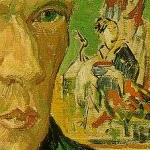
(Picture note: The above painting from 1887 is titled "The Italian Woman." Most commentators feel sure that the model is Segatori.)

Friday, May 14, 2010

Meandering in Montmartre, Part Two

0


When I ended my last post I was recalling my first visit to Montmartre, back in 2005. My family and I followed Rue des Abbesses to Rue Lepic (the street where Vincent and Theo moved to a few months after Vincent arrived in Paris). We followed Rue Lepic--an upward slanting and curving street that is virtually all residential--until it ended, and then we took a series of turns. At that point we were about as high as one can be on the Butte Montmartre. In fact, we were level with the Basilique du Sacré-Cœur, only behind it now, a block or two away, in an area thriving with restaurants and shops and overrun with crowds of summer tourists. Hot and thirsty, we grabbed a seat at an outside table of one of the cafes. I can't remember what my wife or kids ordered, but I ordered a large Stella Artois draft. And though I'm not a big fan of Stella, I can attest that I savored that one. As we sat and enjoyed our drinks we spied a sign on the wall of the cafe that indicated that the building dated to the nineteenth century and had been then a favorite hangout of the Neoimpressionist community located in Montmartre. I believe the sign even mentioned Van Gogh by name. So, what do you know, we had stumbled onto one of his old watering holes.

When we were finished at the cafe, we wandered the area for a bit longer, checking out some stores, and then found our way back to the Rue Lepic and down the hill again. It was my wife who discovered it: an unassuming, creamy white-toned building with white shutters and dark blue doors, a building that melded almost invisibly into the others lining the east side of Rue Lepic. We'd walked by it the first time without evening noticing. But a rectangular sign with gold letters affixed to the wall near the front door told you: it was the building where Vincent and Theo lived all those years ago. Immediately, of course, we started snapping pictures. My wife made me pose beneath the sign. People walking by studied us curiously, unable to figure why this rather ordinary building should attract such interest.

Well, that was 2005. As it turned out, our camera was having difficulties and we lost most of our pictures from the trip, including half that we took in Paris and almost all we had taken in the south. So part of my reason (albeit a small part) for wanting to return this past summer was to snap some pictures that would last. Indeed, on that cloudy Saturday morning last summer when I arrived in Paris the first place I went after I unloaded my baggage at the hotel was Montmartre. It was far cooler in May 2009 than it had been in August 2005, but not so cool that as to be uncomfortable, especially when the sun peeked out. From the 2005 trip I knew precisely where Vincent and Theo's building was located. I skipped the Basilica and headed toward Rue Lepic, stopping along the way to observe the curve of the streets, the color and architecture of the buildings, the characteristics of the inhabitants. I wanted to burn Monmartre into my memory as well as take dozens of documentary photos. (Such as the ones above.) I examined Vincent and Theo's building again; then, I headed up the street toward the Moulin de la Galette, the umbrella name for two famous windmills--located almost at the heighest point on the street--that Van Gogh depicted in various paintings. An historically significant edifice--it had to be defended during the seige of Paris in 1814--during Van Gogh's lifetime it was regarded as a colorful bit of scenery; a convenient end destination for center town Parisians out for a long walk; and the site of a popular observation deck (at the "Blute-Fin" mill) and a "guinguette" (bar/dancing venue) at the "Radet" mill. Since I'd decided to make the creation of one of Van Gogh's windmill paintings a significant scene in the novel, I lingered for a long time outside the (unfortunately locked) gate to the Blute-Fin mill and then further on to the Radet mill, which tops a still functioning restaurant.

When I'd stood and gawked and photographed as much as I could, I continued on the Rue Lepic until I found the same cafe I'd visited with my family in 2005. This time, instead of sitting outside, I headed in without hesitation. I wanted to sit down, yes, and after the long stretch of Arkansas to Montmartre traveling a tall beer sounded awfully nice, but mostly I just wanted to see the interior, which was narrower and longer, more tightly packed, than I expected. I took my table--the place was almost empty inside--ordered my beer, brought my journal out from my backback, and began recording: what I'd seen and was now seeing, how the day had gone and was going. Without quite realizing it, I was sitting inside what would become the model for Café du Tambourin, the cafe appears in several of my Paris scenes. (Du Tambourin was an actual cafe, but I have no idea of its real life address as it does not operate anymore, at least under that name.) I think at the moment what I felt was pure fatigue, but accompanied by the delicious knowledge that I'd arrived--in Vincent's old neighborhood--and that I was gratefully off my feet; that I had a home here for as long as I wanted it, or at least until my beer ran out.