




 0
0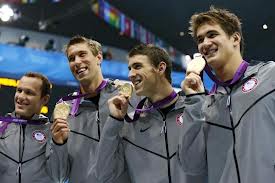
I have to admit that in a little way, like much of the American and world public, I've been bitten by the Olympic bug. Having spent several summers of my childhood logging morning training laps in a swimming pool, I always watch the Olympic swim races with interest. (Like nearly all my brothers and sisters, I swam for our local summer league team way down in backwoods Accokeek, Maryland.) Not just because I like to see my countrymen do well--and we have--but because it's a beautiful thing to see the various strokes carried out by such astonishingly accomplished athletes. When I swam, my favorite strokes were butterfly and breaststroke; not surprisingly, these were also the strokes I did best, at least relative to other kids. (Backstroke was a chore, mostly because you couldn't see where you were going. Freestyle--a.k.a. the Australian crawl--always struck me as a perfectly uninteresting if efficient way to get from point A to point B.) My favorite event, however, both to watch and to participate in, was the medley. Even today, my favorite individual Olympic races are the medleys and my favorite Olympic relay race is the medley relay, which only a few days ago the United States men won once again for god knows how many straight Olympics. What I like about the medleys is seeing an individual or group of individuals show a complete mastery over a range of strokes. It really is a thing of beauty and an incredible athletic feat. And as a competitor long ago, I know I enjoyed the physical challenge of trying to master four strokes in a race, even if I never quite managed to. The versatility show by a great medley swimmer pushes the very meaning of greatness and becomes its own special, higher kind of virtuosity, more spectacular and even god-like than the more mortal if still rare virtuosity of the swimmer who can master one stroke--say breaststroke (great breaststrokers tend to be the outliers of the swimming world)--so well that he or she is virtually unbeatable at it.
It's the same in other endeavors. Thinking of well-known and well-regarded actors, the ones I admire deepest are those whose roles vary so widely from film to film and play to play that it is impossible to gather them into one single category. In fact, you don't really associate these actors with any single role, or kind of role, because the actor himself or herself disappears inside every role he or she plays. I think of Dustin Hoffman, for instance, or Meryl Streep, who I'm sure will eventually go down as the greatest film actor, male or female, the United States ever produced. When I watch Hoffman or Streep in a film I never feel like I am watching Dustin play a role or Meryl play a role; I feel I am watching the characters they intend to portray. Hoffman and Streep are so flexible and so versatile as performers that they themselves are virtually lost in their performances. Compare these two actors to someone like Tom Cruise who--based on the admittedly small number of Cruise movies I've seen--seems to play the same role over and over; worse, that role always strikes me as some heroically idealized version of himself that Cruise carries around in his head. (I realize it's common sport to make fun of Tom Cruise these days, but what the heck. He can afford it.) Hoffman and Streep, the true virtuosos, have no interest in playing themselves. They know there's too much fun to be had mastering the art of becoming other people.
Thus I arrive at my usual subject, historical fiction, only to say that it seems to me one could divide up historical fiction writers into two fundamental camps. Those who make a career of digging into a past historical period and finding more and more stories to tell from that period, and those for whom the talent to write historical fiction is one of several writing talents they show. I think of Madison Smartt Bell, who already had a significant and flourishing career as a writer of contemporary fiction before he began writing the novels that are now known as the "Haitian Trilogy." I think of Bernard Malamud, who wrote several great contemporary novels and countless great short stories in a variety of voices, but who also composed an astounding historical novel called The Fixer, which I consider to be his finest work. Think of Alice Munro, perhaps the greatest short story writer North America has ever produced, who writes mostly and cuttingly about her own times but has proven herself an equal master at exploring the rurual Canadian past. It seems that the writers we honor with the highest accolades are always those who move with seemingly effortlessness from project to project, genre to genre, period to period, like Shakespeare moving from tragedy to comedy to romance to history. This is not to say that many fine and even important novels cannot be produced by a writer who sees his or her life task as the writing of historical fiction. It's just that perhaps the finest historical novels might in the end be written by those who also write contemporary realistic fiction and science fiction and magic realism and even detective fiction. Because writers of such versatility are our greatest virtuosos. (Jonathan Lethem is a newer, younger name that springs to mind as part of this discussion.)
I guess what I am trying to argue is that there's an evident virtuosity in the versatility that allows a Bell or a Malamud or a Munro to move freely between past and present, just as there is an incredible virtuosity in the versatility that allows a writer like Sherman Alexie to move between fiction and poetry, screenplay and memoir. And too I guess I am saying that with these writers I trust their need to explore the past when they do choose to explore it. I am compelled by their own compulsion, because I know it's not a matter of career necessity; it's not simply "what they do." It's what they've been called to by the material itself. And that's the highest calling there is.


