Showing posts with label The Langlois Bridge. Show all posts

Thursday, December 3, 2009

Turning houses (and hotels) around

0


Several years ago, I wrote a short story in which a wife follows her husband to the site of what she thinks will be an adulterous liaison. At the last moment the wife changes her mind and decides not to confront her husband. She turns around, leaves the hotel parking lot, and heads back the other way toward home. For convenience more than anything else I set the story in a part of southern Maryland that I knew fairly well. In fact, the hotel where I decided the liaison would take place actually exists on Maryland Highway 301, near LaPlata. However, the scene as I imagined it only worked logistically if the hotel stood on the right side of the highway as one drove south, as the wife character did. For the sake of my story, the wife had to take a right hand turn into the hotel from 301, but go back in the opposite direction--northward--when heading home. Problem: the hotel in question doesn't sit on the right side of Highway 301 as you head south. It sits on the left side. In fact, there is no hotel on right side of that stretch of highway. So, I asked myself, what should I do? I actually did worry about this, especially if some squirrelly grandma southern Maryland reader got his or her paws on my story, but finally I decided that verisimilitude was a lot less important to the story than that my scene be allowed to play out as I imagined it. So what did I do? Simple: I moved the hotel to the other side of the highway. Problem solved! Whether or not this would satisfy the famously scrupulous fact checkers at The Atlantic I have no idea, but since the story did not appear in The Atlantic but a different literary journal, who cares.

I ran into a similar situation last May when I took a third visit to the "Pont Van Gogh" outside Arles. (See previous posts.) Staring again at the house sitting just behind the little drawbridge --a drawbridge identical to the one portrayed in Van Gogh's The Langlois Bridge at Arles with Women Washing and other paintings--I realized for the first time that I was looking at the back of the house. Wait a minute?! (Checking the above picture, it's probably perfectly apparent to you that what you are looking at the back of a house. What I can say? I can be awfully slow at times.) There are two small canals in the area and they run parallel to each other. The drawbridge in question spans one, the front of the house in question faces the other. This would not be a problem except that in my novel Van Gogh walks out from Arles to the drawbridge and while enjoying the view of the homey little edifice, he spots the bridgemaster coming out of his house via the front door. This, as it turned out, would be physically impossible as Van Gogh would not even be able to see the man's front door. So, again, I had to ask myself: What do I do? I could have the man come out the back, but this seemed unlikely and would also be increasingly awkward, as the scene also features the bridgemaster's wife and one of his daughters coming out of, and going into, the house. Also, since on my third visit to Pont Van Gogh I finally circumnavigated the house and rendered some very particular drawings of its front, I decided that the front of the house was a piece of scenery I really wanted in my novel. So in the end I had three choices: 1) Ditch the scene; 2) move the drawbridge to the other canal; or 3) turn the house around, so its front faced the bridge. Of these three options, #3 seemed the least drastic, the easiest, and the one that best allowed my scene to do the work it needed to do. In fiction writing classes we talk about staying true to what the story needs rather than what a reader or the author wants, we talk about a hierarchy that puts the story at top, the reader second, and the author last. Sometimes "giving the story what it needs" can be as broad as completely changing the plot, adding a character or characters, or moving the action to a whole other part of the world. On the other hand, sometimes it simply means turning a house around. I'm not sure if such a move would be sanctioned by the Guardians of Purity in creative nonfiction writing, but to me a little move like this is exactly what the freedom--and the responsibility--of fiction writing means. Giving your story what it needs. And it's also why I declare, and will keeping declaring until I am out of breath, that my Van Gogh book is a novel not a biography. That single word designates something crucial, not just about what happens inside the book but about my entire method of composition.

That said, it's certainly true that we writers of historical fiction research our subjects thoroughly in order to render accurate pictures of past peoples, costumes, and geographies. Other posts on this blog have detailed just such efforts. And later ones likely will too. So when, in the making of historical fiction, is it okay to depart knowingly from strict factuality? How much leeway do we give ourselves, and why? Anyone care to comment? Advise?

Wednesday, December 2, 2009

The Langlois bridge?--Part Two

0


In my last post, I described the somewhat off-the-beaten-path Van Gogh site of the Langlois Bridge, or "Pont Van Gogh" as it is actually designated on maps (because the real Langlois bridge was removed several decades ago). Besides the bridge itself, what I was most intrigued by when I went there was the tall, dying, long unoccupied house that sits very close to the bridge. (That's it in the photo.) Even on my first visit to Pont Van Gogh I think I took more pictures of this house than the bridge itself. And on my most recent visit last May, I left the bridge behind and walked through waist high weeds to circumnavigate the house. I would have taken more and closer pictures of it except that the battery in my camera died. So I brought out my sketchpad and starting drawing it from several different angles. Having to do so was a real blessing, because it forced me to look a lot more closely at the house than if I were merely snapping a photo.

I cannot swear to the age of the house, but I have to assume it was once occupied by whomever was responsible for operating the bridge. In fact, in Van Gogh's painting of the real Langlois Bridge, a similar structure does sit off to the right. When I decided for the sake of my novel to accept a tour guide's story that the Langlois Bridge was really called the "L'anglais" Bridge in Van Gogh's time, because an Englishman was the bridgemaster, this old house became more important. It would be the home of this unknown and unnamed Englishman, who I decided would feature prominently in my Arles scenes. After all, Van Gogh depicted the bridge in several paintings and must have walked to it from his hotel room in Arles repeatedly. Plenty of occasions for interaction. In my novel, his friendship with this English bridgemaster has essentially stood in for the friendship that in real life he seemed to have enjoyed with his postman Roulin. That is, a good-natured, easy going, rather masculine give and take, which allowed him, as I imagine it, to escape for a few moments or hours the severity of his commitment to painting. Roulin's physical appearance, as depicted by Van Gogh in a well known portrait, actually influenced my mental image of the English bridgemaster, whom I've named Portis. They aren't identical by any means, but elements of Roulin's appearance--his heft, his beard, his hail-fellow-well-met redness--coordinate pretty well with an Englishman occupying an easy job who enjoys his pint (or more) every day.

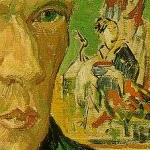
But it's a fair question to ask: "Why do this?" All I can give as an answer is to say that I never asked myself the question; instead, I asked "Why not?" I liked the idea of semi-slothful expatriate Englishman in my novel, one who lives in a crumbling old house with his lovely provencal wife and two children. And just as in real life Van Gogh eventually painted Roulin (see photo) and his wife, in my novel Vincent--at Portis's suggestion--paints Portis's daughters. On of these daughters, who I've named Elise, is in my telling the model for Van Gogh's famous "MousmƩ" sketch and painting. (I posted about that some weeks back.) Later, Van Gogh's fallout with Gauguin is catalyzed by tensions and jealousies involving Elyse and the entire Portis family. In real life, the failure of the experiment of the Yellow House was rooted in differences between Van Gogh and Gauguin over matters of art, taste, and technique. Fundamental aspects of any friendship--like respect--were in question. It wasn't simply a matter of one man getting angry over unwashed dishes. This is all true of my novel as well. But it's a rare interpersonal combustion that has only one cause, and deciding to bring the Portis family into the mix has made, I hope, for a more drastic, believable, and intriguing blowup between the two proud men.

Next time: Even more about the Pont Van Gogh! Who knew there was this much to say?

Monday, November 30, 2009

The Langlois bridge?--Part One

0


One of the interesting if also offputting aspects of traveling around Arles is the amount of Van Gogh related siteseeing. In the summer months especially, individuals, walking tours, and even tour buses hurry from place to place inside and outside the city, looking for the exact spot where Van Gogh painted this or that painting, catching amused sneers from the natives who--probably rightly--are sure there are lots better ways to spend a day in southern France. I have to admit that in conducting research for my novel I too have been just such an individual and even a member of such tour groups. One of the first places I sought out when I arrived in Arles for the first time in 2005 was the "Langlois bridge,"designated clearly on all the tourist maps as the place where Van Gogh created his first important Arles painting. In fact, nowadays it's also referred to as the "Pont Van Gogh" (the Van Gogh bridge).

The bridge is outside of the city, a ten minute drive at most. It's a curious combination of bustling tourist spot and hushed artistic retreat. It sits peacefully on a thin canal with little in the way of modernity nearby, except for the paved road that drops you off there. A modest stretch of roadside gravel exists for parking. It's a homely but enormously quiet, even reverent, spot, with this small and antiquated and inoperative bridge sitting in a permanently raised position, a dilapidated house beside it, and a nearby cover of trees that once passed through puts you out on a foot-worn path that runs alongside the canal. You can walk as far as you want northward or southward, with nary an interruption or distraction. When I visit the bridge I immediately want to stay. I want to sit. I want to absorb. Each time I go, I stay longer. Not just photographing, but sketching and journaling, soaking in the quiet, the greenery. I know I'm not alone in this feeling. Usually I see at least one other person there--always alone--lounging on a stretch of earth, with book or picnic basket or sketchbook in hand. You should not be surprised, however, if while you visit a enormous coach pulls up for ten minutes to let out a gaggle of Japanese tourists, who take a flurry of pictures and then get back on in search of the next Van Gogh destination. The tourists come and go in a cycle. The place takes them in, absorbs them, and then sends them on their way. You stay, getting the longer, richer experience; and quickly you stop noticing them.

The place has a feeling of genineness and subdued beauty that has in fact little to do with Van Gogh and his painting, though that it is his painting that brings all the visitors. You see, this bridge, proudly proclaimed on the nearby sign as subject of Van Gogh's Langlois Bridge, actually isn't. If you read a little deeper into Arles information you find out that a string of fourteen or so identical small bridges once spanned the canal. At some point in the 20th century they were removed for being useless vestiges of an outworn technology. And, sad but true, one of the bridges removed was the actual bridge Van Gogh painted. In the name of historical preservation, however, a single bridge was left standing. Since this bridge is identical to Van Gogh's bridge it is proudly (and self-servingly) proclaimed by the tourist industry as his bridge, which in some sense it is. For the working novelist trying to soak up atmosphere, it's certainly accurate enough. And a pleasant place to vist. Things get even murkier though. Later in my 2005 visit I was told by a tour guide in Arles--a white-haired American woman who moved between a kind of noisy and nasal, northern accented English to a fluid, deeper-toned French within which you couldn't hear a trace of the American midwest--that everyone had the name of the bridge wrong. It's true name in Van Gogh's time was not the "Langlois" bridge but the "L'Anglais," or the "English," bridge, because the man who tended the bridge was known to be an Englishman. I've not heard that story from any other source--and Van Gogh's painting always goes (and always has) by the title The Langlois Bridge--but nevertheless I immediately jumped on the story. It captivated my imagination, and it ended up affecting what happens in the Arles section of my novel. More on that next time.

(Photos: Van Gogh's The Langlois Bridge with Women Washing, and the still extent "L'Anglais" bridge on a peaceful if cloudy day last May.)