




 1
1
As we all know, schools are starting these days--at least here in the U.S.--and that means too the beginning of football season. In fact, tonight I will be taking my youngest son and his friend to Estes stadium at UCA to see the Bears' season opener. With football so much in the air and on the news and in people's hearts--at least here in the U.S.--I think, strangely enough, of Van Gogh. And I think of the position of middle linebacker, the man at the exact center of the defense: midway between the sidelines, midway between the defensive line and the defensive backfield; the man with the most leeway of anyone on defense to circuit freely and make whatever plays need to be made. That could mean rushing up to help the line stop a running play, or dropping back to help cover a receiver, or blitzing to try to sack (tackle) the other team's quarterback. A successful middle linebacker sees and understands the field as a whole, and the developing play as a whole, and he uses his roaming freedom to enhance the whole defense.
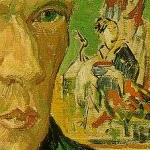
It may be a stretch of a metaphor, but I feel safe in calling Van Gogh the middle linebacker of the Neoimpressionists working in Paris in the 1880s. That is, he moved freely between factions, between cliques, between individuals, and between styles, with only one end in mind--and it was a good one: learning and absorbing as much as he could. Having just spent several years working alone in the Dutch provinces, and then a few disappointing months in Antwerp, he was not just willing but eager to listen, to watch, to discuss, to experiment, and to change. And he refused to let interpersonal squabbles--replete with their petty resentments, paranoid suspicions, and blatant attempts at empire building--distract him from his purpose. He set up walls against no one, was willing and able to see value in the working practices and painterly results of many different kinds of artists. Whereas almost every other leading neoimpressionist eventually chose a particular camp to belong to, and thus allies to swear by, Van Gogh stubbornly resisted making such choices. He felt that he could and did learn from all of them. Certainly in his paintings from his Paris years we see him trying on and trying out many different artistic gestures. He did not carry all of these gestures with him to Arles--by his own admission, he "abandoned" much of what he learned in Paris (something of an overstatement, actually)--yet it was by carrying on these experiments at all that he grew as a painter; it's why his Paris period counts as the one in which he learned and grew the most. It was in Paris that Van Gogh became a modern painter. And he grew the most because he circulated the most. Whereas Van Gogh's associate Emile Bernard became a disciple of Gauguin and thus turned his back on the Divisionist group of Seurat and Signac and Pissarro, and whereas Seurat despised and scorned Gauguin and thus avoided company with all members of the so-called "Symbolistes," Van Gogh had friends in both camps. He literally worshipped Gauguin and for a long time was terribly close to Bernard, yet he ate and drank with Signac, and he admired Seurat's breakthroughs deeply. He did not fully buy into the optic theories behind Divisionism, but he did see the divisionist method as an excellent way to vary the texture of a painting. A quick scan of his Paris paintings reveals the number of works in which he played with and tried to learn from this method.
Finally, sadly, Van Gogh's attempt to stay above the fray wore him out and depressed him. His resentment over the exaggerated factionalism and trivial backbiting among painters in Paris drove him out of the city. At the very least, it played a significant part in his decision to leave. Probably playing into that decision too was the realization that he had learned as much from these people as he could, and the fear--which he wrote about in his letters--that if he stayed in Paris much longer his health would be ruined and himself turned into an alcoholic. (Much drinking among the painters in Paris of the day, not shockingly.) Shortly after moving to Arles he wrote Theo about how much better felt in his body and how much more at home. (Van Gogh was always fundamentally a rural person.) Ironically, however, only eight months later he suffered his first epileptic attack--if that's what it was--an infamous breakdown greater and more devastating than he ever could have imagined in Paris. At that point, the linebacker had taken more than enough shots, and it was all he could do to get up and off the field with dignity.


.jpg)


