Showing posts with label Eugene Boch. Show all posts

Saturday, October 24, 2009

Twisting History

0


During a session at the recent APA conference I attended (see an earlier post), an audience member asked me and the other presenters if we felt guilty for "twisting history" to our own ends. (The other two readers were also presenting fictionalized versions of real people.) I suspect that the question came in part as a response to my depicting Eugene Boch and Dodge MacKnight--real painters who lived together in Fontvielle when Van Gogh lived in Arles--as a homosexual couple. Very little is known about the two men; in fact, almost all we do know about them are the impressions Van Gogh records in his letters. The question actually surprised me, because in writing those scenes I felt completely committed to my conception of the two men. I felt that, based on the available evidence, they could have been exactly as I depicted them. They seemed so real to me I almost forgot I was rendering an interpretation.

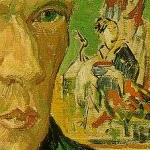
And maybe that's the heart of the issue. An intepretation is decidedly different from a "twisting." "Twisting" implies self-conscious deception, a deliberate, cynical manipulation of known facts. Indeed, a subversion of them. But there are so few facts known about Boch and MacKnight that I not only felt free to imagine them, but I had to do so if I wanted to include them in the book. What is clear from Van Gogh's letters is that he did not like MacKnight and did not respect him as an artist, while he adored Boch. When MacKnight left the area, apparently for good, Vincent was clearly gratified. He reports in one letter that Boch visited him at his studio and, with MacKnight not around, they could talk at length. He eventually painted a now famous portrait of Boch (that's it above) and described the picture in rather overheated terms to Theo, emphasizing that the painting expressed "my love for this man." Shortly after the missive to Theo, Boch and MacKnight disappear from the letters.

It does not seem any great leap of fantasy to see a real if muted drama of jealousy going on between the three men. In my rendering, Vincent isn't aware of the nature of his emotions toward Boch, but he certainly does feel them. And he sends a rather clumsy note to Boch pleading with him to come to Arles to see the finished painting. It's a similar move to his clumsy actions toward the women with whom he was obsessed; the only difference is that the emotions this time are directed to a man. Boch, who realizes Vincent implicit feelings and the potential disaster they pose to his relationship with MacKnight, discards the note, effectively ending his friendship with Vincent (and explaining, in my mind, his elimination as a subjecct from Vincent's letters). As I indicated in an earlier post, one must be careful not to immediately interpret 19th century male-to-male expressions of affection as proof of homosexuality. Such expressions were more conventional then than now. But, even so, this does not mean that one can't make such an interpretation if--based on the evidence--it seems reasonable, or at least possible. After all, in the murky world of historical fiction, capturing what is possible is really the best you can hope for. Who knows, from a distance of a 100 or 1000 or 2000 years, what's actual. And given the main duty of any writer--i.e., to make the reader believe--intepretations are crucial to engender concreteness to your drama. That's not "twisting" history but creating an alternative history. And just as in current theoretical physics it's possible to posit numerous, simultaneously existing universes, each as real as any other, any of these alternative histories can be--in fact, must be--as real to the writer as biographical truth, which is often too shadowy to comprehend.

Sunday, October 11, 2009

The First Unveiling

0


I took my novel on the road this weekend when I attended, and read at, the annual conference of the Arkansas Philological Association. This group puts on a comfortable and very welcoming get together every year in some lovely regional locations. This year the gathering was held in the grand old Ozarks mountain town of Eureka Springs, and given that my novel is just begging to be heard, even if it's still in progress, I jumped on the invitation from Conference Director Chuck Bane to participate in a creative writing session. I did read a tiny bit of the novel to a class of mine about a year ago, but the APA conference was the very first time I'd revealed it in anything approximating a public forum. And it also happened to be the very first time my wife heard it--something I'm a little chagrined to admit, but only a little, because I'm about to dump the entire, and too long, manuscript on her.

As you can imagine, I was rather tense. I've talk about what I'm doing to many people--family, colleagues, students, friends, readers of this blog--but never actually exposed it. But, honestly, what really frazzled me was deciding which scenes to read. This, I've learned, is a whole other level of difficulty from deciding which of one's short stories to read. After all, the novel scenes must effectively represent an entire book. The story needs only be itself. And in my case, it was the first time "out of the house" for this book. Ahhhh! I figured I had time enough (20 mins.) to read two scenes. But which? Good gosh, there are scores of scenes in this book, at least in its current form. How would I decide which two are absolute right two? The day before I left I ran off about ten different scenes and started rehearsing them over and over, trying to figure which two would best strike an audience as well as best fit the time limit and best present the range of characters and perspectives that are in the book. I finally chose to read the scene about the party in Paris attended by Suzanne Valadon (see a previous post) and a scene in which Vincent paints the well known portrait of his Belgian friend Boch. I guess it was a fine enough choice, because I received many compliments afterwards, but what interested me most about the whole experience was realizing once again how much you learn about your own writing by reading it aloud. I know, I know, this is a very old and boring truth. It doesn't sound like a revelation. In fact, I tell it to my own students all the time, but this weekend I learned that I can afford to be reminded of it myself. After all, I thought these scenes were fairly polished already, and yet I found myself--as I practiced reading them--slashing through them with pen: cutting words, cutting more words, cutting more words, changing words, inserting other words, changing names, attacking whole paragraphs. Whew! I put those suckers through the wringer. How could I have not realized before how much additional editing they needed?

Garry Craig Powell, a great writer and a good friend of mine in the Writing Department at UCA, told me last spring that the most valuable thing he did when revising his own novel was to read a chapter of it aloud every night to his girlfriend. Not only because she is his best critic but because by reading aloud he learned so well what worked in the sentences and what simply didn't. At the time I told him that I understood what he meant--because I did--but now I really understand. And now my wife has not only a mammoth manuscript to wade through but will be forced to listen to it every night as I start a new phase of revision: reading the entire thing aloud. Thanks Garry, thanks APA, and thanks Chuck Bane. You've already made my book a lot better.

Quick note: I received a lovely note from the poet Anne Whitehouse, who has published a poem called "Van Gogh in Arles." Click on the title to get to the poem. As I told Anne, she's really captured well the physicality of Van Gogh's attraction to the landscape of the region. Anne's poem reminds us too how this once utterly unknown painter has so captivated the imaginations of myriad literary artists. I know he did mine. That's something of a miracle, as are his paintings.