




 0
0

In my last post, I described the somewhat off-the-beaten-path Van Gogh site of the Langlois Bridge, or "Pont Van Gogh" as it is actually designated on maps (because the real Langlois bridge was removed several decades ago). Besides the bridge itself, what I was most intrigued by when I went there was the tall, dying, long unoccupied house that sits very close to the bridge. (That's it in the photo.) Even on my first visit to Pont Van Gogh I think I took more pictures of this house than the bridge itself. And on my most recent visit last May, I left the bridge behind and walked through waist high weeds to circumnavigate the house. I would have taken more and closer pictures of it except that the battery in my camera died. So I brought out my sketchpad and starting drawing it from several different angles. Having to do so was a real blessing, because it forced me to look a lot more closely at the house than if I were merely snapping a photo.
I cannot swear to the age of the house, but I have to assume it was once occupied by whomever was responsible for operating the bridge. In fact, in Van Gogh's painting of the real Langlois Bridge, a similar structure does sit off to the right. When I decided for the sake of my novel to accept a tour guide's story that the Langlois Bridge was really called the "L'anglais" Bridge in Van Gogh's time, because an Englishman was the bridgemaster, this old house became more important. It would be the home of this unknown and unnamed Englishman, who I decided would feature prominently in my Arles scenes. After all, Van Gogh depicted the bridge in several paintings and must have walked to it from his hotel room in Arles repeatedly. Plenty of occasions for interaction. In my novel, his friendship with this English bridgemaster has essentially stood in for the friendship that in real life he seemed to have enjoyed with his postman Roulin. That is, a good-natured, easy going, rather masculine give and take, which allowed him, as I imagine it, to escape for a few moments or hours the severity of his commitment to painting. Roulin's physical appearance, as depicted by Van Gogh in a well known portrait, actually influenced my mental image of the English bridgemaster, whom I've named Portis. They aren't identical by any means, but elements of Roulin's appearance--his heft, his beard, his hail-fellow-well-met redness--coordinate pretty well with an Englishman occupying an easy job who enjoys his pint (or more) every day.
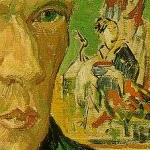
But it's a fair question to ask: "Why do this?" All I can give as an answer is to say that I never asked myself the question; instead, I asked "Why not?" I liked the idea of semi-slothful expatriate Englishman in my novel, one who lives in a crumbling old house with his lovely provencal wife and two children. And just as in real life Van Gogh eventually painted Roulin (see photo) and his wife, in my novel Vincent--at Portis's suggestion--paints Portis's daughters. On of these daughters, who I've named Elise, is in my telling the model for Van Gogh's famous "Mousmé" sketch and painting. (I posted about that some weeks back.) Later, Van Gogh's fallout with Gauguin is catalyzed by tensions and jealousies involving Elyse and the entire Portis family. In real life, the failure of the experiment of the Yellow House was rooted in differences between Van Gogh and Gauguin over matters of art, taste, and technique. Fundamental aspects of any friendship--like respect--were in question. It wasn't simply a matter of one man getting angry over unwashed dishes. This is all true of my novel as well. But it's a rare interpersonal combustion that has only one cause, and deciding to bring the Portis family into the mix has made, I hope, for a more drastic, believable, and intriguing blowup between the two proud men.
Next time: Even more about the Pont Van Gogh! Who knew there was this much to say?


