Monday, January 21, 2013

Novel writing class returns

0


After a break of two-and-a-half years, Novel Writing Workshop returns to my university this semester.  In the interim period, dozens of students have asked me about the class and scores of oral histories have been told; a few students lobbied my department's Chair hard for its return; and, not insignificantly, our first collection of graduate students matriculated.  In some ways, it's a very different pedagogical landscape now than when I taught the course a couple years ago.  Then, novel writing workshops were still relatively rare and excitingly new, certainly on the undergraduate level, and the idea that the students would not just start but finish a novel in one semester struck me as potentially hazardous: to GPAs; to other course work; to jobs; to relationships; most of all, to sleep schedules. Yet that's what I asked the students to do.  And nearly all of them succeeded.  Now, novel writing workshops are a considerably less unusual phenomenon.  Indeed, sometimes I think they are everywhere.   Still more typical on the graduate as opposed to the undergraduate level--although one of our graduate students, who was an undergrad a year ago, informs that he took a novel writing course in college--they are, in any case, far more characteristic of creative writing degree programs than in the past.  It can't be coincidental that at the AWP conference in Boston this year, a panel will be held on not just on promoting the idea of the novel writing workshop but on the fact of it; that is, the nuts and bolts of how different experienced instructors of the course have taught it.  I think it's even fair to say that novel writing workshops are becoming the cornerstone of progressive fiction writing programs.  And in part this is because in the last three years those who teach the course have been talking to each other about it--Cathy Day's blog The Big Thing has been especially instructive--pushing each other, motivating each other, spreading the gospel.

So I'm glad it's back at my school, and I know the students are too.  But I admit to being a bit nervous.  In the intervening years since last I taught the course, a mythology has developed around it, a retrospective awe.  Students have told me that for years, ever since they selected our major, they have been eagerly anticipating the chance to experience this one course.  Can this semester possibly meet their high expectations?  Yes, it can.  But, here's the scary part: It's all up to them.  More than any other course I teach, in my novel writing class, the students teach themselves and teach each other.  I offer them a platform through which they can learn about novel writing, but they have to take advantage of it, and they have to encourage each other to take advantage of it.  While I do separate the class into small peer review groups, there will be no full class workshopping.  As I emphasized at our first meeting the other night, the course is about production more than anything else.   The last time I taught the course, again to all undergraduates, the room was fully with unusually mature and unusually talented people.  What the course offered was exactly what most of them were looking for: space, opportunity, deadlines.  Almost entirely seniors, they'd workshopped plenty in their college career.  What they wanted from Novel Writing was something else,  and they were eager to take control of it.  There were certainly bumps along the way that semester, but for the most part--with a notable exception or two--a genuine esprit de corps ruled.

I can only hope my current group has the same experience.  It's a fresh batch, with different backgrounds.  For the first time, graduate students are participating along with undergraduates.  That's a new dynamic for me, and for both of those student populations.  And there's another professor sitting in!  Not even from my own department!  Like last time, we will read Chris Baty's No Plot No Problem (for practical motivation) and a couple of short novels (as models for storytelling over a reasonably short space), and we will periodically break off into peer groups.  But mostly we will be writing.  I'll be writing along with them, which actually is going to be more of a challenge for me this time than last.  Mainly because right now I am in the latter stages of a novel I started early last semester.  I had intended on exploring this novel idea through the Novel Workshop, but when the class was delayed from fall until spring I didn't feel like waiting.  Now I will need to hurry to finish my draft, then immediately start another novel--the subject of which I haven't even clarified for myself yet.   Hard to know what the next few months will bring, but I'm sure it will be an adventure.  There will be exhileration and despair.  There will be careful planning and last second inspiration and a great deal of fatigue.  Some will give up; most, I hope and expect, will soldier on.  Some will get pissed at me and at their peer reviewers.  Some will get pissed at the novels we read.  But if they each individually can hold it together, when the finish line comes they will have learned more than from perhaps any other writing course.  And they will have learned it the best possible way: by doing it themselves.

Publication announcement: I'm happy to report that another chapter from my Van Gogh novel will soon appear in print.  The journal Versal, an international literary magazine based in Amsterdam, is publishing a chapter from the section of the book that details Van Gogh's Paris years.  The point of view character is Suzanne Valadon, a post-Impressionist painter who circulated widely among the Impressionists and Post-Impressionists and even modeled for a few of them.  During my research for the novel, I read an account she'd written of seeing Van Gogh at a Paris party.  I used some details from that account to construct the chapter.  The issue of Versal will appear in May, accompanied by a launch party in Amsterdam.  Really sorry to have to miss that one.  While I will be in London in June for the Great Writing Conference, there's simply no way for me to make it to Amsterdam in May.  Ah, well.

Monday, January 14, 2013

One Sunday Morning

2

A couple years ago this blog put me in contact with Anne Whitehouse, a poet and novelist who had written a poem called "Van Gogh in Arles" detailing Van Gogh's heroic struggles to keep painting outdoors in the face of the infamous mistral of Provence.  Anyone who has ever visited that part of the world knows how real and ferocious a force a mistral can be.  (I keenly remember going running one morning in the middle of a mistral and finding myself barely able to move forward.  Thank heaven it was a sunny late spring day and not the middle of winter.)  I admired Anne's poem then and provided a link to it.  I'm happy to tell you now that the poem is included in Anne's  poetry collection, One Sunday Morning, available from Finishing Line Press.

Just as in her previous volume, Blessings and Cursings, Whitehouse is able to capture the dualistic nature of so many common experiences; the two-sided identity of what might seem to be singularly positive or negative developments; or, viewed through a different lens, the deeply unified nature of what appears on the surface to be a divided, battle-torn life.   With a voice of gorgeous understatement and placid wisdom, she pushes at several tiny but beautiful ironies, ironies that are subtle until she exposes them,  and then they seem perfectly obvious.  An example of this phenomenon is the poem "Meditations in June," a poem of lessons learned in a life honestly spent, a poem that admits--like almost all of Whitehouse's work--to being "ever more certain / Of my uncertainty."  In the poem's final stanza, Whitehouse invokes a visit to a hospital to see a terribly ill friend, and her summary of that experience could stand as the ethos of the entire collection:

                               The world is a terrible place.
                               There's no getting out alive,
                               Said my friend from his hospital bed,
                               Elation disguising his dread--
                               Or the other way around.

Is this life the locus of more elation or more dread, the book seems to ask; and, more to the point, is it possible that there's no difference?  Certainly, scattered through its pages are examples of both and either.  Several of the poems seem almost to be gathered out of variant pieces that when brought together resonate with a new, surer power.  They seem less like conscious riffs on a theme than an after-the-fact discovery of connections and oppositions where previously none were suspected.  For example, there is the poem "Consolations," the three parts of which describe, respectively, the poet lusting after fruit she spies at the highest reaches of a tree ("orange-yellow suns glowing / in green shade"), a WWII veterans attempt to escape lingering nightmares from that war through fierce, scientific concentration on nature, and the poet--her voice returned to the poem--describing a dive into the sea.  Each segment details a consolation but also suggest the ways in which the consolation is inescapably bound with an original torment.  The oppositional language of the last stanza brings this home: "the coolness seeped in my skin / and spread all through me / and I relaxed, and I was warm."  There may be no better example of the unity of torment and consolation than the title poem, which describes a wounded stag, "blood stream[ing] from the hole in its rump" after its tail has been ripped off by coyote, who stands nearby, eyeing the poet and worrying the tail "To and fro like a fish in its mouth."  As barbaric as the image is, it is underscored by the stag's unavoidable beauty: "Its antlers . . . fuzz-tipped and green, / Its large eyes liquid and brown." Also by the poet's rising sense of awe at the spectacle of nature at work.  The nature of nature, if you will.  When the stag limps away, "its left foreleg . . . lame / . . . its life helplessly slipping away," the image is of course a sad one, but not necessarily tragic.

While Whitehouse includes no haiku in the volume, every poem demonstrates the directness and elegantly austere language characteristic of that form, not surprising in a poet who, like so many eastern masters, attempts to show through nature what is behind nature and through the individual life what is behind that life, constructing it and maintaining it in a beautiful, tenuous balance of opposites.

Followup to last week: In response to my post last week about a photograph (unearthed only in the 1990s) that some believe to be a photograph of the thirty-something Van Gogh--and thus the only photograph that shows his adult face--reader Shannon sent me a link to a really interesting experiment.  A photographer tries to imitate a famous Van Gogh self-portait to the closest detail possible; as a way, I suppose, of showing us what the man who painted the self-portait "really" looked like while he was painting it.  Of course, self-portaits can be doctored just like any portaits and any paintings can be, but even so it sounded like a fun project.  Follow this link to view the results.  You'll see the familiar self-portait give way, bit by bit, to the photographer's copying rendition.  Cool stuff!  And I must say that the photograph this experiment creates does, in my mind, look much more like Vincent than the supposedly "real" photograph I discussed in last week's post.

Monday, January 7, 2013

A picture of Vincent?

4

A photo historian named Joseph Buberger recently emailed me a copy of the photograph that you see on the left.  As reported by USA Today, the photograph was discovered several years ago by artist Tom Stanford in an album of cabinet card photographs that he found in an antiques shop in Massachusetts.  It has since been featured in an exhibit titled Discovering Vincent Van Gogh: A Forensic Study of Identification--at the Seton Gallery at the University of New Haven in 2004--and has been widely circulated through the internet.  As soon as he saw the photograph, Stanford felt certain it was Vincent, and Joseph, who assisted with the aforementioned exhibit, agrees.  Joseph also has forwarded to me an email from Pascal Bonafoux, French art historian and curator, who seems to accept that the man in the picture could likely be Van Gogh himself.   Not all experts concur, however, at least not those at the Van Gogh Museum in Amsterdam.  The reason why this became a hot topic of conversation is that until the photograph in question surfaced, it was assumed that no adult photographs of Van Gogh existed.  Or rather, no photographs in which his face is visible.  There is one standard photograph of him sitting at a table beside the Siene with Emile Bernard, but in that picture Van Gogh's back is to the camera.   The only photographs that represent his face are from earlier in life, when his identity was still very much in formation: one when he is boy and another late in his teens, after he had worked for a couple years as an art dealer in The Hague.  (See that one below.)  Thus everyone who looks at this "recent" photograph wants to  know: Is this what the famous post-Impressionist actually looked like?

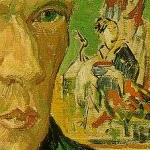
To be honest, I have my doubts.  While the man in the photograph does bear a resemblance to some of Van Gogh's painted self-portraits, he seems less akin to others.  (For instance, the self-portrait on the left, painted during his Paris years, bears a stronger resemblance--in my opinion--to the teenager photograph than this new one.)  Besides, portait paintings are by no means a scientifically accurate reflection of what a person looks like.   It would seem to make sense to compare the photograph first to the known photographs of Vincent, especially the one from his late teens.  When I do that, I have a hard time saying that the men in the two pictures are the same person.  The photograph Stanford discovered dates from 1886.  As you can see from the name and address imprinted on the picture, the photographer who took it worked in Paris.  Indeed, in late February of that year Vincent moved to Paris from Antwerp and stayed in the city for two years.  So if the picture does show Vincent, it is Vincent as he was when he shared an apartment with his brother Theo, circulated among the post-Impressionists, and learned a lot about brightening his palette.  However, in 1886 he was only thirty-three years old.  Less than fifteen years had passed from the time when the other photograph was taken.  Is that enough time for a person to change as drastically as Vincent would have had to?  One could easily argue that those were a very hard fifteen years for Van Gogh.  He gave up art dealing and tried to become a minister and then later decided to be painter. He suffered through a series of dispiriting romantic upheavals--I've written about those before--lived for long stretches in dire poverty and on little food, endured bouts of poor health, and worked himself ragged.  At thirty-three, he'd already lived a couple lifetimes.  Too, while his life was never truly stable, it was in some crucial ways more stable when he lived in Paris with Theo than at any other period in his adult life.  He was no longer starving; he started to look after his health, especially his teeth; and he tried to dress more like a professional man than a laborer.  If there was ever a time he would get such a photograph made, it would be during those years.


But even so, I'm still not convinced.  Van Gogh never had--not at any time in his adult life--much money to burn. In fact, what money he had came in the form of handouts from Theo.  That money typically went to paint and other supplies, books, and--at least while in Paris--visits to cafes.   There would not have been much leftover to pay a photographer.  (Of course, maybe Theo wanted the photograph made and paid the fee.)  Nor is there any mention in his letters of him sitting for a photograph.  (Then again, he wrote far fewer letters when he lived in Paris than before or after.)  And I have to ask why, if this is a legitimate photograph of Van Gogh, it only surfaced now and not much earlier?  Would not Theo have held on to it after Vincent left Paris for Arles?  (Theo religiously saved all the letters Vincent wrote him; why not a photograph too?)  Wouldn't some other family member have taken possession of it after Theo died in 1891?  If it is Vincent, why was the photograph included in an album of photographs featuring mostly clergymen?  And, most important, does it really look that much like the man?   It could be Vincent, or it could simply be an anonymous 19th century Parisian who bears a passing resemblance to him.   If it is Vincent, than we can surely say that the man changed a great deal between his late teens and early thirties.  (It's not just that he's older--that's to be expected--but the very structure of his face, and even his nose, looks different to me.) Just as a comparison, look at these two photographs of Paul Gauguin.  The one on the left dates from 1880, when the artist was 32; the one on the right dates from 1891, when Gauguin was 43.  That's an eleven year time span, and yet there's no mistaking either image for anyone but Paul Gauguin.  The man on the left is quite obviously the same man as on the right.  I know it's not fair to compare how one person ages to how another does, but it gets to the heart of the question for me.  Would an even older-than-his-years Vincent looked like the man in the recently discovered photograph, or would he have looked more like his own photograph from fourteen or so years earlier?

Postscript:  Happy New Year!  I hope everyone is enjoying a pleasant start to 2013.

Monday, December 31, 2012

Resolution roundup

3


I've never been one to make New Year's resolutions.  It has always seemed to me that if there's something you need to do or change then you just do or change it.  No matter what month of the year it is.  And if you have to think about what resolution to form for the new year--i.e., if it's not glaringly obvious--then chances are you are doing pretty well, and you should just carry on.  But I have to admit that there is something about the dawning of a new year that prods some people into action, into committing themselves to doing or changing what they've long known they should.  And that, especially if they follow through, is certainly a positive thing.   That was me last year around this time, when I made the sudden resolution to write creatively every single day of the year 2012.  Not that I wasn't consistent and dedicated in my writing before.  I talk to my students all the time about making writing a
habit--and I've blogged about this--and for much of my writing life this has more or less meant getting up early on weekdays and writing before the rest of the house wakes and life must begin.  Of course, there were always days when the burden of grading student papers was simply too great, and I had to sacrifice my writing time to that duty.  And there were the days when I traveled to conferences: crazy busy affairs in which once the day starts there is barely any down time to be found.   There were other days when I was visiting out-of-town family and didn't feel the requirement to push myself to the notebook or the computer.   And then there weekends when I afforded my creative brain some time off.  Still and all, I was living the message.  At least I thought so until some visiting writers came to my campus who indicated that working writers should literally write every day.   Even on a beach vacation.  Even on Christmas.  Even if you travel to a conference!  One of these writers, Heather Sellers, in her book Chapter After Chapter frames the idea this way: Even if you are on leave of absence from your home you do not take a leave of absence from your book.  It might just mean working on it a bit differently.  You could bring a few chapters with you to line edit.  Or you could exchange novels-in-progress with another writer, and you agree to read each other's work while you're away.  In that way, your book keeps getting worked on even if you are not at your writing desk and you are not the one working on it.

Because I was more or less living the message already, for several years I ignored the every day mandate and kept working the same way I always had.   (And in point of fact, I know that many successful writers do not write literally every day, even though they all make writing a habit.)  Then, when I was on sabbatical in 2009, I added a sixth day, Sunday, to my writing week.  When I got off sabbatical I decided to hold on to that Sunday work session.  And then last year, at the end of December, in what was a quick, unanticipated decision, I committed myself to going all the way.  Just for one year--no matter where I was or what else I had to do--I would write creatively every single day.  Even if that meant for only 5 minutes.  Of course this begs the question as to what I mean by "writing creatively."  I knew what I meant, so I didn't actively formulate guidelines--they were innate--but for the sake of this post I'll tell you what those innate guidelines were.  If I composed original fiction, creative nonfiction, poetry or plays, that (of course) counted.  If I revised or edited fiction, creative nonfiction, poetry, or plays, that counted. If I wrote in a journal--and by this I mean the kind of descriptive, impressionistic, and exploratory journal one might keep on an overseas trip, as opposed to the "It's Tuesday, and I just had leftover fajitas for lunch" kind of journal--that counted.  And that, friends, was pretty much it.  Many other activites, even if they were related to my writing, did not count.  Writing a blog post did not count.  Commenting on other people's blog posts did not count.  Writing queries to agents and publishers did not count.  Conducting research for a story or novel, unless I carried this out during an active writing session, did not count.  Writing letters or emails--no matter to whom and about what--did not count.  Composing a letter-to-the-editor in response to something I read in a newspaper or magazine did not count.  Writing critiques of my students' creative work or of a friend's creative work did not count.   In fact, all the writing I do for my job as a university professor--grant proposals, committee reports, letters of recommendation, syllabi, assignment instructions--most definitely did not count!  (Don't get me wrong; I belong the school that says all writing is creative--or has the potential to be--but for my New Year's resolution to accomplish what it was meant to accomplish, I had to stay true to my innately understood definition.)

So how did it turn out?  Well, I'm happy to report, on this last day of 2012, that I did it!  I wrote creatively every single day.  And though I took several trips this year, the only one that truly challenged my resolution was my March trip to the madness of the AWP conference in Chicago.   Part of the difficulty there was that I also blogged every day from the conference.  There were a couple days at AWP when I logged my creative writing time only by composing observational haiku during down moments at the book fair table I was manning for Toad Suck Review.  Those haiku may not be thunderous literature, but they kept my creative brain engaged.  More importantly, I enjoyed doing them.  During family trips--such as our east coast marathon in July and a Thanksgiving trip to Lowell, Arkansas--I kept to the resolution by simply doing what I always do: getting up before everybody else, starting a pot of coffee, and then writing.  I can't know how much more I wrote because of my resolution--quantity really wasn't the point--but I did write a lot.  I composed many many short stories--some very brief, some rather long; I composed a series of long poems (because I taught a course on the Long Poem during the spring semester), some of which I've arranged into a chapbook; I wrote one original play and adapted a short story I wrote into another;  I wrote some creative nonfiction; I carried out substantial new edits on my story collection, Island Fog, a thematically-unified book in which all the stories are set in Nantucket Island, Massachusetts; I gathered together and edited other stories of mine for a different collection (most of those stories being set in the south) that I sent off to a contest just two weeks ago; I substantially edited and revised (once again) my Van Gogh novel as well as the (much shorter) novel that I wrote after it; and, as of last count this morning, I've written the first 215 pages of a semi-comic, wildly braided novel that I'm having a good time with--even if I'm not 100% sure where it's going.  How much of all this writing will eventually appear in print I can't say.  But I can say that because of the resolution, and because of sticking to it, I've felt more intimately engaged with my writing life this year than ever before.  And that's precisely what the write-every-day mandate is about.  I highly recommend it--at least for one year!

So what about next year?  Let me get back to you about that.  ; )

Reading report: I've been enjoying a couple books so far during this Christmas holiday.  The first was sent to me by a booking agent for writers in the hopes that UCA would want to invite his client.  I put it aside for weeks and then decided on a whim to read it during Winter Break.  It's called Cocktail Hour Under the Tree of Forgetfulness (2011) by Alexandra Fuller, the author of Don't Let's Go to the Dogs Tonight (2003).  The latter was her memoir about growing up in Africa, so with this latest volume Fuller decided to chronicle her mother's story of having grown up in Africa.   It's a gem of a book, carefully researched and composed, so much so that she is able to convincingly narrate scenes that happened between her parents and others long before she was born.  While it's an extremely personal and familial book, it also presents a superb picture of central Africa and the changes that occurred there between the 1940s and the 2000s.  Her book reminds me that perhaps the only way to truthfully tell history is to tell the history of individual people who experience it.  Anything else skirts dangerously close to propaganda.  It's a fantastic, engaging read.

After finishing Fuller's volume, I started on Canada (2012) by Richard Ford.   All I can say about this one is that I think it's the best Richard Ford novel I've ever read, which is saying a lot given how many he has written and their consistently high quality.  The opening lines: "First I'll tell about the robbery our parents committed.  Then about the murders, which happened later." If this sounds like an interesting premise for a novel--it is.

Monday, December 24, 2012

Rams and oxen

0

In my more itinerant years, when I worked at a variety of book stores (and other places), I would pass a slow moment reading into different arcane subjects.  There was rarely free time enough to read deeply into any volume or into any actually valuable literature, so I tended to skim through lighter fare.  I hesitate to admit, but will anyway, that astrology books were part of the mix.  I found them entertaining despite the fact that descriptions of those born under my own "sun sign" were, well, let's say condescending, to put it nicely.  Incriminating is more like it.  More importantly, not at all relevant to the person I knew walking around inside my body.  Something was fundamentally "off."  And I guess this isn't so surprising.  Categorizing millions of people according to a twelve category system is really no different, and about as accurate, as racial profiling, ethnic stereotyping, or reiterating regional cliches.  The seeming certainty of a stereotype always dissolves when it comes up against the complexity of the individual person.  Always.   Which, coincidentally, is why I and so many other writing teachers, constantly advise my students to run from personality cliches as fast their typing fingers can move them.  (By the way, I know enough to know that a committed astrology-believer would tell me that not only the sun sign but one's entire astrological "chart" is what defines one, but that's a level of arcana I simply refuse to descend to for this post.)  Despite feeling that western astrology missed the mark in my case, I would continue now and again for entertainment's sake to look into New Age subjects, albeit having been raised Roman Catholic it was impossible for me to take any of them very seriously.  At some point, I don't remember when, I found out that the Chinese had their own astrological system, a far older and more entrenched structure than even western astrology.  I found out that the year I was born, according to the Chinese calendar, was a year of the Ox.  Reading into the traits of my fellow Oxen, I found these characteristics: deliberate, patient, serious, methodical, introverted, goal-oriented, having a distant air but affectionate with friends and family, protective, demonstrating great stamina, deriving special pleasure in work well done.  Well, I thought, now that's someone I recognize.  Maybe the Chinese were on to something!

I've long known Van Gogh's birthdate: March 30, 1853.  Thus I've also long known that he's an Aries according to western astrology.  Arians are the Rams of the western zodiac.  To be honest, many of the stereotypical Arian traits do fit Van Gogh.  He certainly was courageous.  He was also headstrong, a battler, someone who liked to lead and not follow.  He had an extraordinary amount of energy, along with a quick temper, and never backed down from a good argument.  If it's true, as I've read, that Arians refuse to submit to directions the point of which they do not see, then, yes, Van Gogh can admittedly act as a poster child for western astrology, if anyone cares to use him in that way.  As true as those traits are--and certainly they are the ones that most people probably think of when they think of the famously independent, passionate Van Gogh--I'm not sure those are the traits of the man that most intrigue me or to which I found myself connecting while I composed my Van Gogh novel.  There was a lot more to him than just a passionate, daring, argumentative fellow.  Plenty of passionate, daring, argumentative people get exactly nowhere in life.  They misdirect their passions; they fritter away their energy and their talents in debating rather than doing.  They don't get started on or stick with what they need to start on and stick with.  Something, and it may simply be a new project, always distracts them.   That was not Van Gogh.  When I think of the man, what I think of first isn't so much his passion as his awesome capacity for hard work.  I mean hours and hours and hours of unrelenting work under physically difficult conditions.  I also think of a man who seemed to intuitively know, from the first second he decided to be an artist, exactly how much labor, how much training, how much simple drudgery would be required of him to get from point A (i.e., enthusiastic amateur) to point B (accomplished professional).  I've written about this before on this blog.  As soon as Van Gogh knew he wanted to be artist--really wanted it; and not just to draw (which he'd done in an idle way for most of his life) but to be able to produce work that was actually masterful--he signed the dotted line, if you will; he committed himself to the necessary drudgery.  He put his shoulder to the wheel and for the next ten years never really lifted it despite a series of upheavals in his personal life.  Whatever he suffered through as a person, the work never stopped.  Never.   And as erratic and even unlikeable as he may seemed to some who knew him, he was remarkably deliberate in his approach to his art.  After all, he did nothing but draw for many years before he allowed himself to paint with oils.  Part of this was financial--paint was rather dear--but mostly it was because he believed, as a matter of principal, that artists needed to train their hand before their brush could be successful.

It came as no surprise when a couple of weeks ago--in a idle moment during end-of-the-semester grading--I checked to see where Van Gogh's birthday fit in the Chinese astrological calendar and discovered that he too was an Ox.  Ah, I thought, now I understand why I understand you.  You're not just a hardheaded Ram; you're a broad-shouldered ox.  I aslo knew why all of the mad genius-emotional-painter stereotypes of Van Gogh--ruthlessly exploited in the 1954 movie Lust for Life--strike me, and have always struck me, as being false.  Or at least incomplete.  Incriminating, let's say.  And unless someone is a criminal, describing them in ways that are incriminating can never be fair--or true.

Lagniappe 1: In a post from a couple of weeks ago, I mentioned that I'd been interviewed by a former student.  One of her questions I didn't bring up in my post, but I think I should have.  The question was simple enough: Which writers inspire you?  I answered rather jauntily, if also honestly, that at this point in my writing life I get all the inspiration I need from an alarm clock and a mug of coffee.  But, I went on to say, if the question really is "Do I ever learn anything from other writers, or see certain structures in their work that I'd like to steal?"then the answer of course is yes.  Then something else occurred to me.  I did find genuinely inspring--if also disturbing--a nonfiction book that my brother lent me over Thanksgiving.  So I recommended it to my former student, and I'm officially recommending it to all of you now.  It's called Escape from Camp 14, and it details the life of Shin Dong-hyuk, the only person to ever escape from a camp for political prisoners in North Korea.   Shin was actually born in the camp, and what he suffered through growing up in that place was truly harrowing, not the least which was to see his mother hanged and his brother shot.  (Perhaps the most harrowing fact of all is that the camp, and many others like it, still exists inside North Korea.) Today Shin Dong-hyuk splits his time between the U.S. and Seoul.  If I'm ever in need of inspiration to keep going--whether that be in writing or anything else--despite painful obstacles, I need look no further than his story.

Lagniappe 2: Merry Christmas!

Monday, December 17, 2012

Glass in finger

0


A few months ago, I picked up a cracked drinking glass that was sitting in our kitchen sink.  Thinking I was looking at a meandering stain, and wanting to get rid of it,  I ran my finger over the crack.  I know.  Bad idea.  Not only was my finger instantly severed, but several slivers of glass embedded themselves inside.  I didn't even realize they were there (well, maybe I suspected it) until the wound closed and and yet my finger remained swollen.  Too, I felt pain if I grabbed anything with my left hand.  Like a door handle.  Or a briefcase.  Or a Sharpie.  I took to wearing a band aid on the supposedly healed finger until I realized this foolishness had to end.  It required two different trips, and two different doctors, and twice having my finger cut into with a scalpel, to get out all the pieces.  For a while, on the second trip, it looked a little dicey.  The doctor said I had "really good blood flow" to my fingers, but he worried that this would make it hard for him to find the stubborn, remaining sliver.  (From the x-ray he knew it was there.)  Blood flow or not, after making the incision he reached in with tweezers and in a matter of seconds pulled out that piece of glass.  I could not believe how big it was. "I'm surprised my finger healed over with that thing inside," I said.  He assured me this was perfectly normal.  The body is really good at closing itself off, he said.  I'd be shocked, he said, at what can remain inside a body after it heals.

Something about the doctor's statement stayed with me, kept tumbling through my mind.  Being a writer, I naturally began thinking of it as a metaphor.  The old adage is that time heals all wounds.  I think many of us can attest to the fact that this is not at all true, at least in terms of emotional pain, which is exactly the kind of pain the adage speaks to.  What happens is that the body heals over and the wound (or, for the sake of my metaphor, the piece of glass) remains inside.  With the cut no longer open and the body no longer at risk for infection, it's almost possible to pretend the glass isn't there; it's almost possible to stop feeling it; it's perfectly possible that no one you know will have any inkling of its existence.  But it does exist; it's only disguised.  And because it does exist, the glass can jab at just the right, bad moment, under just the right kind of pressure, when certain memories rise up as fresh and humiliating or stabbing as if the events happened only the day before.  "Whoa," you  think, "where did that come from?"  The answer is easy: It came from inside you, where the glass has been this whole time, pressing constantly if subtly against a nerve.  I think it's not an exaggeration to say that every single person on the planet carries these slivers of glass inside the fingers of their souls.  Some slivers are just bigger than others. Some slivers cause more pain.  And, unfortunately, some people choose to take their pain out on others, thus inserting new pieces of glasses into other impressionable souls.  Most of us, I imagine, see the slivers of glass as strictly our own problem; we would rather not burden any one else with them.  In fact, we would rather just pretend our fingers never got cut in the first place, because, after all, most of the time that's how it feels.

After tricking out this metaphor in my mind, I naturally thought of Van Gogh, that infamously combustible bundle of nerves, determination, and passion.  There were several slivers of glasses that inserted themselves into his metaphorical fingers and of which he never got free.  It's easy to think of the various women with whom he became tragically obsessed: a pretty young Englishwoman in London named Ursula Loyer; his cousin Kee--a widow and single mother when Vincent fell hard for her; most of all Sien, the former prostitute with whom he lived for a year and a half in The Hague (and the model for his drawing "Sorrow").  The first two woman quickly rejected him, while his relationship with Sien turned, over the course of many months, from near perfect domestic bliss to a tense standoff between two clearly mismatched souls.  Eventually, Van Gogh gave up all hope of marrying, and in fact never did, a regret he never got over.  But as bad as all that might sound, I don't think his relationship with any of these women ever became the defining sliver of glass in his finger.  Neither did his relationship with his brother Theo, the person to whom he sent so many of his letters: some angry, some pleading, some optimistic, some merely informative, some soaked with resentment.  No, in the end, Vincent was quite at peace with his brother.

The biggest piece of glass--and perhaps the only true one--was his father, the Reverend Theodorus Van Gogh.  That his father could never appreciate or perhaps really accept Vincent's artistic ambitions is an understatement; but on the other hand, Vincent never quite realized--or admitted to--the extent to which he tried his father's patience and the extent to which his father finally did about as much as he possibly could and bent about as far as he was temperamentally able.  To Vincent, Theodorus forever remained the man who threw him out of his house on Christmas Day, 1881--an action that in practical terms made Vincent's life much harder--and the man who always seemed to regard his son as someone vaguely disreputable and more or less a complete failure. The thing is, this is exactly how most people--especially people who were not artists--saw Vincent as well.  But it matters more, I suppose, when such a condescending viewpoint is one's own father's.  And I think the root cause of Vincent's disappointment--what made his father's view so very painful for him--was his abiding and innate love for the man.  After all, for several years of his younger life--and I don't mind his childhood; I mean his twenties--Vincent admired his father over anyone else.  His father's life as minister of the gospel was precisely what Vincent aspired to.  And thus the pain doubled when he was faced with his father's disapproval.  It became actually biting.  Vincent's admiration soured to resentment of, and even loathing for, the man.  It's been said by many commentators that Van Gogh's life after  Theodorus died in 1885 was merely a matter of searching for a replacement father figure.  I have previously discussed that idea in this blog, so I won't rehash it here. What I will say is that it's easy to transcribe this emotional set of facts with my bloody new metaphor.  Theodorus--both the idea of the man and the factual memory of him--became for Vincent the single largest sliver of glass inside his body, jabbing ruthlessly on an inner nerve, creating a pain that propelled him into several other encounters, encounters that each in their own way failed and perhaps had to.  Because the true source of the pain could never be relieved.  There wasn't a doctor alive capable of removing a piece of glass that large.

Afterword: Although it's being put up today, I composed this post prior to the events that occurred in Newtown, Connecticut last Friday, December 14, 2012.  It's sad for me to realize that we've just witnessed a horrific example of a clearly disturbed person taking out his pain on others.  I'm afraid that for those directly affected, immeasurbly large pieces of glass have been inserted into their souls.  Let's do more than keep them in our thoughts; let them motivate us to contstructive action.  I'm heartened by the fact that in the last two days, constructive dialogue about what that action might be has already begun.

Monday, December 10, 2012

Exploiting the squishy

0

A former student interviewed me via email for a graduate school assignment last week.  She was supposed to contact three working writers and ask them questions about their processes.  It's an interesting  idea for an assignment, and I was honored to be asked.  Since this student reads my blog, she focused her questions--and they were good ones--on the making of my Van Gogh novel.  Inevitably I found myself not only talking about my own specific work habits but discussing the ontology of historical fiction.  What is it about this form that makes everyone so eager to define and proscribe?  Maybe it's the notion that history is beyond one's own self--that no individual owns history-- or at least one shouldn't be allowed to, even for the sake of writing a novel.  History, some argue, must remain unassailable.  I know this is the approach that Hilary Mantel takes.  She's spoken quite scornfully of those who would dare play with historical fact for the sake of dramatized presentation.  (For example, she detested The Tudors.  More than detested.  She mocked it.  Having never seen the thing, I can't argue with her.)  For Mantel, a fond reader of history, someone indeed who came to writing because of her love for reading history, the first and abiding requirement for the writer of historical fiction is to get the history precisely right.  Every fact that is presented in a novel must be verifiably drawn from history.  In Mantel's mind--and about this she's right--the real facts of history often suggest colorful possibilites and intriguing personal quirks that writers can exploit.  So why abandon them?  Okay, fair enough.  But finally I've decided that her approach sounds a bit too much like a straitjacket.  Doesn't it force a writer to choose as his subjects highly chronicled personages, like Henry VIII and his court, because those are exactly the kinds of people about which facts are readily available?  Surely other kinds of people are worthy of treatment in historical novels, yes? Not to knock the achievement of Wolf Hall, but I'm not sure the world really needed another book about Henry VIII, did it?  (For the uninitiated, Wolf Hall is a serious and brilliant novel that details Henry's attempts to annul his marriage to Catherine of Aragon and marry Anne Boleyn.  The point of view character in the novel, Thomas Cromwell, is quite an intriguing man.  But I suggest not reading Wolf Hall over a stretch of weeks.   It's rather coldly narrated, and there is a dizzying number of characters to keep track of.  Put it down, and you might not remember who they are the next time you pick it up.  It's absolutely worth sticking with until the end, but it will try your patience.)

I guess here's my fundamental issue with the "facts only" approach: "Facts only" is the approach biographers must necessarily take.  But writing a historical novel is nothing like writing a biography.  I was about to write off Mantel as a schoolmarmish guadian of the literal until I heard her interviewed recently on the radio.  She said something that caught my attention.  Historical fiction must be based on the factual she said once again, but then she added that it was between the facts that the novel really happens.  No matter how many facts an author assembles there will be "squishy" areas in which the writer's imagination can and must operate.  Well, hallelujah, I thought.  That's exactly it.  That's the business of dramatization.  You enter with your imagination what can only be explored with the imagination--namely the inner person--and you do your best to make him or her real.  And that's true of any kind of fiction.  And it's also why the protagonists of well-writtten historical novels feel more vivid to me than the subjects of biographies.   Biographies too often strike me as being nothing but an assemby of data, as if a record of jobs held, books produced, and places lived is enough to capture a person's identity, the real him or her.  But it's not.  It never will be.  I've waded through thick biographies, traversed a whole life,  and come out the other end not feeling as if I knew the subject any better than before I started reading.  And so here in essence is what I told my former student: The reseach I carried out on the Van Gogh book, substantial as it was, certainly suggested many scenes to me and a variety of people to depict, but the actual writing of the scenes was the same act of the imagination as with any of my other fictions, because I had to not just report but see through.  I had to be a bit of a mind reader.  I had to know my protagonist not from the outside in but the inside out.  And that means entering countless "squishy" areas and making my own decisions, from the details of what a room looked like, to what was precisely said (and how) in a given conversation to how badly a moment of betrayal stung.

And here's the other "secret" about the historical fiction process that I shared with my student.  While you do as much research as possible, enough to feel like you "know" your subject, to see through his eyes in the immediacy of a dramatized moment part of yourself has to be inside that subject.  Don't get me wrong.  I'm not saying that in my novel  I merely pose myself in nineteenth century dress.  I certainly was trying to capture what it felt like to be the actual Vincent Van Gogh, to live that actual life.  But it's impossible to really feel grounded inside another character, to bring to him the right amount of empathy, without extending some of yourself into the character.  So, yes, there's a piece of undercover me in the Van Gogh of my novel.  How much?  That is something you can't really quantify.  And, here's my point, it's part of the normal alchemy of fiction writing.  It is in no way unique to historical fiction writing.  After all, writers say constantly that there is a piece of themselves in every character they write.  And that's all I'm saying here.  The same is true if one's character is a world famous man about whom scores of biographies and several novels have already been written.  It's still the same process.  You have to enter a squishy, indeterminate space; then you exploit the freedom of that space by forging a kind of union between yourself and the historical person.  The result of the union is the protagonist of a novel.  I'm confident this is just as much true of Hilary Mantel's Thomas Cromwell as it is of my Vincent Van Gogh.  And because that protagonist is a character--and not just an array of facts--he breathes and moves and affects people in way no subject of any bigography ever can.  And so maybe that means he's actually more real.