Monday, November 29, 2010

Blackwell's bite

0

Several months ago, I blogged about the novelist Elise Blackwell and her thoughts on how and when to use research in the writing of historical fiction. Recently, I’ve been reading her fine novel Grub, a contemporary reworking of George Gissing’s New Grub Street (1891), that renowned satire of English literary and publishing circles of the late nineteenth century. Grub is a wonderful read: skewering without being mean-spirited, clever without being trivial, clear-eyed and tender at the same time. Blackwell loves her characters but is completely honest about their faults. Anyone who is a writer or is married to one or who works inside a writing community will recognize some of Blackwell’s creations, if not all of them. Writers may also find themselves nodding in agreement at a few of Blackwell’s zingers at the big New York houses. Coming on the heels of the criticism I leveled in my last post, the following passage certainly caught my eye. In it, Blackwell is writing from the perspective of Andrew Yarborough, a novelist and editor who, thoroughly disenchanted with the practices of the big publishing houses, has decided to leave them for good.

There was little good will there toward talent that didn’t sell well, small tolerance for the sophomore slump, no willingness to risk a quiet novel that might prove a sleeper. What bothered him most was the shift to decision by committee. No doubt it prevented some truly horrible books from being published, but it was clear that it overemphasized market concerns and selected for lowest common denominators. He’d had to write rejection letters for several brilliant but peculiar novels he’d badly wanted to publish. . . . He couldn’t say whether he’d quit or been fired, but he remembered the shaking anger with which he’d argued with one publisher over a nine-hundred-page labor novel that was as dazzling and important as it was desperate for substantive editing. “It’s the writer’s job to have the book ready for the copyeditor,” was the line that had infuriated him and started the fight that ended in unemployment.

I’ve got nothing against expecting writers to edit their own work as carefully as possible, but I sure do understand the complaint that publishers choose books according to lowest common denominators. I see that phenomenon all the time in books I peruse. And a prejudice against 900-pagers? Well, I’m afraid that goes without saying.

Saturday, November 13, 2010

The Specter of Stone

3


It wasn't as if I'd never heard of the man . . .

As difficult as it is for some people to believe, I conceived of, researched, and began writing my Van Gogh novel Yellow before I knew of Irving Stone's earlier Van Gogh novel Lust for Life. Sure, I knew Stone's name. I'd heard of The Agony and The Ecstasy, his fictional take on Michelangelo, if only because of the celebrated 1965 film starring Charlton Heston, a staple of local "4:00 Movie" programs during the pre-cable 70s of my childhood. But I think it was my wife who casually asked one day, "You do know he wrote a novel about Van Gogh too, don't you?" Uhh . . . Truly, my blood ran a little cold. But with some quick internet leg work I found the dates on Lust for Life the novel (1934) and the movie (1956). I breathed a little easier. After all, the book was published more than seventy years in the past. Should a book from that long ago permanently mark as "Off Limits" a famous man's life? It's one thing if the book was 10 or 20 years old, but 70? If anything, I figured it was time for an updated examination of the painter. Isn't that what writers and scholars are supposed to do? After all, in my research for the novel it became clear that the number of Van Gogh biographies ran into the dozens. Dozens of biographies, but only one novel allowed? Surely not. And, besides, how many other people--and here I mean readers, not just the public in general--were probably as ignorant of Stone's book as I was?

So I happily solidered on, spending years drafting, revising, editing, and shaping Yellow. The result is an admittedly long novel--though I cut out a great deal--but long for a good reason: I'm showing Van Gogh over virtually his whole life span, from his childhood in rural Brabant to his release from St. Paul's mental hospital in Saint-Remy, France, three months before he died. I realized, of course, that some agents and editors might balk at a novel close to 800 pages long. What I didn't expect, but what I've heard recently, is concern over the legacy of Stone. Lust for Life, I hear from some quarters, is simply too embedded in our culture--it's still in print and still selling well--squeezing out the possibility that any other novel can try to tell the story of Vincent's whole life. If one writes about Van Gogh these days, it must be from a drastically restricted vantage point. It's disheartening to hear such opinions, not only because it means the speaker won't be representing my novel, but also because I suspect the speaker is misguided. After all, another way to think about the same set of facts is this: The continued success of Lust for Life, more than seventy years after its first publication, shows just how deeply ingrained is western society's fascination with Van Gogh, how we revel in his many evident quirks and gape awestruck at his determination, how we see him as the truest archetype for the iconoclastic, starving artist--a "real" artist if you will. And how willing we are to lay down money for him. If we're that interested in Van Gogh, doesn't this suggest other Van Gogh books could succeed as well as Lust for Life? Or simply succeed? After all, our media--books, television, movies--is, if anything, famous for its willingness to recycle ideas and characters. How many Da Vinci Code knockoffs appeared in the wake of Dan Brown's book?How many new vampire series have appeared in the last five years? Yet there's only room for one Van Gogh novel?

Ironically, Yellow isn't a knockoff of anything. I still haven't read Stone's book, though I'm certainly more aware of it these days. While I was writing, I avoided it on purpose. I had a pretty clear idea of what I wanted to achieve in Yellow, and I didn't want to feel like I had to pull back or change course because of something Stone did; whether that meant trying to avoid being like Stone or trying to actually mimic something about Lust for Life that I admired. I wanted and needed to stay true to my own vision of Van Gogh and of my novel. That seemed easiest to do without Irving Stone's 70+ year old Van Gogh vision running through my head. And it seemed the only way to make a Van Gogh biographical that could stand on its own and draw new generations of readers. Even now, as I'm more or less done with the book, I still don't seek out Lust for Life. In part it's lethargy, in part it's because I have so much else, for a variety of reasons, that I simply have to read. But of course, having not read Lust for Life, I am arguably not the best person to say whether Yellow charts new territory or not. So what do you all think? Does it sound like I have case, or does it seem true to you that Lust for Life has permanently coopted Vincent Van Gogh from fiction?

I began this project after being so purely blown away by the Van Gogh paintings I saw in Amsterdam's Van Gogh Museum. My feelings were so stirred they simply demanded a fictional response. I didn't know what else to do with them. I simply couldn't turn this subject down. I still believe I made the right decision in pursuing it. But Irving Stone is trying his best to shake that belief.

Friday, October 1, 2010

A Cure for Dismal Reading

0


I’ve finished a novel that I just have to recommend. As a historical novel, it certainly is a proper subject for Creating Van Gogh and should be of special interest to readers of this blog. But to call Joseph Skibell’s A Curable Romantic, released last month by Workman, a successful historical novel is to suggest only the beginnings of its breadth and its charm. You could also call it a supernatural novel or a religious novel or a comic novel or a World War Two novel or a novel about modern Jewish identity (the prevailing theme of every one of Skibell’s books). But the best thing to call it is simply a wonder. A Curable Romantic takes you from Szibotya, a small Galician town on the rim of Austro-Hungarian Empire, to the seventh heaven--literally. Along the way one encounters dybbuks and angels, reincarnations and possessions, exorcisms and excursions into the afterlife. Too there’s Sigmund Freud—who in Skibell's humourous characterization is at turns brilliant and ridiculous, cowardly and insightful, dead set against all religious “fantasy” and at the same time ready to believe almost anything . (Perhaps my favorite moment in the novel is when Freud shows a map he has drawn for the narrator, Jakob Sammelsohn. The map details the history of Sammelsohn’s soul as explained to Freud by the dybbuk Freud has been psychoanalyzing for weeks.) Skibell's rendering of Freud is emblematic of the book as a whole: a quirky but seamless blend of history, personality, tragedy, and impossibility. The novel introduces us to other historical figures as well, most importantly L. L. Zamenhof, inventor of Esperanto. As Zamenhof replaces Freud as the most important father figure in Sammelsohn's life, we are led through a (somewhat fantastical) history of that language’s bid for world acceptance. The latter part of the novel, meanwhile, chronicles the creation of the Warsaw ghetto. And as if that wasn’t enough, we are finally taken through several layers of heaven by our narrator and a semi-psychic, semi-magical rabbi with whom he has become associated.

Readers of Skibell’s first novel A Blessing on the Moon are already familiar with his idiosyncratic blending of magic realism, world history, black comedy, and Jewish folklore. But that unlikely bouillabaisse is all the more delicious, and ingenious, in his latest book. The novel is simply startling: bitingly funny, sexually urgent, and gently nostalgic all at once. It is also in many ways a perfect book for America and for these times. So much of the history of immigration in this country, after all, is tied to the events in Europe from 1890 to 1945, events that culminated in the war that opens when A Curable Romantic ends. And so much of our bestselling fiction these days is tied to the magical that it seems perfectly natural for a novel to describe a standoff between Sigmund Freud and a sexually frustrated dybbuk. Yet because the magic in Skibell’s book is so smartly done, and so not presented merely to dazzle or gross out, the book becomes relevant--even important--in ways that a Twilight or a Shining or a Harry Potter can never be. While as entertaining and as fantastcial as any novel you will ever read, A Curable Romantic asks seriously universal and profoundly eternal questions while leading a reader through some very real byways of late 19th and 20th century European history. If this seems too much to ask of a single volume of fiction, I am happy to report that A Curable Romantic delivers on all fronts.

I have long thought that Skibell deserves as much acclaim as other more heralded novelists of his generation (including one that recently landed on the cover of Time). I can only expect that A Curable Romantic will finally win him what he so richly deserves.

Sunday, September 19, 2010

A novel experiment

0


I've mentioned several times on this blog that I teach creative writing at the University of Central Arkansas. My students are great, talented and up for anything. They have to be this semester, as I'm trying out a brand new experiment in my Novel Writing workshop, a 4000 level class that I've taught before but am teaching quite differently this fall. When I've run the class in the past, all I've asked is that my students start novels, the first 3-4 chapters, which we workshopped over the course of the semester. And too they read books about novel writing and gave reports on those books. It worked, sort of. They all planned out and did start novels, and they did learn a few things about the artistry of novel writing. But they never really confronted the other and perhaps more important fact of novel writing--that it's an endurance test. It's that fact and not a lack of artistry that keeps most would-be novelists from being actual ones.

So this semester, having seen too many promising novels simply stop at semester's end, and inspired by a provocative session I attended at the AWP conference a couple years ago, I'm asking a lot more. Both from them and myself. This semester my students aren't just starting novels but completing them. That's right, they'll each be writing a full novel (albeit a short one) over the course of one semester. And I'll be right there in the trenches with them. This semester I'm going to write a novel of my own, start to finish (or a draft, at least). To do so I'm going to have abandon my usual longhand first style of composing and go straight to the keyboard. (In fact, I already have, because we've already started.) I'm also going to have to shove a few other favored activities aside. And I know I'm going to have to be fiercely efficient when it comes to knocking off my other teaching and university responsibilities. But I've got to do this. Because I can't ask my students, who are plenty busy with their other classes and their own projects, to take on the challege of writing a whole novel in a semester if I'm not willing to join them at it. Plus, what an opportunity for me. Having recently completed my Van Gogh novel Yellow, a six+ year project, I get to start and finish another one in a relative blink of an eye. What a refreshing concept!

Will it be a great novel? Will theirs? I don't know, but that's not really the point. The point of the class is to learn about novel writing, and there's no better way to learn than to actually write one. So that is what I have to ask of them and what I am asking of them. To feel it and fight through it every step of the way, start to finish. When the semester is all over, not only will they have finished a draft of a novel, but they'll really know and appreciate all that someone must rise to, deal with, and overcome to complete a major creative project like a novel. Of course, plenty of revision will be ahead for them once the semester is over--for me too--if they want to truly complete their novels, but at least they will have the experience and satisfaction of getting through a whole draft. That's a significant accomplishment, especially considering that completing the first draft seems to be the biggest obstacle against novel writing for most of my students. Many of them start and stop one. Then start and stop another. Then a third. And so on. (They've told me this themselves.) But this semester they'll have no choice but to finish. And I think the prospect really excites them.

I've adopted the National Novel Writing Month plan, with some alterations. NaNoWriMo partcipants must write a 50,000 word novel in a month; my students will write a 55,000 word novel in a semester. Why 55K? Well, last spring the Writing Department ran a novella writing course. Because 50K is considered the upper limit for a novella I felt I had to ask my novel writing students to go beyond that. Thus I tagged on another 5K. I've broken down the whole semester for them, with 4600 words due every week (except the last week when I merely ask for 4400). We will also be reading a couple of short novels and will talk about how the authors of those books make their novels do such good work in 50-60K words. And while workshopping has to be less of a concern--production has to be the emphasis--my students will form small peer groups this semester and will periodically share their developing novels with members of their groups. So far so good. I've had remarkably few complaints and seen a lot of energized, committed faces. They're ready for the adventure, and a couple weeks into it I'm already seeing sizeable (and growing) word counts. I'm proud of them. And I'm sure it's going to be quite a ride before we're done.

Tuesday, September 14, 2010

The debate continues . . .

0


I hardly knew that when I mentioned my decision to portray Van Gogh as a lefthander in my novel Yellow that the subject might cause such commotion in the blogosphere. My new internet friend Svend Hendriksen--I mentioned him in my last post--continues to send me various proofs of Vincent's lefthandedness. A couple of them certainly bear repeating in this space. First, Svend recommends that I look at Van Gogh's famous Vincent's Bedroom in Arles, a picture the painter cared so much for that he made multiple copies. Svend, with his engineer's eye for detail, points out a few telling features of this painting: 1) the water pitcher on the rear table sits with its handle pointed to the left, a position only favorable to a lefthander; and 2) Vincent chose to put his pillows at the far end at the bed, a position more advantageous to a lefthander. According to Svend, a righthander would naturally put the pillows at the lower end, as getting in and out of that end would be easier for a righthanded person. Svend has sent his analysis to the Van Gogh Museum in Amsterdam and presently awaits a response. Svend also references Van Gogh's pictures of potato and peet diggers. About 90% of these drawings portray the diggers as digging in a lefthanded fashion, an unusual abundance given that most of humanity is righthanded.
Meanwhile, a lengthy and informative comment from "Stuart," coming in response to my last post, points out that Gauguin's famous picture of Vincent working in front of an easel shows Vincent holding the brush in his right hand. Now, one must be careful to take at face value anything that Gauguin said, wrote, or painted. Notice his apparently invented account, published in his memoir Avant et Apres, of Vincent publicly charging him with a razor blade. Notice too his taking credit for advising and influencing Vincent during the creation of the Sunflower series, when that series was completed before Gauguin even arrived in Arles! That said, we can't simply discount the fact that in Gaugin's painting he portrays Vincent as a righty. From this and other evidence, Stuart wonders if Van Gogh was ambidextrous, sometimes using his right hand and other times his left. (See Stuart's comment to get his full explanation.) A new and fascinating possibility! If anyone has an addtional insight to add to this unexpectedly hot topic, please let me know. You can comment on this post or email me at johnv@uca.edu.

Tuesday, September 7, 2010

Van Gogh the lefty--verified!

13


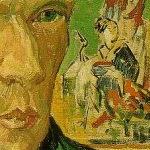
I posted several weeks ago about my reasons for portraying Van Gogh as a lefthander in my novel. My choice was based solely on Van Gogh's personality profile, backed up by my amateur's knowledge of the theories of handedness. (And, admittedly, some personal projection, as I myself am lefthanded.) What a pleasant surprise then to receive an email from Svend Hendriksen, a Danish gentleman currently living in Greenland, who has looked into the question of Van Gogh's handedness with considerable attention. Svend tells me I'm right: Van Gogh was undoubtedly a lefthander! And the evidence can be found in the paintings themselves. Svend calls my attention most particularly to an 1888 self-portrait by Van Gogh. (That's it over there). Notice that Van Gogh holds his palette in his right hand, indicating that he paints with his left. Now many would (and do) look at the portrait and say that since Van Gogh must have employed a mirror while painting the picture, what we see is a mirror (that is, reversed) image of the man. Thus, they conclude, he painted with his right hand. And Svend reports that the Van Gogh Museum in Amsterdam does describe Van Gogh as being righthanded. However, Svend points out that the button on Van Gogh's coat is on the same side as the palette he holds, and on men's coats of the period this button would have always been situated on the right side. In other words, this evidence suggests that Van Gogh in real life, not just in the portrait, held the palette with his right hand. It's perfectly possible that for the sake of his painting he corrected the reversed image to show the world how he really worked: with his left. From what I know of Van Gogh generally, it is not hard to imagine him being stubborn on this point.


Svend has passed along a number of other interesting tidbits about Van Gogh, for instance that photographs of the man's paint box reveal that he kept it quite full. As Svend says, it's "a huge volume for a poor man's palette." Well, certainly paint was dear, an expense that Van Gogh avoided for years by concentrating solely on his drawing. But when he began painting he sacrificed almost everything else--food included--to keep himself supplied. And looking at his effusive, glorious pictures, especially from the Paris and Arles periods, it certainly looks as if he operated with a full box. Svend's comments make intuitive sense.


Svend, by the way, was not trained as an art historian but as an explosives engineer. He served for years in the Danish army. Yet he now brings his mechnical know-how to the study of paintings. His story reminds me of a phenomenon that I find profound: There is something about Van Gogh--his story, his paintings, his personality--that draws people to him like a magnet. Not only professional art historians but informed amateur sleuths and everyday idlers alike. For instance, the man who owns the house at which I stay when I visit Arles, a science teacher and devoted amateur astronomer, has done considerable work studying Van Gogh's use of constellations in his night paintings. He has even advised academics from America on the matter. Amazing how this Dutch painter, who struggled so and was so little known in his lifetime, has attacted and keeps attracting such a broad, enthusiastic audience. Perhaps this simply proves that Van Gogh knew exactly what he was doing all along: painting not for his time but the future. Indeed.

Thursday, September 2, 2010

Van Gogh in the Middle

1


As we all know, schools are starting these days--at least here in the U.S.--and that means too the beginning of football season. In fact, tonight I will be taking my youngest son and his friend to Estes stadium at UCA to see the Bears' season opener. With football so much in the air and on the news and in people's hearts--at least here in the U.S.--I think, strangely enough, of Van Gogh. And I think of the position of middle linebacker, the man at the exact center of the defense: midway between the sidelines, midway between the defensive line and the defensive backfield; the man with the most leeway of anyone on defense to circuit freely and make whatever plays need to be made. That could mean rushing up to help the line stop a running play, or dropping back to help cover a receiver, or blitzing to try to sack (tackle) the other team's quarterback. A successful middle linebacker sees and understands the field as a whole, and the developing play as a whole, and he uses his roaming freedom to enhance the whole defense.


It may be a stretch of a metaphor, but I feel safe in calling Van Gogh the middle linebacker of the Neoimpressionists working in Paris in the 1880s. That is, he moved freely between factions, between cliques, between individuals, and between styles, with only one end in mind--and it was a good one: learning and absorbing as much as he could. Having just spent several years working alone in the Dutch provinces, and then a few disappointing months in Antwerp, he was not just willing but eager to listen, to watch, to discuss, to experiment, and to change. And he refused to let interpersonal squabbles--replete with their petty resentments, paranoid suspicions, and blatant attempts at empire building--distract him from his purpose. He set up walls against no one, was willing and able to see value in the working practices and painterly results of many different kinds of artists. Whereas almost every other leading neoimpressionist eventually chose a particular camp to belong to, and thus allies to swear by, Van Gogh stubbornly resisted making such choices. He felt that he could and did learn from all of them. Certainly in his paintings from his Paris years we see him trying on and trying out many different artistic gestures. He did not carry all of these gestures with him to Arles--by his own admission, he "abandoned" much of what he learned in Paris (something of an overstatement, actually)--yet it was by carrying on these experiments at all that he grew as a painter; it's why his Paris period counts as the one in which he learned and grew the most. It was in Paris that Van Gogh became a modern painter. And he grew the most because he circulated the most. Whereas Van Gogh's associate Emile Bernard became a disciple of Gauguin and thus turned his back on the Divisionist group of Seurat and Signac and Pissarro, and whereas Seurat despised and scorned Gauguin and thus avoided company with all members of the so-called "Symbolistes," Van Gogh had friends in both camps. He literally worshipped Gauguin and for a long time was terribly close to Bernard, yet he ate and drank with Signac, and he admired Seurat's breakthroughs deeply. He did not fully buy into the optic theories behind Divisionism, but he did see the divisionist method as an excellent way to vary the texture of a painting. A quick scan of his Paris paintings reveals the number of works in which he played with and tried to learn from this method.


Finally, sadly, Van Gogh's attempt to stay above the fray wore him out and depressed him. His resentment over the exaggerated factionalism and trivial backbiting among painters in Paris drove him out of the city. At the very least, it played a significant part in his decision to leave. Probably playing into that decision too was the realization that he had learned as much from these people as he could, and the fear--which he wrote about in his letters--that if he stayed in Paris much longer his health would be ruined and himself turned into an alcoholic. (Much drinking among the painters in Paris of the day, not shockingly.) Shortly after moving to Arles he wrote Theo about how much better felt in his body and how much more at home. (Van Gogh was always fundamentally a rural person.) Ironically, however, only eight months later he suffered his first epileptic attack--if that's what it was--an infamous breakdown greater and more devastating than he ever could have imagined in Paris. At that point, the linebacker had taken more than enough shots, and it was all he could do to get up and off the field with dignity.