Sunday, November 8, 2009

Writing-Running

0


Several years ago, I participated in a writing group comprised of differently faculty members from my university. The group went by the rather creative appellation of "The Bachelor Hotel Second Monday Riding Club" (too difficult to explain). While enjoying conveniently strong margaritas, we critiqued each other's fiction, nonfiction, and poetry. At the time I was working on a (different) novel, and I remember remarking to a fellow group member, a poet, that I anticipated at least two more years of work before I finished the book. The poet was flabberghasted, almost physically bothered. Used to working in short, intense segments, he couldn't imagine such a prolonged, sustained commitment to one creative work. The simple endurance of it. "Yes," I said, picking up on his analogy, "writing a novel is like running a marathon." The odd thing is that when I said that I had never run a marathon before. I had read about running marathons. I had hoped someday to run one. But I'd never actually done it. Today, having trained for and completed five marathons, I can tell you that writing a novel is not just like but almost exactly like running a marathon.

I suppose this connection is on my mind at the moment because I am currently training for another go at the St. Jude's Memphis Marathon, which is held every year on the first weekend of December. (I did a 20 mile training run yesterday morning.) But the connection is also on my mind because it's so true. There are stretches in any marathon race when you feel great, when you feel better than you have any reasonable right to expect, when you tell yourself you've never run faster or sounder, when a PR (personal record) is a sure thing. Too, there are stretches in every marathon when you feel numbed and dully achy and vaguely discontented, when it seems so far from the finish and you know the worst is still ahead. And then there are, I guarantee, stretches in every marathon when your legs gams hurt so bad and your feet are so sore you don't understand why in the world you signed up for the race in the first place. You can think of a million other, better ways to spend your morning than running 26 miles. What's the point? you think. Was I insane? A masochist? The end to the torture seems only farther away, not closer, with each step. Yet there's nothing you can do except to keep pushing on through the pain. One step at a time. But too there is a stretch late in every marathon when you realize you will finish, you'll even finish with some muscle tissue intact, and you start to feel much better. Your soreness all but disappears. You feel a surge of new, unexplained energy, along with a rush of relief, pride, and gratitude that is as difficult to describe as it is profound to feel. Your step picks up and, weary legs and all, you fly to the finish. That's why I signed up, you think as you cross the finish line. That's why.

So too with novel writing--and novel revising, such as I'm engaged in now. There are days when I'm amazed at how accomplished, even profound, some of these scenes are. I read them aloud to myself not quite believing that I wrote them. And there certainly are other times when I'm less than sure about a scene but I know I have to keep going, keep pushing on: editing, fixing, cutting, adding. Whatever it takes. Doing what looks like it needs doing and hoping for the best. And too there have been the sloughs of despond: days in which I suspect the project is a mistake, a waste of not hours but whole years of my life. I don't let such suspicions linger. I push them from my mind, or fight them with some useful facts. I tell myself that the novel has been a blessing. I've learned so much about Van Gogh and about Neoimpressionism. I've been to the south of France. I've learned to speak a little French and will eventually speak more. I've had a hell of time taking a real life and make it imaginary. All that's true, of course, but in those moments I'd feel a lot happier if I could be sure the novel will turn out to be the thing I know it can be. Lately, however, as the final shape of the manuscript comes closer and closer into view, I've felt a deep, resonating satisfaction. In many ways this book is exactly what I hoped it could be when I started. In fact, it might even be better. Oh, I'm not done with it yet. Don't get me wrong. I've still got months, more revising, and many crucial decisions, ahead. But I'm feeling a new energy. The end is finally in sight. And I'm sprinting.

Tuesday, November 3, 2009

Thank you, Monda Fason

1

I should take a moment, and one post, to thank blogger queen Monda Strange Fason for her invaluable techno help with this blog. When I started Creating Van Gogh in September, I was using a conventional template: functional but utterly boring. Monda, a colleague at the University of Central Arkansas, seized on the theme of my blog and designed the layout you see today. Immediately, I felt 100% better about the whole undertaking. Monda, by the way, is a committed and talented blogger herself. She maintains three blogs, two of which--No Telling and Fresh Ribbon--have received the impressive "Blog of Note" distinction from blogger.com. Check out these blogs for some entertaining and stylishly presented talk about writing. And if you need a jump start for your creativity, take a look at her third blog: Easy Street Prompts.

Monday, November 2, 2009

Vincent's religion, Part Two

0


Today, I'd like to mention a few of the important connections within my own book that I've been able to develop and explore by dramatizing the near obsessive religious devotion Van Gogh demonstrated as a young man. (After he gave up on art dealing and before he decided to become a painter.) These connections make ignoring Van Gogh's religious inclinations not just cowardly but disabling to the dramatic power of the story. Many connections come to mind, but two in particular.

1) His love/hate relationship with his father. In his letters to Theo, Vincent probably complains about his father more than anyone else, and yet earlier in life he had hoped to follow in his father's footsteps; in fact, he wanted the exact kind of job his father did: ministering to a small town flock. This duality cannot be a coincidence. What most influences you can also be what you most resist and resent. And by drawing so fiery close to his father's faith as a young man, he surely felt even more bitterness, more disillusionment when that faith rejected him as a candidate for ministry. True, Theodorus Van Gogh was never convinced of his son's ambitions as a painter. He supported but did not exactly approve of or understand these ambitions; and he certainly did not approve of Vincent's deportment, his dress, or some of the relationships into which he entered. He even threw Vincent out of the house on Christmas day, 1881. But by dramatizing Vincent's religious faith, I show in the novel that the later break with his father came from a more profound place than "Dad doesn't like me" or "Dad was mean to me." The division between father and son is more painful, more resent-full, more chasmal than that.

2) Peak moments. I'm trying to create an echo effect between Vincent's first sermon--delivered in a London church in October, 1876--and the final scene of my novel in which he paints The Sower (1888). The sermon was clearly a psychologically "peak moment" for Van Gogh, as we can tell from his bragging letter to Theo. He must have felt, after years of struggling to find a new path once he gave up art dealing, that he had finally arrived. If, in only a little way, he was sharing in his father's glory, his father's position. I present the sermon as not just a nervous experience but an ecstatic one, with blooming white light puncturing him. There is a distinct echo of this transcendent moment when in the last scene he works on what I consider the finest painting of his finest period (i.e., Arles). The scene is bathed in yellow, not white, light (if you've seen the painting, you understand) but the ecstatic emotions are similar. My point is to emphasize that the high emotions of sermonizing and the high emotions of painting come from the same psychological place in him. It's just that the former was a rather forced--that is, wrong-- choice of vocation (apparently, no one was particularly turned on by the sermon), selected for doubtful reasons that seem to involve a desire to identify more strongly with, and win the love of, his father; whereas the latter was the truer ecstasy, borne of the truer life choice: to become a painter. As I hope my book will demonstrate, there really was no other choice for him--it just took him a while to make it.

(Pictured above: The Crucifixion of St. Peter by Caravaggio)

Sunday, November 1, 2009

Vincent's religion, Part One

0


I thought it fitting on a Sunday to write about an aspect of Van Gogh's life that is little remarked on, except by those who have studied his biography closely: his religious nature. Anyone writing about Van Gogh, either to fictionalize him, like I am, or to do a straight biography, can't get around the influence of religion in his life. Not only were both his father and grandfather ministers, but for several years he was intent, even fanatic, about finding work as a missionary. During a crucial if crushing period, he was convinced that such was his calling. Of course, things didn't work out that way, and he later wrote with some regret and bewilderment about the religious "mania" that governed his younger self. For me, the writer of historical fiction, the challenge is what to do with that religious mania in my novel. I don't feel I can or should rightly ignore it. In fact, it's not hard to argue that Van Gogh simply transferred his mania for religion into a manic for art, which he always spoke of in sacred, even moralistic, terms. He did not compose religious paintings, at least as we normally think of them, but the impulse to create was a holy one for him, the vocation of painter something like a monastic calling. ("The Studio of the South" that he once hoped to build in Arles would have had a monastic structure, in fact, with Gauguin serving as its "abbot.") And he certainly did believe that art should and could be redemptive. While in later years he no longer attended church or studied the bible, religious language dominates his discussion of individual paintings and of the profession generally. So in writing about Van Gogh, even fictionalizing him, I feel the need to treat his religious impulses with respect rather than patronize them. I need to integrate them into the whole picture of him as a character.

But this does cause me to worry (just a tad). After all, treating religious subjects in fiction is dicey these days. The challenge is an aesthetic one of course but also--maybe even fundamentally--a political one. Earlier in the history of imaginative literature it was not hard to generate profound drama involving religious crises, decisions, even triumphs. The problem in our current age, at least in America, is that religion--or at least Christianity--has been co-opted by the far right. "To be religious" and to think religiously in contemporary America comes with a whole series of automatic political positions, positions that many, including me, find reprehensible, hypocritical, and un-Christian. It's true that plenty of practicing Christians are not right-wingers, but it's also true that many more of them are. The loudest of them are. The most influential of them are. In Arkansas, where I live now, to be religious and at the same time leftward-leaning politically is to be regarded as a servant of the devil. (All right, that's an exaggeration--but not a huge one.) Leftward leaning churches exist here but are few and far between.

So the problem for the writer of fiction is that to treat religion seriously is to run the risk that the literary reader recoils with fright and nausea, suffers flashbacks from the George Bush era. Unfortunately, the right in America has conditioned too many Americans to reject religious subjects automatically. And this is a shame. The religious impulse--be it for Christianity or some other faith--is a human impulse like any other. It is not some mutation in our DNA. It's not going anywhere. And with a figure like Van Gogh, for whom it was truly central in his life, I cannot ignore it. The difference in how I handle it, and how I hope it will work in my book, is that any religious discussions, meditations, activities etc. will be directed to developing a picture of Van Gogh's unique character not trying to sell religion to the non-believer. Sometimes books of fiction do try to act them way: sermons thinly disguised. But I'm not arguing for any religious position, just trying to show a certain committed idealism that fed and sustained him through his difficult years of artistic apprenticeship.

(Next post: more specifics.)

Thursday, October 29, 2009

Reverse historical fiction

0


In two earlier posts, I wrote about the APA conference I attended recently, but I wanted to add one more note. In the same session in which I read, a colleague of mine at UCA, Conrad Shumaker, presented a terrific piece that I can only describe as "reverse historical fiction." In many historical fictions people out of real life are rendered anew in the imagined universe of a novel or short story. There are so many examples of this, both in adult and young adult historical fiction, that I don't think I need to prove it to you. But here's the thing about Conrad's piece: he took a very familiar fictional character and moved him into the real world. Sort of. Conrad's story is an epistolary one in which a literature professor describes the troubled history of a (deceased) colleague's doctoral dissertation, one that the colleague was forced to drop. The long and short of it is that while a graduate student, this man discovered that Huckleberry Finn was no fictitious character but a real person who wrote down his life story and gave it to Samuel Clemens, merely hoping for assistance in getting the memoir published. Except Clemens up and stole the manuscript, recreating it--with only minor changes, and no acknowledgement of the real Huck--in his own The Adventures of Huckleberry Finn, a book that of course won Clemens considerable critical acclaim and not a little income. The real Huck, as it turned out, didn't quite "light out for the territories," or, rather, he did but only to wind up the owner of a greasy spoon in Missouri. The protagonist of Conrad's story had uncovered and proven Twain's literary theft, but the discovery was so provocative, so potentionally threatening to the American literature canon, that he was forced to give up the project and his (typewritten) manuscript (this was the 1950s) was destroyed.

My brief summary can hardly do justice to Conrad's comic/academic/detective tour de force. It was intoxicating in the way of all great stories but also eyeopening. It reminded me that the door between the fictional and the historical--through which writers of historical fiction so often pull real people kicking and screaming--swings both ways. We can also take fictional characters and push them into our tawdry, duplicitious world.

Tuesday, October 27, 2009

Substituting landscapes

0


Probably one of the biggest challenges for a writer of historical fiction, or any fiction featuring a setting not intimately familiar to the author herself, is how to establish a palpable, credible texture to a landscape (or cityscape). This is why writers take so many trips! For the sake of this novel, I've traveled three times to France, but for other reasons--and in some cases several years ago--I've also traveled to England, to the Netherlands, and (briefly) to Belgium. All countries featured in the novel. Such feel-for-the-place excursions can be very useful. Many writers, however, whether for personal or economic reasons, cannot make tours of foreign places. So they rely on photographs and written accounts. A couple years ago I heard an interview on NPR with Debra Dean, author of The Madonnas of Leningrad. She said she relied entirely on maps and photographs when writing her novel, and didn't visit the city until after she'd finished! One writer I know likes to tell an anecdote about the reception for one of his published short stories, set in a far eastern country he'd never visited. He received an excited fan letter from a man who said that he especially appreciated the author's descriptions of the countryside. Surprised, the author reexamined his own story and, just as he expected, found that the story contained no real description of landscape at all. What he had done was to look up the names of a few tree indigenous to the region and inserted those names into the story.

Well, that's the minimalist approach, I guess. Not one I care to risk when working on a big, fat historical novel. However, while I've traveled in Holland I've never visited the Brabant province, where Vincent grew up. And Vincent, as you might suspect, was famously an explorer as a child, something of an amateur naturalist. How, I thought as I wrote the Brabant scenes, do I capture the essence of the landscape, especially as it looked in the nineteenth century? I have seen a few old photographs of Brabant and these helped immensely. But what finally carried the day for me is what I can only call "substitution." I grew up in a rural part of southern Maryland. Specifically, Accokeek, Maryland, and, even more specifically, the unique section of Accokeek known as Moyoane Reserve (pictured above), where all the lots are at least five acres and anyone who buys there must agree not to commercially develop that lot. Literally, I grew up in the woods. My "street" was a dirt road; my driveway was gravel. I spent a good deal of time wandering through those woods and walking along routes that led me past farms and fields and ponds. So when I needed to capture the feeling of what it's like for Vincent to be hunting turtles in a creek, or scrambling up a tree to snag a bird's nest, or hiking a dusty road, or watching a farmer sow his field, it was my memories of southern Maryland that fed my imagination, that gave veracity to the landscape and to Vincent's instinct for it. Whether I really captured 19th century Brabant in this strange, alchemical, substituting fashion I can't know. But I hope it has made those scenes physically convincing. At least as convincing as my friend's short story.

Extra note: A big shout of thanks to Erika Dreifus, and her great blog Practicing Writing, for generously giving a little publicity to Creating Van Gogh. For intelligent writing talk and timely updates, check out Practicing Writing.

(Photo credits: David Cremer and Elaine McVinney)

Saturday, October 24, 2009

Twisting History

0


During a session at the recent APA conference I attended (see an earlier post), an audience member asked me and the other presenters if we felt guilty for "twisting history" to our own ends. (The other two readers were also presenting fictionalized versions of real people.) I suspect that the question came in part as a response to my depicting Eugene Boch and Dodge MacKnight--real painters who lived together in Fontvielle when Van Gogh lived in Arles--as a homosexual couple. Very little is known about the two men; in fact, almost all we do know about them are the impressions Van Gogh records in his letters. The question actually surprised me, because in writing those scenes I felt completely committed to my conception of the two men. I felt that, based on the available evidence, they could have been exactly as I depicted them. They seemed so real to me I almost forgot I was rendering an interpretation.

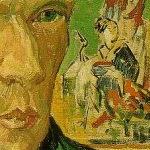
And maybe that's the heart of the issue. An intepretation is decidedly different from a "twisting." "Twisting" implies self-conscious deception, a deliberate, cynical manipulation of known facts. Indeed, a subversion of them. But there are so few facts known about Boch and MacKnight that I not only felt free to imagine them, but I had to do so if I wanted to include them in the book. What is clear from Van Gogh's letters is that he did not like MacKnight and did not respect him as an artist, while he adored Boch. When MacKnight left the area, apparently for good, Vincent was clearly gratified. He reports in one letter that Boch visited him at his studio and, with MacKnight not around, they could talk at length. He eventually painted a now famous portrait of Boch (that's it above) and described the picture in rather overheated terms to Theo, emphasizing that the painting expressed "my love for this man." Shortly after the missive to Theo, Boch and MacKnight disappear from the letters.

It does not seem any great leap of fantasy to see a real if muted drama of jealousy going on between the three men. In my rendering, Vincent isn't aware of the nature of his emotions toward Boch, but he certainly does feel them. And he sends a rather clumsy note to Boch pleading with him to come to Arles to see the finished painting. It's a similar move to his clumsy actions toward the women with whom he was obsessed; the only difference is that the emotions this time are directed to a man. Boch, who realizes Vincent implicit feelings and the potential disaster they pose to his relationship with MacKnight, discards the note, effectively ending his friendship with Vincent (and explaining, in my mind, his elimination as a subjecct from Vincent's letters). As I indicated in an earlier post, one must be careful not to immediately interpret 19th century male-to-male expressions of affection as proof of homosexuality. Such expressions were more conventional then than now. But, even so, this does not mean that one can't make such an interpretation if--based on the evidence--it seems reasonable, or at least possible. After all, in the murky world of historical fiction, capturing what is possible is really the best you can hope for. Who knows, from a distance of a 100 or 1000 or 2000 years, what's actual. And given the main duty of any writer--i.e., to make the reader believe--intepretations are crucial to engender concreteness to your drama. That's not "twisting" history but creating an alternative history. And just as in current theoretical physics it's possible to posit numerous, simultaneously existing universes, each as real as any other, any of these alternative histories can be--in fact, must be--as real to the writer as biographical truth, which is often too shadowy to comprehend.